
Is Your Retirement At Risk?

Is this Happening to You? You’re Thinking: “I am 40 and I have no saving. Is it too late change my life and to start saving for retirement? How much money have I saved for retirement?

How Do Your Retirement Savings Stack Up Against Your Peers?

Based on Fidelity’s savings factor system, a 40-year-old should try to have $150,000 – or approximately 3x his or her annual salary – already saved for retirement.

However, if a 40-year-old has less than $150,000 in retirement savings available, this individual may need to play catch-up to ensure he or she is prepared financially for retirement.

How much money should I have saved by age 40?

Based on Fidelity’s savings factor system, a 40-year-old should try to have $150,000 – or approximately 3x his or her annual salary – already saved for retirement. However, if a 40-year-old has less than $150,000 in retirement savings available, this individual may need to play catch-up to ensure he or she is prepared financially for retirement.

You’re Age 35, 50, or 60: How Much Should You Have Saved for Retirement by Now?

If you want to track your progress toward a goal, chances are there is an app that can do that for you. For example, you can track your steps, your packages, your diet, and even your family’s whereabouts.

But when it comes to saving for your retirement, how much time do you spend tracking your progress? And at what point in your life should you start paying attention?

Retirement planning can be intimidating at any age—even more so early in your career. When retirement seems so far in the future, it’s hard to plan for it with so many competing priorities in the present. For example, in addition to your regular bills, you may have student loans to repay. Or you may be trying to save money to purchase a home or save for your kids’ college education.

Still, it’s important to make steady progress toward saving, no matter what your age. Moreover, taking stock of where you stand can help you plan with more intention based on your situation.

How much money should a 25 year old save for retirement?

Saving 15% of income per year (including any employer contributions) is an appropriate savings level for many people. Having one to one-and-a-half times your income saved for retirement by age 35 is an attainable target for someone who starts saving at age 25.

How much money should you have saved by age 50?

How much should you have saved by age 50? Generally, you should aim to have 6 times your annual salary when you come into your 50s, and up to 8 times by your 60th birthday. Keep in mind that this is a ballpark figure and assume that you are retiring at age 65.

How much retirement savings should you have by 60?

We recommend that by the age of 60, you have about eight times your current salary saved for retirement. So, if you earn $75,000 a year, you will have between $525,000 to $600,000 in retirement savings by 60. How do you know if this is the right amount for you? Think of it as a general guideline.

Average Retirement Savings Balance by Age

Perhaps the most official measure of American retirement savings comes from the Federal Reserve System. The Fed calculated average retirement account balances for individuals in 2019, the latest year for which figures are available. Broken down by age, those balances are as follows:

AGEAVERAGE RETIREMENT ACCOUNT BALANCE
35-44$131,950
45-54$254,720
55-64$408,420
65-74$426,070

QUESTION: Will an additional 30k to 75k help you retire financially prosperously? Are you willing to be paid for what you are already doing but not being paid for?

No retirement savings? Here’s a comprehensive guide to help you retire wealthy.

If you’re starting to save for retirement at 40, that’s not ideal, but it’s also far from being too late.

While the standard advice is to begin stashing away money for retirement in your early 20s, that’s not what most people do, as it turns out.

According to an annual report published by investment management company Vanguard, the median balance Americans aged 35 to 44 had saved in Vanguard retirement plans was $28,318 in 2022.

That means if you have no retirement savings at 40, or perhaps haven’t made a concerted effort to start saving, you’re really not that far behind your peers.

Is it too late to save for retirement at 40?

If you’re wondering how to save for retirement in your 40s, avoid making the mistake of thinking you’ll never retire and you’ll just keep working until your last day on earth.

That’s an unlikely scenario.

Instead, start planning and taking proactive measures.

While it may not seem like you have a long time until you hit retirement, it’s still crucial to maximize your contributions to an employer-sponsored retirement plan, such as a 401(k) or 403(b), as soon as possible.

“At 40, you still have about 20 to 25 years until retirement, which is a considerable amount of time to grow your investments,” says Taylor Kovar, CEO at Kovar Wealth Management in Lufkin, Texas.

“Your investment mix should be a balance between growth-oriented investments and some conservative options to protect against market downturns,” he says. “A significant portion of your portfolio should be in stocks or stock mutual funds.”

Kovar suggests considering index funds or exchange-traded funds (ETFs), two types of pooled investment vehicles, for broad market exposure with lower fees.

“Be honest about your risk tolerance,” he says. “At 40, you might not have the same risk capacity as someone in their 20s, but you still need some growth to ensure your savings last.”

Also, catch-up contributions are a great idea for investors over age 50. The idea behind catch-up contributions is exactly what the name suggests: You can juice up your retirement savings even if you got a late start.

While your time horizon is shorter if you start investing after 40, you can jump-start your retirement investing by using disciplined budgeting, minimizing debt and maximizing the amount you salt away regularly.

Understanding the need for retirement savings at 40

At 40, you’re approaching the midpoint of your working life, which is a wake-up call that it’s time to start prioritizing your financial future.

If you’re currently 40, your full Social Security retirement age is 67, so you have plenty of time left in the workforce.

But financial responsibilities for many people peak in their 40s and 50s, as children’s college expenses take precedence over other saving and spending categories. That means you may want to consider less expensive vacations for a while, and maybe keep that car an extra few years.

Cutting back on lifestyle doesn’t sound great, but there’s a way to look at the bright side: Starting your retirement savings at 40 allows you to take more risk with stocks than you would if you started a decade later. Your future self will thank you for starting now, instead of waiting another 10 years.

How to kickstart your retirement savings at 40

Kickstarting portfolio growth at 40 requires a very focused approach.

Many financial advisors suggest a more aggressive allocation for those with a longer time horizon and higher risk tolerance. Some might even recommend an 80/20 stock/bond split, or even a stock-heavy 90/10 allocation, at age 40.

But if you’re nervous about market ups and downs and find that you don’t sleep well if, for example, your portfolio is showing a big drop during a bear market, you may want a more conservative allocation.

Whatever the mix, it’s important to diversify using asset classes like stocks, fixed-income securities and alternatives, such as real estate or even commodities.

Another tried-and-true plan is to use tax-advantaged retirement accounts, such as 401(k)s or individual retirement accounts (IRAs) to maximize your contributions.

How much should you save?

If you’re starting at 40, you’re playing a bit of catch-up versus the person who began saving for retirement at 30. That means you’ll have to put away more than you might want to, given the commonly accepted advice that you should try to accumulate and set aside at least three times your annual salary in retirement savings by age 40.

But remember, you’re likely not as far behind as you might think. According to Vanguard’s “How America Saves 2023” report, only 16% of retirement plan participants aged 35 to 44 contributed the maximum allowed amount in 2022.

Late starters can begin to catch up by maximizing contributions to tax-advantaged retirement accounts and being diligent about saving.

Maximizing 401(k)s and IRAs to save for retirement.

If you’re saving for retirement at 40, maximizing retirement savings through 401(k)s and IRAs is a critical step.

Michael Nemes, financial advisor at Nemes Rush Family Wealth Management in Novi, Michigan, says paying attention to your tax bracket is crucial.

“If you’re in your 40s, your income is hopefully going to be increasing in the future as you move towards retirement,” he says.

That means your tax bracket may be lower now than it will be in the future.

“Take advantage of the lower tax bracket now by utilizing the Roth feature of your 401(k), if your plan offers one,” he says.

The Roth feature, which is offered as part of most retirement plans these days, means that you pay tax on the contributions now, so your investment earnings and any qualified distributions are tax-free, he adds.

Contribute the maximum you’re allowed to your employer-sponsored 401(k), taking advantage of an employer match, if it’s offered. The employer match is essentially free money, so it’s a good idea to take your employer up on that benefit.

If you work at a non-profit or government agency, you may have a similar qualified retirement plan, such as a 403(b) or 457(b).

If you’ve maxed out your employer-sponsored plan, you can save extra money with an IRA, which also allows for tax-advantaged savings.

After you turn 50, you can maximize those qualified accounts with catch-up contributions.

Don’t forget to regularly review and adjust your investment allocations. One big mistake many investors make is just setting and forgetting their 401(k)s, resulting in declines as some funds outperform others. It’s a good idea to review your holdings at least once a year.

FREE MKS Master Key System Financial Coaching Advisors and Retirement Planning

At any age, it can help to have a roadmap for a comfortable retirement. A financial planner can bring a fresh perspective to your situation, along with personalized strategies as you begin thinking about retirement.

If you’re in your 40s, a planner can help you figure out how much you need to save if you want to retire at 67, 70 or some other age. A planner can also help you consider various scenarios, even including semi-retirement or other options.

He or she will typically run a comprehensive analysis of your financial situation, including not just retirement savings and your portfolio allocations but also college savings, tax strategies, insurance and your mortgage payoff rate.

Although you probably don’t have your retirement vision completely fleshed out at 40, because almost no one does, working with a financial planner can be a great start as you work toward your eventual goals.

Free Insurance and Retirement Planning Coaching

At 40, integrating insurance into your retirement planning and financial planning is crucial. Life insurance is crucial to protect your family in the event of your untimely death.

It’s not just the family’s chief breadwinner who needs to be insured. Stay-at-home parents would also be wise to consider life insurance. In the event of an early death, life insurance helps cover child care and ongoing household expenses and can help maintain stability at a difficult time.

While you may not need life insurance in the future, after you are no longer working and no longer have children living at home, it’s necessary for many people throughout their working years.

Tailoring insurance coverage to your situation is a way of bolstering your retirement savings with a safety net.

Be sure to regularly review and update policies as your life circumstances change.

FREE Retirement Lifestyle Planning Coaching

We humans are pretty bad at thinking about our future selves, but that’s exactly what we have to do when planning for our future lifestyles in retirement. So go ahead and put on that futuristic thinking cap. If you establish financial goals and invest wisely, you can set yourself up for flexibility and a more enjoyable lifestyle down the road.

While your specific retirement dreams will almost certainly evolve over time, early planning can help ensure financial security, giving you more freedom to explore new interests or unexpected opportunities.

Health care considerations for retirement

It’s good practice to anticipate rising medical costs by factoring in health insurance premiums, co-pays and potential long-term care expenses.

As you get older, you’ll have to evaluate Medicare options and supplement plans to understand coverage gaps. At 40, nobody is thinking about Medicare, but many retirees find it’s a good insurance program, even if they choose to supplement it with private insurance.

Throughout your life, maintaining a healthy lifestyle to mitigate the effects of health issues can dramatically reduce medical costs over the long haul. That can make your retirement years not only less expensive but also more enjoyable.

Frequently asked questions (FAQs)

[1]: What is the minimum amount I should start saving for retirement at 40?

Investment management company Fidelity Investments recommends saving “at least 15% of your pre-tax income each year, which includes any employer match.” But this figure assumes “you save for retirement from age 25 to age 67.”

So, if you don’t start saving until age 40, you may need to save a higher percentage of your income. This can help you accumulate a nice pile of money by the time you retire. It also takes into account those inevitable market swings over the next few decades, while allowing you to benefit from the power of compounding.

[2]: Is it possible to retire comfortably even if I start saving at 40?

Yes, it’s very possible to retire comfortably even if you start saving at 40.

Regular contributions to your retirement accounts will go a long way toward making that dream a reality. Take advantage of catch-up contributions after the age of 50. Adjusting your lifestyle, managing your debt and seeking professional advice from a planner may also increase the likelihood of a comfortable retirement despite a relatively late start.

“If you are 40 and just starting to save, you should also start adjusting your expectations around your retirement date,” says Anne Lester, author of “Your Best Financial Life.”

“Planning to work until you are 70 and to claim Social Security at that age is one of the most powerful things you can do to boost your retirement success,” she adds.

That strategy offers benefits, including a higher monthly check, more years to save for retirement and a nest egg that doesn’t need to generate income for as many years, as you’re delaying retirement.

[3]: Can I rely solely on Social Security for my retirement?

Relying solely on Social Security for retirement is risky, as it’s highly unlikely to cover even your basic life expenses, never mind extras, such as travel or just having some fun!

For a better chance at achieving financial security, supplement Social Security with personal savings and investments.

[4]: What are some mistakes to avoid when starting retirement savings late?

If you’re beginning the process of saving for retirement in your 40s, you’re likely in your peak earning years but also have less wiggle room to make mistakes.

Steer clear of high-risk investments, particularly those that are illiquid and difficult to sell, such as non-publicly-traded real estate investment trusts (REITs).

You’ll probably have to adjust your lifestyle to make more money available for saving. Nobody enjoys that part, but sticking to a budget is a proven way to help manage your expenses.

A common mistake is underestimating how much you’ll need in your retirement years. People often believe their spending will decrease in retirement, but that’s not always what happens.

Running out of money in retirement is a very real risk, and it’s not pleasant to think about, but you can avoid that through deliberate planning and saving.

[5]: How does inflation impact my retirement savings?

Inflation erodes your purchasing power, reducing the value of your retirement savings.

Whether you’re already on retirement or still earning big money, in debt or just want more prosperity, abundance or money-making potential let us help you for FREE.

Live Long and Prosperously

Sydney Reitenbach and Michael Kissiner

Text: 650-515-7545

Emil: mjkkissinger@yahoo.com

Review: mksmasterkeycoaching.com

PS. We’ve all seen it lately as inflation rose significantly for the first time in years starting in 2021. As prices increase, so will your cost of living. That usually means you’ll need a larger nest egg to maintain your current lifestyle. An allocation into stocks has historically been a reliable way to protect against inflation.

Review: Live In The End – Whatever You Asked, Believe You Have It: https://www.youtube.com/watch?v=lXPr3FgQBxc&t=2s

Review: Millionaire Game-Plan – Become Self-Made Millionaire: https://www.youtube.com/watch?v=_psnFAHCYq0

Disclaimer: Opinions expressed here are the author’s alone, not those of any bank, credit card issuer, airlines, hotel chain, or other commercial entity and have not been reviewed, approved or otherwise endorsed by any of such entities.

This content is for educational purposes only and is not intended and should not be understood to constitute financial, investment, insurance or legal advice. All individuals are encouraged to seek advice from a qualified financial professional before making any financial, insurance or investment decisions.

Note: While the offers mentioned above are accurate at the time of publication, they’re subject to change at any time and may have changed or may no longer be available.

Are You or Do You Have a Troubled Business?

Do You Face the Common Challenges Veteran-Owned Troubled Businesses Suffer?

Have you challenges getting appropriate financial capital, obtaining and utilizing business and management skills, developing and utilizing social capital, or identifying successful mentors or coaches?

Success or failure does not depend on one, but rather on multiple factors related to barriers. These challenges can include a lack of knowledge or access to local resources as well as the feeling of being unsupported by both government and local communities. The Take Away of this information is There Is No Limit of what you can do or How we can help you!

Have You Ever Reviewed these Key Veteran Success/Failure Considerations?

1. Veteran Business Entrepreneurial Success?

80% of veteran business owners considered themselves to be a successful in 2023. 54 % were Profitable –13 % were Broke even — 29 % Reported a financial loss (Unprofitable)

2. Barriers to Veteran Entrepreneurship?

Veteran entrepreneurs encounter a variety of challenges such as capital, mentorships, and networks.

Barriers and challenges are not always exclusive, but here are the most common hurdles.

3. Veteran Financial Barriers?

* Lack of access to capital 37%

* Lack of financing 34%

* Current economic situation 27%

* Irregular income 22%

4. Veteran Social and Human Capital Barriers?

* Problems finding good employees/contracted personnel 30%

* Lack of mentors for my business 20%

* Lack of organizations to assist entrepreneurs 12%

* Lack of relationships with other entrepreneurs 11%

5. Veteran Regulation Barriers, Business Climate, and Policy Barriers?

Taxes and legal fees 20%

Federal regulations and policies 20%

State regulations and policies 13%

Startup paperwork and bureaucracy 12%

6. Personal Barriers?

* Lack of experience in entrepreneurship or business ownership 18%

* Fear of Failure 14%

* Personal health issues (disability, etc.) 13%

* Lack of knowledge or education on the business 13%

Yesterday at the NorCal VBOC [www.norcalvboc.org] I was asked what I would do to help a troubled veteran who needed help.  I answered for FREE I would analyze them, help them, coach them, and provide them with programs and opportunities that would change their life, business, finances, and that of their families for greater success.

For No Cost We’ll Help You Have:

1. Greater Entrepreneurial Success and Profitability in 2024 and beyond

2. Eliminate Barriers to Veteran Entrepreneurship

3. Eliminate Financial Barriers

4. Remove or Eliminate Social and Human Capital Barriers

5. Remove or Eliminate Regulation Barriers, Business Climate, and Policy Barriers?

6. Remove or Eliminate Personal Barriers

So, if you’re a veteran or someone who’s looking for the opportunity to start or build their own successful and highly profitable business in 2024 or simply wants to create a new income-stream alongside an existing business…it’s really important to contact us as soon as possible.

(All this incredible opportunity will only be available for a very limited period so you must grab it right now, while you have the chance…)

Live Long and Prosperously,

Michael Kissinger

Honorably Discharged US Army Special Forces Member with 2 sons who served in the US Navy.

Text: 650-515-7545

Email: mjkkissinger@yahoo.com

See: mksmasterkeycoaching.com

Do You Face the Common Challenges Veteran-Owned Troubled Businesses Suffer?

Do You Face the Common Challenges of the Military Spouse?

Are You a Military Spouse Wanting to Work or Start or Grow Your Own Small Business?

There are nearly 1 million U.S. military spouses (U.S. Department of Defense). As a military family member, your pride and honor run deep. You serve right alongside your servicemember with every PCS, deployment, and TDY.

Why Military Spouses Work or Start a Small Business

In an interview of military spouses about three-quarters of them mentioned financial reasons are their reasons for starting a business or for working. They are working to pay bills and cover basic expenses.  This was their most widely cited primary reason.

The majority of spouses also discussed nonmonetary motives such as working to avoid boredom and keep busy, working for personal fulfillment or independence, or working to maintain skills and career status.

Spouses’ motivation for working varied based on the pay grade of the service member, the family’s financial situation, and the education and occupation of the military spouse.

For example, personal fulfillment or independence was a nonfinancial primary reason for working that was widely cited by better-educated spouses and those married to officers.

Spouses with less education, married to more-junior enlisted service members, and in more challenging financial circumstances tended to cite financial necessity as their primary reason for working.

Key Business Start Up Considerations

  • Military wives are employed at lower rates and earn less than civilian wives, on average.
  • Civilian wives with the same characteristics as military wives actually have better employment outcomes than the average civilian wife.
  • The majority of military spouses believe that the military lifestyle—including frequent moves, deployments and long hours that keep service members from assisting with parenting, and living in areas with poor local labor market conditions—has negatively affected their employment opportunities. Almost half believe that their educational opportunities have suffered.
  • Military spouses work for different reasons, based on their own education level, their service member’s pay grade, and their financial situation.

Supporting a military career can be a job all on its own. If you are a military spouse looking to start or grow a small business and need help contact us. We offer the same flexible resources for spouses as we do for veteran business owners.

Key Working Considerations

  • The clearest indicator of the challenges of military spouse employment is the fact that almost two-thirds of those interviewed felt that being a military spouse had a negative impact on their work opportunities.
  • The most frequently cited cause was frequent and disruptive moves.
  • Other causes cited were service member absence and the related heavy parenting responsibilities as well as childcare difficulties.
  • These spouses also referred to the inflexibility of the military workplace to accommodate the needs of military parents.
  • Finally, some spouses cited an employer bias against or stigmatization of military spouses, often driven by the employer’s concern that the spouse will be forced to leave abruptly.
  • As with frequent moves and service member absence, this perceived cause is uniquely military.
  • Many spouses also reported a negative impact on their education. Almost half the spouses believed that their educational opportunities had suffered negatively, once again citing frequent moves and service member absence.

If you are a military spouse looking or seeking employment and need help contact us. We offer the same flexible resources for spouses as we do for all.

Do You Face the Common Challenges of the Transitioning Veteran or Military Spouse?

Eliminate the Challenges of Transitioning Military Veterans

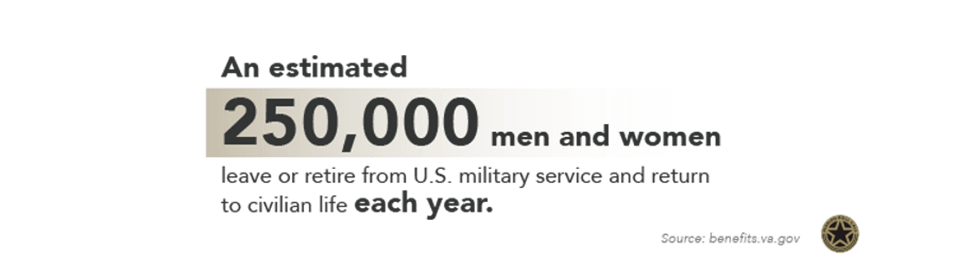
Serving in the U.S. Armed Forces is an honorable path that should be celebrated and applauded. Yet the value of this service is not always reflected in veterans’ experiences upon leaving the military. Our nation’s veterans are experienced, disciplined and highly skilled, making them natural entrepreneurs.

Many, however, face challenges transitioning back to civilian life and may not have access to the right resources or networks on the path to becoming a veteran business owner. They often face problems related to difficulties in transitioning from military life to civilian life, which can involve navigating complex bureaucracy to access benefits; the effects of traumatic or moral injuries; and systemic gaps in mental health services.

  • There are the practical considerations, such as where to live and what job or career to pursue. While on active duty, service members receive food and housing allowances, in addition to medical care. Going from having these fundamental needs provided for to having to seek them out can be a drastic shift for military families.
  • Navigating the healthcare system, finding a home, and applying for jobs are all things that can be overwhelming when leaving or retiring from a career that provided these necessities and created relative ease in securing them.
  • What’s more, securing a job that assures the same kind of financial security in a new phase of life can be daunting, especially for those with a service-connected disability. Only one in four U.S. veterans have a job lined up after leaving the armed forces, according to the Pew Research Center. Shultz, who learned to speak multiple languages over her three decades of service, is looking to add something new to her toolbox — learning how to translate her skills into corporate language.
  • According to a report from the Pew Research Center on veteran experiences, 55% of veterans who had traumatic experiences and 66% of veterans who have experienced post-traumatic stress (PTS) said their readjustment to civilian life was at least somewhat difficult.
  • Among those with PTS, 3 in 10 said it was very difficult. Moreover, 30% of veterans stated the military did not prepare them well for making the transition to civilian life and 15% felt the military did not prepare them at all.
  • Getting capital and quality education and skills to start and grow a business is one of the biggest obstacles for transitioning entrepreneurs. Veterans have access to several programs to help them launch and grow their business, or even virtual job fairs if necessary. The SBA has several veteran-specific funding programs.
  • Veterans’ common stressors can impact family, social, and professional relationships, as they have a sense of social disconnectedness due to loss of military camaraderie.
  • To make matters worse, many civilians may not be aware of or fully understand these unique issues.

Here are some of the common challenges transitioning veterans may be up against

1. Difficulties Transitioning from Active Duty to Civilian Life

2. Experiencing PTS and Gaps in Mental Health Support

3. Missing the Camaraderie, Community, and Purpose Found While Serving

4. Navigating VA Bureaucracy for Access to Benefits

5. Lack of Proper Transportation for Disabled Veterans

6. Being Confronted with Veteran Stereotypes in Entertainment and Civilian Life

The State of Homelessness Among Women Veterans 

Three women Veterans’ stories of homelessness

Army Veteran Kimberly Carrillo left the military after five years in part because she lacked access to adequate daycare. After her marriage ended and her mother died, she fell into depression, lost her job and couch-surfed, kids in tow. Carrillo and her family were homeless.

Marine Veteran Natasha McCoy spent 20 years after service gainfully employed as a truck driver, residing in her vehicle. From the outside, she seemed fine. On the inside, she was anything but. “When I quit driving, I had a period when I was adrift,” said McCoy, a member of the Cherokee Nation. 

Air Force Veteran Alex Dobson was homeless for six or seven years before she entered the military. When she found herself without a safe place to call home after leaving the military, the familiar feelings of danger and invisibility came flooding back. “You’re in survival mode,” said Dobson, a member of the Muscogee Nation.

Carrillo, McCoy and Dobson’s stories illustrate the different ways homelessness can impact the lives of women Veterans.

Thankfully, they are among the nearly one million Veterans and their family members whom VA has connected with permanent housing or with services that prevented them from falling into homelessness since 2010. That includes nearly 22,000 women Veterans served through VHA Homeless Programs in fiscal year 2023.

But we recognize that VA must accelerate efforts to provide housing solutions, health care, and community employment services to address the unique challenges of nearly two million women Veterans—the fastest growing segment of the Veteran population—and their families.

That’s especially true now as we look at data on homelessness among women Veterans.

Rising number of women Veterans who are homeless

Although it’s true that, from 2020 to 2023, total homelessness among Veterans decreased by 4.5%—from 37,252 to 33,574—homelessness among women Veterans actually increased by nearly 24%—from 3,126 to 3,980—according to data from the U.S. Department of Housing and Urban Development.

In that same period, the number of unsheltered women Veterans—those living on the streets, in a car or in another unsafe situation—jumped nearly 48%, from 1,464 to 2,165.

While the general proportion of women Veterans experiencing homelessness is still low, the trend is concerning, given that VA estimates women are on track to make up 18% of all U.S. Veterans by 2040.

Factors that contribute to homelessness among Veterans

Reducing and preventing homelessness among women Veterans starts by recognizing some of the contributing factors unique to them:

Trauma. There’s evidence of a connection between women Veteran homelessness and trauma. Women Veterans who were homeless have told VA researchers that the experience of trauma before, during and after military service contributed to their housing instability.

Military sexual assault. We also find that one in three women say “yes” when screened by VA health care for military sexual assault (MST), which is sexual assault or threatening sexual harassment during a person’s military service. 

Intimate partner violence. Many women Veterans who are homeless also report having a history of intimate partner violence.

Poverty. Housing is a large expense for anyone, but studies show that women are more likely than men to be at risk of poverty.Single parenthood. Women also shoulder more of the costs of child-rearing, particularly as single parents. 

Other complex challenges, often connected to or worsened in service, can be common characteristics of women Veterans’ experience of housing instability. These include childhood adversity, substance use, relationship termination, medical problems, a post-traumatic stress disorder diagnosis and unemployment.

FREE Assistance Considerations for ALL Veterans

Reitenbach-Kissinger Institute celebrates your commitment, and we know you have ambitions too. We have educated those who serve with portable and accessible learning.

We stand ready to serve you with free, flexible online higher education. We believe military families deserve the opportunity to learn without the burden of debt too.

Fulfill your goals by getting started and enrolling in the FREE MKS Master Key Coaching Challenge that supports your grit and dedication. Our programs are available in person, on the phone, online, on Zoom, designated locations or online.

FREE Business and Personal Development Assistance from RKI.

Review: Veterans Entrepreneurial Road Map to a Highly Profitable Life and Business: https://lnkd.in/ehgSWeEv

Review: You Are the Architect of Realities: https://lnkd.in/gBmEqUQT

Review: See: You Are the Power: https://lnkd.in/gbmjc4NM

Review: Review: Winning Attitude – Become the Winner When Surrounded by Losers: https://lnkd.in/gbmjc4NM

Live Long and Prosperously,

Sydney Reitenbach – Former Military Spouse

Text: 650-515-7545

Email: mjkkissinger@yahoo.com

See: mksmasterkeycoaching.com

Michael Kissinger has over 30+ years of experience in business and management industry. He was the Business Development Director for Swords to Plowshares and Vitetnan Veterans of California. He received his BA from the University of San Francisco. He was an adjunct business professor at Golden Gate University and San Francisco State University. He was Honorably Discharged from the US Army as a member of the 10th Special Forces.

branches of military - Google Search | Military veterans, Military branches,  United states armed forces

Our Mission: We empower veterans and veteran business owners to effectively build their business and to communicate with a highly skeptical, media-blitzed consumer by using progressive business and marketing strategies that produce tangible results.

We’ll help you uncover the pain points of your ideal audience, differentiate yourself from your competitors and focus your valuable resources on your company’s strengths. This will enable you to constantly be on the lookout for new opportunities and never stop growing.

Disclaimer Our vision is to help you bring your biggest dream into reality. As stipulated by law, we cannot and do not make any guarantees about your ability to get results or earn any money with our ideas, information, tools, or strategies. Your results are completely up to you, your level of awareness, expertise, the action you take and the service you provide to others. Any testimonials, financial numbers mentioned in emails or referenced on any of our web pages should not be considered exact, actual or as a promise of potential earnings – all numbers are illustrative only, as I am sure you understand. That being said, we believe in you and we are here to support you in making the changes you want for your life and giving you methods, strategies, and ideas that will help move you in the direction of your dream.

Are You Ready for an Opulence Upgrade in 2024?

Ready For An Opulence Upgrade for Life?

Ready for a journey of transformation, a pathway to not just envision but to manifest a reality brimming with prosperity, wealth, and richness?

This is not just another episode of 2023. This is an odyssey into the deepest realms of prosperity consciousness, a voyage to discover the untapped potential within you. 

You stand at the precipice of your greatest dreams, the summit of infinite possibilities.

You can experience the “The Opulence Upgrade,” an entirely different level of prosperity consciousness.

This is not just about making money but living a luxurious life.

This upgrade delves into a world where your reality is the canvas, and your imagination, the brush.

An “Opulence Upgrade” is a concept that encompasses much more than just an increase in material wealth.

It signifies a comprehensive enhancement of one’s lifestyle, mindset, and experiences, elevating them to a level of extraordinary luxury, quality, and richness.

An Opulence Upgrade is a holistic transformation encompassing all areas of life. It’s about embracing a lifestyle where luxury, quality, and richness permeate every aspect of existence, from mindset to living standards, from personal health to social connections.

It’s a journey towards not just living better, but living with an unmatched level of elegance and abundance.

The Opulence Upgrade is not just a mere aspiration for wealth, but a journey towards a life resplendent with purpose, beauty, joy and all the finer things in life. Fine cars, meals, mansions, jets, there is no limit once the secret of the opulence upgrade is revealed to you.

To live the Opulence Upgrade is to walk in a world where every moment is an expression of your highest potential. It is to dine with the kings and queens of your aspirations, to converse with the dreams of your heart, and to dance to the rhythm of limitless abundance.

The Opulence Upgrade is not just a shift; it’s a leap into a new paradigm of living. It’s an invitation to a banquet of possibilities, where the menu is crafted by your deepest desires and the music is the melody of your highest aspirations. Embrace this upgrade, and step into a world where the opulence of your dreams becomes the opulence of your reality.

Ready for an Opulence Upgrade in 2024?

The method by which Opulence can be transmuted into its financial equivalent, consists of six definite, practical steps, viz:

  1. First. Fix in your mind the exact amount of Opulence you desire. It is not sufficient merely to say “I want plenty of Opulence. “Be definite as to the amount. (There is a psychological reason for definiteness which will be described in a subsequent chapter).
  2. Second. Determine exactly what you intend to give in return for the Opulence you desire. (There is no such reality as “something for nothing.)
  3. Third. Establish a definite date when you intend to possess the Opulence you desire.
  4. Fourth. Create a definite plan for carrying out your desire, and begin at once, whether you are ready or not, to put this plan into action.
  5. Fifth. Write out a clear, concise statement of the Opulence you intend to acquire, name the time limit for its acquisition, state what you intend to give in return for the money, and describe clearly the plan through which you intend to accumulate it.
  6. Sixth. Read your written statement aloud, twice daily, once just before retiring at night, and once after arising in the morning.

SEE AND FEEL AND BELIEVE YOURSELF ALREADY IN POSSESSION OF OPULENCE

It is important that you follow the instructions described in these six steps. It is especially important that you observe, and follow the instructions in the sixth paragraph. You may complain that it is impossible for you to “see yourself in possession of money” before you actually have it.

Here is where a BURNING DESIRE will come to your aid. If you truly DESIRE money so keenly that your desire is an obsession, you will have no difficulty in convincing yourself that you will acquire it.

The object is to want money, and to become so determined to have it that you CONVINCE yourself you will have it.

To the uninitiated, who has not been schooled in the working principles of the human mind, these instructions may appear impractical. It may be helpful, to all who fail to recognize the soundness of the six steps, to know that the information they convey, was received from Andrew Carnegie, who began as an ordinary laborer in the steel mills, but managed, despite his humble beginning, to make these principles yield him a fortune of considerably more than one hundred million dollars.

Ready for a Change in 2024? Contact us to Learn and Applythe LAW OF OPULENCE in your Life or Business!

Happy New Years to All.

Reitenbach-Kissinger Institute

Sydney Reitenbach and Michael Kissinger

Text: 650-515-7545

Email: mjkkissinger@yahoo.com

See: mksmasterkeycoaching.com

See: THE SPIRITUAL LAW OF OPULENCE | Thomas Troward

See: The Opulence Upgrade: https://lnkd.in/gGNATPb6

See: THE SPIRITUAL LAW OF OPULENCE: https://www.youtube.com/watch?v=JHMWigSkmAo

See: LAW OF OPULENCE: https://www.youtube.com/watch?v=58i1m12OEKQ&list=PL298C8E417A047184&index=1

See: The Science of Getting Rich by Wallace D. Wattles

See: THE SCIENCE OF BEING GREAT – Wallace D. Wattles

See: The Science of Being Well – Wallace D. Wattles

See: Neville Goddard Proof, The Law Works