

Simple, Straight Forward, Easy, Elementary, Proven Wealth Building Strategies and Assets Protection Techniques for You to Retire Rich and in Comfort
Understanding the Benefits of Asset Protection
Asset protection is a legal strategy that is used to safeguard assets from anyone who wants to have a part of your estate. Some of the benefits of asset protection include:
- Protecting your assets: It can help you protect your assets from creditors, lawsuits, and other risks, which can be especially important if you are in a high-risk profession or have a significant amount of assets.
- Reducing legal fees: It assists you with reducing legal fees by minimizing the risk of lawsuits and other legal challenges.
- Maintaining control: It gives you better control over your assets, rather than having them tied up in legal battles.
- Maximizing your wealth: It allows you to maximize your wealth by minimizing the impact of legal fees, taxes, and other costs on your assets.
- Ensuring financial security: Most importantly, it provides financial security for you and your family, helping to protect your assets for future generations.
- It’s important to note that asset protection is a complex legal area, and it’s always a good idea to work with an experienced attorney to ensure that your assets end up in the right hands.
Asset Protection Strategies to Consider for Your Protection
There are several asset protection strategies that can be used to safeguard assets. Some common asset protection strategies include:
- Setting up trusts: A trust is a legal document intended to transfer legal control of assets from one party (the trustor) to another party (the trustee). This is done to ensure the contents of the trust are distributed to the beneficiaries of the trustor if the trustor becomes unable to disburse the contents on their own due to severe illness, incapacitation, or death. The trustee is required to manage the contents of the trust for the benefit of the beneficiaries according to the directions set forth by the trustor.
- Creating limited liability entities: Limited liability entities, such as limited liability companies (LLCs) and corporations, can be used to protect assets by separating personal assets from business assets. This can help to limit liability in the event of a lawsuit or other legal challenge.
- Transferring assets to family members: Transferring assets to family members, such as children or spouses, can be an effective asset protection strategy, as it can be more difficult for creditors to seize assets that are held by family members.
- Establishing offshore accounts: Establishing offshore accounts, such as foreign trusts or corporations, can be an effective asset protection strategy, as these accounts may be subject to different laws and regulations that make it more difficult for creditors to access assets.
- Using insurance: Insurance can be an effective asset protection strategy, as it can help to cover the cost of legal fees, damages, and other losses in the event of a lawsuit or other legal challenge.
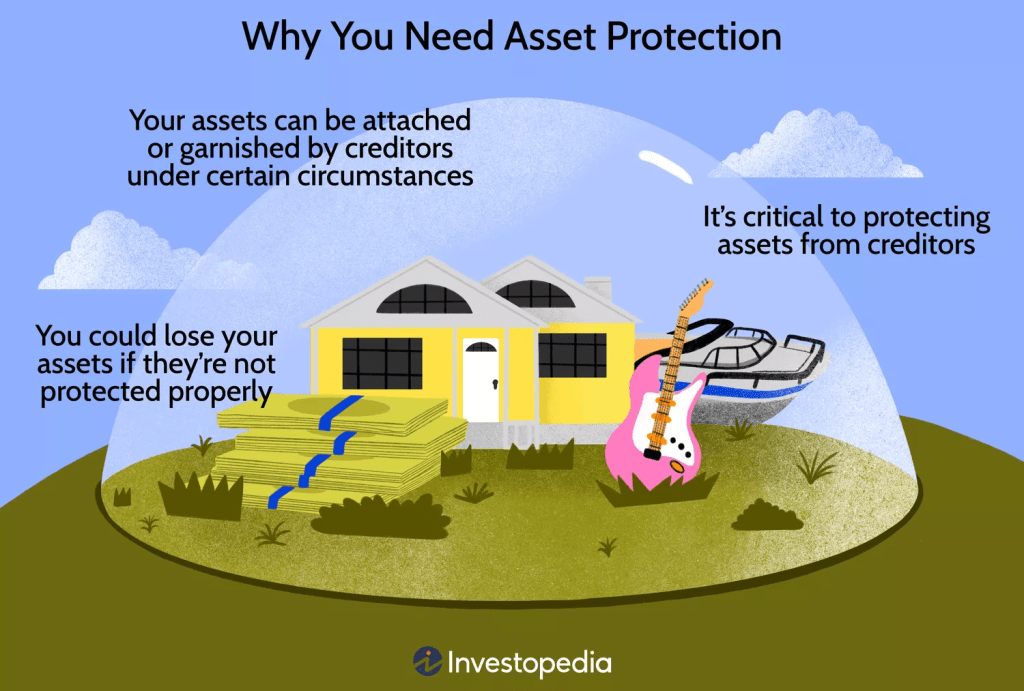
Why You Need Asset Protection
Having asset protection is critical to protecting your assets from creditors. There are many circumstances in which your assets can be attached or garnished by creditors, including if you file for bankruptcy, get a divorce, or are in a civil lawsuit.
It’s important to consider these circumstances before they occur, If you don’t protect your assets properly, you could lose them.
Asset Protection Caps for IRAs
Contributions and earnings in your traditional or Roth individual retirement accounts (IRAs) have an inflation-adjusted protection cap of $1 million against bankruptcy proceedings.
In addition, amounts rolled over from qualified plans, such as 403(b) and 457 plans, have unlimited protection. However, this protection only applies to bankruptcy, not to judgments awarded in other courts like if someone was injured due to your actions.
Protection also does not include judgments for most domestic relations lawsuits, such as child support. In such cases, state law must be consulted to determine whether any protection exists and to what degree.
Many U.S. laws protect assets in the event of lawsuits, bankruptcies, and collection agency actions.2 You can also purchase an asset protection plan.
Qualified Retirement Plans
Assets in employer-sponsored plans have unlimited protection from bankruptcy, regardless of whether or not the plan is subject to the Employee Retirement Income Security Act (ERISA).
This includes SEP IRAs, SIMPLE IRAs, defined-benefit and defined-contribution plans, 403(b) and 457 plans, and governmental or church plans under the Internal Revenue Service (IRS) code section 414. Amounts in your SEP IRA from regular IRA contributions are currently subject to a $1,512,350 limitation. This amount is adjusted for inflation every three years.3
ERISA plans are also protected in all other cases, except under qualified domestic relations orders (QDRO)—where assets can be awarded to your former spouse or other alternate payees—and tax levies from the IRS.
For this purpose, a qualified plan is not considered an ERISA plan if it covers only the business owner. The protection for owner-only plans is determined by state law.
Homesteads
Homestead exemption is a legal exemption in many states that protects a home from creditors following the death of a spouse or during bankruptcy.
The amount of protection you have for your home varies widely from state to state. Some states offer unlimited protection, others offer limited protection, and a few states provide no protection at all.
Annuities and Life Insurance
Asset protection for annuities and life insurance is determined by state law. Some protect the cash surrender values of life insurance policies and the proceeds of annuity contracts from attachment, garnishment, or legal process in favor of creditors.6
Other states protect only the beneficiary’s interest to the extent reasonably necessary for support. There are also states that do not provide any protection.
How to Plan for Asset Protection
You can plan for asset protection in several ways. The key is to create as many obstacles as possible for creditors before they can legally claim rights to your property. Here are several ways to protect your assets.
Asset Protection Trusts
Several states, including Alaska, Delaware, Hawaii, Michigan, Mississippi, Missouri, Nevada, New Hampshire, Ohio, Oklahoma, Rhode Island, South Dakota, Tennessee, Utah, Virginia, West Virginia, and Wyoming, allow asset protection trusts (APT), which are a type of irrevocable trust.
Asset protection trusts offer a way to transfer a portion of your assets into a trust run by an independent trustee. The trust’s assets will be out of the reach of most creditors, and you can receive occasional distributions. These trusts may even allow you to shield the assets for your children.
The requirements for an asset protection trust are:
- It must be irrevocable.
- The trustee must be an individual located in the state, or a bank or trust company licensed in that state.
- It must only allow distributions at the trustee’s discretion.
- It must have a spendthrift clause.
- Some or all of the trust’s assets must be located in the trust’s state.
- The trust’s documents and administration must be in the state.9
If you are considering an asset protection trust, consider working with an attorney who is experienced in this field. This way, you can ensure your trust meets regulatory requirements.
Accounts-Receivable Financing
If you own a business, you could borrow against its receivables and put the money into a non-business account. This would make the debt-encumbered asset less attractive to your creditors and make otherwise accessible assets untouchable.
Stripped-Out Equity
Another option for protecting your assets is to pull the equity out of them and put that cash into assets that your state protects. Suppose, for example, that you own an apartment building and are concerned about potential lawsuits. If you took out a loan against the building’s equity, you could place the funds in a protected asset, such as an annuity (if annuities are sheltered from judgments in your state).
Family Limited Partnerships
Assets transferred into a family limited partnership (FLP) are exchanged for shares in the partnership.
Because the FLP owns the assets, the assets are protected from creditors under the Uniform Partnership Act (UPA). However, you control the FLP and thus the assets. There is no market for the shares you receive, so their value is significantly less than the value of the asset exchanged.
Other Asset Protection Strategies
Here are some other inexpensive, simple ways to protect your assets:
- Transfer assets to your spouse’s name. However, transferring assets to your spouse could have consequences if you divorce.
- Put more money into your employer-sponsored retirement plan because it might have unlimited protection.
- Buy an umbrella insurance policy that protects you from personal injury claims above the standard coverage offered by your home and auto policies.
- Make the most of your state’s laws regarding homesteads, annuities, and life insurance. Paying down your mortgage, for example, could protect cash.
- Don’t mix business assets with personal assets. That way, if your company runs into a problem, your personal assets may not be at risk.
What Trust Is Best for Asset Protection?
An irrevocable trust like an asset protection trust can help keep your assets protected from creditors. An irrevocable trust is a trust that the grantor cannot change. It can also help your heirs avoid probate.10
Can You Withdraw Money From an Irrevocable Trust?
An irrevocable trust is designed to restrict the grantor from changing it. Once you transfer money into the trust, you cannot remove it. If you are the trustee, you can make necessary withdrawals to cover expenses.7
What Does an Umbrella Policy Not Cover?
An umbrella policy is an insurance policy that provides extended liability coverage, but it does not cover damage or destruction to your own property. It covers the cost of injury to another person or damage to their property.
Your Assets Lost
You’ve worked hard to build a nest egg: cash, investments, properties, and more. But all these assets could be lost in an instant through a lawsuit—even when the lawsuit isn’t your fault.
After you’re gone, similar threats could devastate the assets you leave to your loved ones—often through no fault of their own.
For example, many people, after inheriting and turning (“transmuting”) their separate property inheritance to community property, find that they lose half when the other spouse decides to divorce the person inheriting.
Let’s look at some key legal strategies you can implement now, before the threat arrives. Indeed, in general these strategies only work if put in place well in advance of trouble.
Here is some expert help in setting up the most complex of asset protection strategies, and we encourage to do it now.
Asset Protection While You’re Alive
Start with protecting your assets while you’re still alive.
For starters, understand that no single solution works for everyone–you really need expert advice for your particular situation.
For example, residents of California have access to a very special financial vehicle called a Private Retirement Plan. A California PRP is much more than a mere financial plan. It includes the creation of a Private Retirement Trust, careful retitling of assets, and a written actuarial plan—all of which must be created by professionals. Read more about PRPs here.
Beyond PRPs, you can structure a variety of irrevocable trusts, charitable trusts or LLCs (particularly LLCs for investment real estate), in which you do not directly own assets, yet retain control and benefits–potentially putting them out of reach of creditors and predators.
Another important action to protect your personal assets during your lifetime may be the creation of a Prenup or Postnup with your spouse. Personal circumstances may require very different strategies, and again, we invite you to contact us to learn about these special strategies.
Asset Protection After You’re Gone
Here’s a disaster seen all too often: An inheritance which required a lifetime to accumulate is taken by a predator, creditor, or divorce after it transfers to a loved one.
You or your loved ones may not even see the threat coming. Lawsuits are at an all-time high. Divorce hits at least half of marriages. And (partly thanks to Covid-19), bankruptcies became pandemic in recent years.
Any inheritance, but especially a significant inheritance, can become a target. Unless you take important legal steps to protect your loved ones and your legacy before you pass away, your legacy may well be lost, and lost quickly. Here in California, inheritance asset protection may be especially vital.
Inheritance Asset Protection strategies go well beyond creating a Living Trust or designating beneficiaries on a bank form. Protection strategies add only a little extra work to the estate planning process, but they can prove highly effective. Many who create a PRP (see above) during their lifetime can pass to their loved ones similar asset protection when they pass away.
Imagine the following tragic asset protection scenarios:
Just 1% at Fault, but Taking 100% of the Hit
Upon your death you leave your house ($650,000), a bank account ($25,000), and your remaining IRA funds ($325,000) to your daughter, let’s call her Eileen. Indeed, all these wonderful assets transfer directly into Eileen’s name.
Eileen is smart and diligent, and by the time of your death she’s attained a high level of financial responsibility. A few months after your death, she’s driving in Los Angeles, California when a teenage drunk-driver runs into her car, pushing her car forward and causing her car to hit a pedestrian. Eileen is ok, but the pedestrian is badly injured and brings a lawsuit against both the drunk driver and Eileen. The judge affirms the pedestrian’s damages are $1 million, and a jury determines that the drunk driver is 99% at fault and Eileen is just 1% at fault for the accident.
So far this sounds like justice. But what happens if that drunk driver cannot pay his 99% of the damages? In California, this scenario can stick Eileen with 100% liability for the $1 million damages, because she can pay; even though it was determined she was just 1% at fault. No kidding.
Creating asset protection for retirement accounts has become more important than ever.
And now, guess what? The pedestrian gains access to the house you left behind, along with the bank account and IRA you lovingly left Eileen –because she is now the legal owner of those assets. Disaster has truly struck.
And perhaps you are beginning to see that when it comes to asset protection, California can be a special kind of minefield.
Bankruptcy Trustee Goes After the Goods
Here’s another possible scenario. You die with a $1 million estate which you successfully leave to your responsible son, Trevor. Trevor is a respected local business owner with a popular restaurant held in his name. He held the business as a sole proprietor, but he didn’t keep much in the bank, and if his business were to fail, he could have effectively walked away.
Suddenly, after years of success, a viral pandemic sweeps through the country, prohibiting townsfolk from socializing publicly, and decimating the dining industry.
Trevor’s restaurant survives for a bit, but after months of lost income, he is forced to file for bankruptcy. Only now you’ve provided him with money in the bank. A Bankruptcy Trustee is appointed and requires Trevor to use your $1 million legacy to satisfy the restaurant’s creditors.
Son-in-Law Cuts Out and Takes Half
Your daughter Tamma and her husband Mike are happily married and living in California when you pass away. Tamma inherits your estate, and she uses half of your generous inheritance to pay off the mortgage on the house she and Mike own together. The other half is transferred to their joint bank account. So far, so good.
Except that five months later, Mike is unfaithful, and the marriage falls apart. Indeed, it’s Mike who files for divorce—maybe because he sees that he can now cash in.
When he files, he argues that as part of the Marital Settlement Agreement, he is now entitled to one-half of the assets acquired with Tamma’s inheritance, because Tamma commingled her inherited assets with him over the last five months, and as a result, the assets became community property.
Mike prevails in California Family Court and walks away with one-half of the inheritance you worked so hard to provide your daughter.
How Can I Protect an Inheritance Against an Heir’s Irresponsible Spouse?
What’s a high-maintenance spouse? It’s a husband or wife who really, really likes to spend money, especially your heir’s inherited money. Such a spouse can be found on any rung of the socio-economic ladder—rich, poor, middle-class, it doesn’t seem to matter.
What’s a high-maintenance spouse? It’s a husband or wife who really, really likes to spend money, especially your heir’s inherited money.
Let’s assume, for example, that you plan to leave some money to your daughter, let’s call her Jane. But you know that Jane’s husband, Ted, is a total spendthrift. He’s always spending all the family money on new cars and motorcycles and stuff, and he really, really wants to buy a boat so he can take his friends out bass fishing. A bass boat can cost $300,000.
A good lawyer could set up a trust with Jane as the beneficiary, but Jane herself could not remove any of the money, because someone else would be named the trustee for her funds.
If the million were properly invested, Jane could take out 4.8 percent, or $48,000 a year. The language of the trust could permit Jane to receive $4,000 a month—plenty for Jane to live on in retirement, within her lifestyle.
And since she herself was blocked from accessing the money, her husband could never pressure her for another big purchase.
Some lawyers call a trust like this a “general needs trust,” or sometimes a “dole-it-out trust.” You dole a little bit of money out every month to Jane for the rest of her life. Result: she is protected from a predator.
Can I Protect My Inheritance with a Trust? Redefining Ownership
Each of the asset protection examples—and disasters—above are based on true stories, and each is especially poignant because the children did not commit any wrongdoing. They didn’t even act irresponsibly. Rather, the threats were outside their control, and sometimes the California asset protection laws (or lack thereof) happened to work against their interests.
Just as tragically, in each case good planning by the parents could have prevented the loss.
How? It all lies in the definition of “ownership.”
The secret to effective asset protection lies in structuring an estate so that your heirs will get full control of your assets, but not actually own them. As John D. Rockefeller once advised, it’s best to “Own nothing, but control everything.” That’s because, by law, what you don’t own can’t be taken from you, even it if it is completely under your control.
Control without ownership for your heirs can be created using an Inheritance Protection Trust, or for retirement assets, an IRA Legacy Trust. Both of these asset protection strategies can allow your loved ones to completely control, access, and manage their inheritances while simultaneously enjoying protection from potential creditors, bankruptcy, lawsuits, and divorce.
How Can I Control, But Not Own Assets?
A good asset protection attorney in California can structure an inheritance in a manner where instead of leaving wealth to your loved one directly in their name, the wealth is left in a California trust for asset protection that continues to exist after your death.
You decide who may control the wealth within the trust (the Trustee) and who will benefit from that wealth (the Beneficiary.)
Whether you appoint your loved one or an independent third party to control the assets within an Inheritance Protection Trust, if properly constructed, all the funds may benefit your loved ones while remaining safe from creditors, bankruptcy, lawsuits, and divorce.
One additional benefit of an Inheritance Protection Trust is that the language used to create it can be drafted right in your Revocable Living Trust.
Most people, in particular Californians, already seek to establish a Revocable Living Trust to avoid probate, direct their assets to the proper beneficiaries, and plan for potential taxes upon death. They can add the feature of asset protection by including an Inheritance Protection Trust.
If you already have a trust and are considering an Inheritance Protection Trust, good news! Many people with existing trusts don’t need to start from scratch. In many instances you may need only to formally update your existing trust by creating a Restatement.
A Restatement has the added benefit of bringing all the language of the trust up-to-date—and typically legal fees are lower than starting from scratch.
You may also want to consider the more advanced strategy of a Dynasty Trust.
How Can I Protect My Retirement Account from a Divorce or Predator?
It has become common for a family’s most valuable asset to be a retirement account like an IRA, 401(k), 403(b), or tax-deferred annuity. It used to be that inherited retirement accounts offered some protection from predators.
But in 2014, the United States Supreme Court unanimously ruled that inherited retirement accounts are no longer considered “retirement accounts” subject to protection from the creditors of a beneficiary. The case was called Clark v. Rameker, 573 U.S. 122 (2014), and it has had a devastating impact.
All in all, creating asset protection for retirement accounts has become more important than ever.
For reasons too lengthy to discuss here, an Inheritance Protection Trust is typically only appropriate for non-retirement assets such as a house, cash or stocks – not retirement accounts.
We recommend seeking special expertise in creating a highly specific kind of trust to deal with the complex laws around retirement accounts, called an IRA Legacy Trust.
An IRA Legacy Trust uses several of the strategic concepts found within an Inheritance Protection Trust, but it’s equipped with a sophisticated tax plan to account for the income tax obligations that exist with most inherited retirement accounts.
Importantly, it can also be sited in a state without state income taxes, such as Nevada, even though your beneficiaries may reside in a high-tax state like California.
Combined with the asset protections of “controlling, not owning,” such a trust can allow you to leave a powerful and safe legacy to your loved ones.
Should I Really Try to Protect My Assets After I Pass Away?
It’s impossible to go through all the possible examples or asset types here. You need to ask questions like, “Are annuities protected from creditors in California?”, and “Is a domestic California asset protection trust right for me?” Only a specialized expert can explain how to protect your assets in California.
Any inheritance, especially a significant inheritance, can become a target. Unless you take important legal steps to protect your legacy before you pass away, it may well be lost, and lost quickly.
If you are the kind of person who says, “What do I care? By the time any of this matters, I’ll be gone anyway,” these planning strategies may not be for you.
But if, like most people, you’re looking for a truly savvy solution, and you see the value of providing protection for your loved ones even after you are gone, we encourage you to schedule a consultation with a competent estate planning attorney.
Together you can determine whether an Inheritance Protection Trust or IRA Legacy Trust may be appropriate for you and those you love.
Two Frequently Asked Asset Protection Questions
Q: Do I need asset protection?
A: Whether or not you need asset protection depends on your specific circumstances and the risks you face. Asset protection can be especially important for individuals who are in high-risk professions, have a significant amount of assets, or are facing potential legal challenges. It’s always a good idea to work with an experienced attorney to ensure that your assets are properly protected.
Q: What is the biggest asset protection planning mistake?
A: One of the biggest asset protection planning mistakes that people make is failing to plan ahead. Many people wait until they are facing a legal challenge or other risks before they consider asset protection, but this can be too late. It’s important to think about asset protection before you face any legal challenges, as it can be more difficult to protect assets once they are already under threat.
Another common mistake is failing to seek professional legal advice since asset protection is a complex legal area.
Recommendation
The lawyers and staff at CunninghamLegal help people plan for some of the most difficult times in their lives; then they guide them when those times come.
Make an appointment to meet with them. The have offices throughout California, and offer in-person, phone, and Zoom appointments. Just call (866) 988-3956 or book an appointment online.
Please also consider joining one of their free online Estate Planning Webinars.
They look forward to working with you!
Bottom Line
If you are considering hiring an asset protection service, check with the Better Business Bureau (BBB) before deciding to use any of these services. Additionally, consider consulting with an attorney who is familiar with the laws of your state and who is an expert in asset protection.
If you really want a life or business asset protection that truly helps you or other family members — even if you don’t know how to do it — contact us.
We work with people all over the world. We’ve helped thousands of people start and succeed in protecting their assets.
Join us if you want to change your life, build assets or protect your assets. You’ll never be alone; we will guide and support you every step of the way.
Liberating the Financially Oppressed,

Reitenbach-Kissinger Institute
Sydney Reitenbach and Michael Kissinger
Text: 650-515-7545
Email: mjkkissinger@yahoo.com
Review: mksmasterkeycoaching.com
By Michael Kissinger
Offers Results Only Coaching: Exceptional Profit Results-Proven Strategies and Universal Law Skills in Management, Marketing, Operations, Finance Every Business Owner Wants-Needs to Achieve Their Essential Transformation
Review and His Work: James L. Cunningham Jr., Esq.
Asset Protection and the Corporate Veil: https://www.youtube.com/watch?v=JcXNliHWEEY
Business Owners: How to PROTECT Assets and Cut Taxes!: https://www.youtube.com/watch?v=dFwvfhgrQX4
How to Keep Assets Private & PROTECT them from Creditors: https://www.youtube.com/watch?v=QZ1zqYKuxzA
How Wealthy People Structure Estates to Reduce Taxes: https://www.youtube.com/watch?v=Eu348HN6L_E
FUNDAMENTALS to Get Started on a Living Trust: Estate Tips!: https://www.youtube.com/watch?v=3qSMGl6pKAA




 REACH YOUR PEAK PERFORMANCE TODAY with the World's #1 Consulting Firm. The Reitenbach-Kissinger Institute and the MKS Master Key Consulting-Law-Engineering Systems. You are committed to achieving your goals. Do not compete without proven consultants. FREE 30-Minute Win the Game of Life or Business Consulting Session Call: 650-515-7545