
Want to Earn an Extra $1,000, $5,000, or even $10,000+ Every Month —

Create a More Flexible Lifestyle for Yourself and Your Family in 2025?

Yes, Earn an Extra $1,000, $5,000, or even $10,000+ Every Month — and Create a More Flexible Lifestyle for Yourself and Your Family in 2025?

Looking for an in-depth business building program that guides you, step by step, in starting a business from scratch that earns you an extra $1,000, $5,000, or even $10,000+ every month — and create a more flexible lifestyle for yourself and your family? If so, do this!

Unlike other business-building programs that require you to “have a good idea” before you join, you don’t need a business idea or product before you start because we’ll take you through the process step-by-step.

So even if you’re new to building a business, we’ll help you if you want to earn an extra money every month — and create a more flexible lifestyle for yourself and your family.

What You’ll Learn Inside this Business-Building Program

* It is packed with the mindset shifts, practical videos, worksheets, pricing advice, and sales techniques you need to quickly build a business that pays you. And pays you well.

* Crucially, the live component means you won’t be doing it alone. You’ll be building your business alongside other motivated members of your cohort, complete with regular Zoom calls and an active community forum where you can ask questions, share your wins, and stay motivated.

It’s easy to be terrified of the unknown. You’ll have a proven system. We’ll show you every step, and an experienced community that can hold your hand while you walk those steps.

* It celebrates your wins with you and shows you exactly how to…

* Apply your profitable system — including rapidly finding paying customers.

* You’ll learn how much to charge, how to create a winning offer, and how to handle difficult customers.

* Start at $1,000/month — or scale up to $250,000+/year. You choose how big you want to grow. 

* You’ll master advanced concepts…like positioning, pricing, and the psychology of marketing and selling. These insights are critical if you want to build a real business with real income.

* You’ll automate your business, so it keeps earning you money — even when you’re sleeping. We’ll share the exact systems we used to keep sales coming in.

* Includes all the strategies, frameworks, hands-on tactics, real-world examples, mindsets, word-for-word scripts, and hard-won breakthroughs you need to start and grow your own business.

* We’ll help you avoid the scraping, scrambling, and speculation that crushes so many new businesses in their first year of existence.

* It’s NOT a series of tactics. It’s a system. And the system works.

Let’s Calculate How Much You Could Make

Building freedom doesn’t happen by accident. You have to do it intentionally.

One of the best ways to do it — to give yourself freedom of time, freedom of location, freedom from $3 worries — is to start building an ASSET that pays you continuously.

Forget about selling a $3,500 product for a minute. Just pretend you have an entry-level $50 product.

If that seems pricey to you, remember that the average person spends over $300/month on “impulse” purchases, so $50 could easily be a trivial amount to your target customer.

(By the way, we’ll even provide the products — even if you don’t think you have any sellable skills. Then, we talk about how to find and talk to your target customers.)

If you sold just 10 of your $50 product every month, and stopped completely after two years…You’d have an extra $12,000 in your bank account!

Now go further. What if actually improved each of those numbers?

Say you sold a more valuable product and priced it higher… or used our systems to boost the number of sales you made per month?

That’s $108,000!

In other words: With a $100 product (which is still pretty small)…Making just one sale a day…And completely stopping after only three years… You’d make $108,000. That’s $3,000 every month for 3 years.

See how powerful your online business could be? 

This is the power of building an asset. Do the work once, then get paid forever. 

You could start building your second income stream right now, and completely change your life’s trajectory.

We’ll show you how:

Turn your skills into services, and your services into product sales. So YOU can build once and get paid forever.

* Think of all the things you could do with an extra $1,000 a month. Or even $10,000 a month.

* Think of how it would feel to know you were safe, secure, and didn’t have to worry about paying your rent next month…or next year. 

* How would it feel to splurge on those coffee shop lattes, or a new TV, or an overseas vacation — all without feeling the slightest trace of guilt?

This is for you if you’re ready to build one of the most powerful, flexible types of assets: a business that PAYS YOU to live your Abundant Life.

Now go think about how much you could make.

Contact us and we’ll show you exactly what it is. What’s important enough to suffer or sacrifice for.

But for now, just remember this: The best thing you can do in 2025 is get started now.

We’ll Help You Get Results With Common Sense-No BS-High Performance Executive-Business-Financial-Systems for Developing Your Life, Building Your Net Worth or Turning Your Vision into Reality.

Reitenbach-Kissinger Institute

Sydney Reitenbach or Michael Kissinger

Text Michael 650-515-7545 Today

Email: mjkkissinger@yahoo.com

WEB: mksmasterkeycoaching.com

TEXT: 650-515-7545,

The Simple 8 Step Path to Wealth: Your Road Map to Financial Freedom and a Rich, Free Life 

Since money is the single most powerful tool we have for navigating this complex world we’ve created, understanding it is critical.

To build wealth you have to invest the difference between your income and your expenses. Or get adopted by a billionaire. The latter is less likely to happen, so while you wait to run into an oil tycoon with no offspring it’s best to focus on decreasing your expenses while increasing your income.

How you do that depends on your individual circumstances, but it may require learning new things or making big changes to make a big difference. If you’re living paycheck to paycheck, you won’t magically build wealth by doing the same thing you’ve always done.

My son, Clayton once said, “I know money is important. I just don’t want to spend my life thinking about it.” This was eye-opening. I love this stuff. But most people have better things to do with their precious time. Bridges to build, diseases to cure, treaties to negotiate, mountains to climb, technologies to create, children to teach, businesses to run.

Unfortunately, benign neglect of things financial leaves you open to the charlatans of the financial world. The people who make investing endlessly complex, because if it can be made complex it becomes more profitable for them, more expensive for us, and we are forced into their waiting arms.

Here’s an important truth: Complex investments exist only to profit those who create and sell them. Not only are they more costly to the investor, they are less effective.

The simple approach I created for him and present now to you is not only easy to understand and implement, it is more powerful than any other.

Together we’ll explore:

  • Debt: why you must avoid it and what to do if you have it
  • The importance of having f-you money
  • How to think about money, and the unique way understanding this is key to building your wealth
  • Where traditional investing advice goes wrong and what actually works
  • What the stock market really is and how it really works
  • Why the stock market always goes up and why most people still lose money investing in it
  • How to invest in a raging bull or bear market
  • Specific investments to implement these strategies
  • The Wealth Building and Wealth Preservation phases of your investing life and why they are not always tied to your age
  • How your asset allocation is tied to those phases and how to choose it
  • How to simplify the sometimes confusing world of 401(k), 403(b), TSP, IRA, and Roth accounts
  • TRFs (target retirement funds), HSAs (health savings accounts), and RMDs (required minimum distributions)
  • What investment firm to use and why the one I recommend is so far superior to the competition
  • Why you should be very cautious when engaging an investment advisor and whether you need to at all
  • Why and how you can be conned, and how to avoid becoming prey
  • Why I don’t recommend dollar cost averaging
  • What financial independence looks like and how to have your money support you
  • What the Four Percent Rule is and how to use it to safely spend your wealth
  • The truth behind Social Security
  • A case study on how this all can be implemented in real life

Building Wealth on a “Foundation of Protection”

Have a solid foundation upon which you can build wealth?

The other day, I received a call from a young 40-something client about retirement planning. “I have two little ones and my wife and I want to make sure that we are doing what we’re supposed to do in getting ready for retirement.” The client also expressed a desire to invest ~$6,000/yr towards college savings via 529 accounts ($250 per month, per child).

While this all sounded respectable and fair, I stopped him in his tracks and said “(Client), I am so happy that you’re being proactive in reaching out to me to discuss and address these issues, but I think we need to step back for a second. We need to look at the foundation upon which you’re looking to build.”

I could tell that my client was puzzled. He proceeded to ask me what I meant. I explained that as an advisor, I strive to develop plans with the strongest chance of succeeding. I am not interested in laying out colorful pages full of rosy assumptions, pretty graphs and a product push on the back-end. I am a professional that breaks down your goal as you communicated it to me, designs a plan to achieve that goal, identifies the risks that can throw a monkey-wrench in that plan, and finally presents solutions that eliminate or mitigate those aforementioned risks. “If we have a plan that ignores risk, we don’t have a plan. We have a pretty looking wish list.”

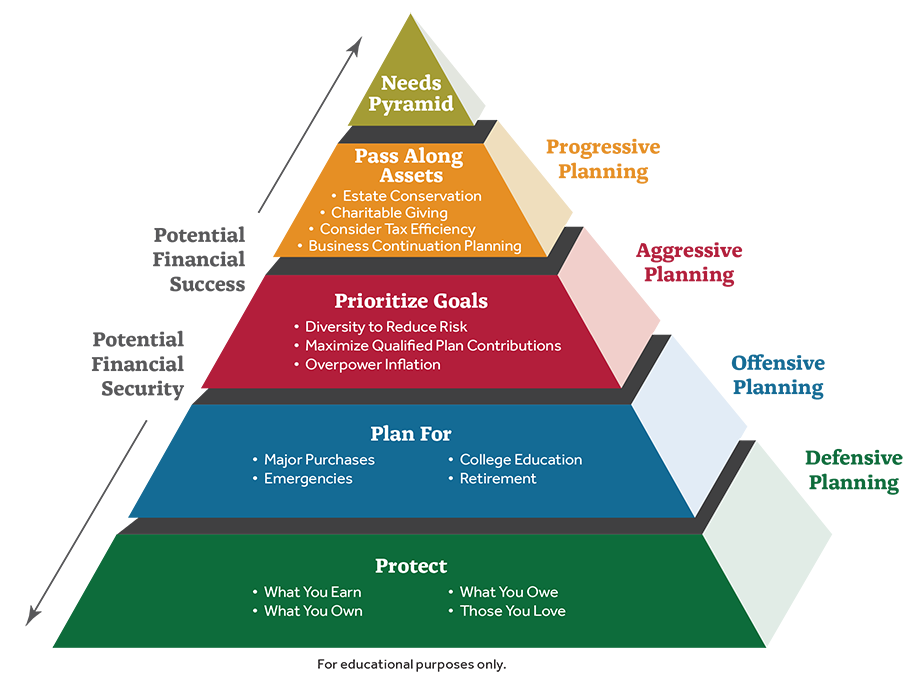
To develop this foundation of protection, I proceeded to describe to the client a foundation on a home. It has a simple, Pyramid-like shape with protection at the base. These are the four areas of your life that need protection – (1) health, (2) financial, (3) personal property and (4) wealth.

Health – To protect your health, you need health insurance and adequate reserves to handle extreme medical emergencies such as max out-of pocket deductibles and co-insurance. Having those funds in liquid cash, in a Health Savings Account are ways to manage this risk. Insurers like AFLAC also have special products to mitigate this risk for middle to low income earners that find it challenging to accumulate such funds.

Financial – Protecting your financial situation is a multi-faceted strategy. At the base of the plan, one should secure adequate Disability insurance. This coverage “protects the paycheck” and insures that you have the funds needed to meet financial obligations in the event that you can’t earn an income due to accident, illness or affliction. Next, would be adequate life insurance. Having a plan for your family is useless if you die and the resources needed to support surviving family is not there. Insurance is the best way to leverage relative lower dollars to generate a legacy for years to come. Building up an emergency fund and paring down debt are also methods of insuring that a savings/investment plan has a maximum chance of success.

Personal Property – Most of these items are required to be protected – auto insurance, homeowners’ insurance, apartment insurance, umbrella coverage, etc. it’s funny how the powers that be (banks, landlords, auto finance companies) make it required for you to protect their things, but we fail to require ourselves to protect our own valued assets.

Wealth – Strategies like proper asset allocations, utilization of protection-focused instruments like annuities and structured products are all ways to help minimize risks to retirement portfolios. In addition, forward-looking asset protecting vehicles like Long-Term Care help retires keep their assets from being decimated by custodial needs that may arise later in life.

While all of these issues may not be applicable to my client in the present sense, discussing these issues help clients see the big picture and plan accordingly.

We identified

(1) that his emergency fund only covered two months of expenses,

(2) there were shortfalls in his life insurance and

(3) that his long-term disability coverage didn’t cover his annual bonus (which made up nearly 40% of his annual compensation).

So the plan right now was to secure the needed supplemental disability and life insurance immediately, cut back spending and build his emergency fund up to be a MINIMUM of three-month’s expenses (the 18-month goal is to build this up to 6 months of income), continue to responsibly manage debt, open two 529 with lower contributions (but reaching out to family and friends to contribute to help build up the account), and finally develop a risk- and time horizon-adjusted asset allocation analysis for the retirement portfolio.

By engaging in actions to fortify his financial foundation, we are now both in a better position to work together to build wealth.

What is a Financial Plan?

A financial plan is a document showing your financial situation, goals, and strategies for achieving those goals. Ongoing financial planning can help you make the most of your money.

  • A comprehensive financial plan should include details about cash flow, savings, debt, investments, insurance and other financial life elements.
  • A financial plan isn’t a static document — it’s a tool to track your progress and one you should adjust as your life evolves. It’s helpful to reevaluate your financial plan after major life milestones, such as getting married, starting a new job, having a child or losing a loved one.
  • You can make a financial plan yourself or get help from a financial planning professional. Online services like robo-advisors have also made financial planning assistance more affordable and accessible than ever.

What’s your financial priority?

  • Financial Planning
  • Retirement Planning
  • Investment Management
  • Tax Strategy
  • Making a financial plan in 9 steps

1. Set financial goals

A good financial plan is guided by your financial goals. If you approach your financial planning from the standpoint of what your money can do for you — whether that’s buying a house or helping you retire early — you’ll make saving feel more intentional.

Make your financial goals inspirational. Ask yourself: What do I want my life to look like in five years? What about in 10 and 20 years? Do I want to own a car or a house? Do I want to be debt-free? Pay off my student loans? Are kids in the picture? How do I imagine my life in retirement?

Having concrete goals can help you identify and complete the next steps and provide a guiding light as you work to make those aims a reality.

2. Track your money

Get a sense of your monthly cash flow — what’s coming in and what’s going out. An accurate picture is key to creating a financial plan and can reveal ways to direct more to savings or debt pay-down. Seeing where your money goes can help you develop immediate, medium-term and long-term plans.

For example, developing a budget is a typical immediate plan. NerdWallet recommends the 50/30/20 budget principles: 50% of your take-home pay goes toward needs (housing, utilities, transportation and other recurring payments), 30% goes toward wants (dining out, clothing, entertainment) and 20% goes toward savings and debt repayment.

Reducing credit card or other high-interest debt is a common medium-term plan, and planning for retirement is a typical long-term plan.

3. Budget for emergencies

The bedrock of any financial plan is putting cash away for emergency expenses. You can start small — $500 is enough to cover small emergencies and repairs so that an unexpected bill doesn’t run up credit card debt. Your next goal could be $1,000, then one month’s basic living expenses, and so on.

Building credit is another way to shockproof your budget. Good credit gives you options when you need them, like the ability to get a decent rate on a car loan. It can also boost your budget by getting you cheaper rates on insurance and letting you skip utility deposits.

4. Tackle high-interest debt

A crucial step in any financial plan: Pay down high-interest debt, such as credit card balances, payday loans, title loans and rent-to-own payments. Interest rates on some of these may be so high that you end up repaying two or three times what you borrowed.

If you’re struggling with revolving debt, a debt consolidation loan or debt management plan may help you wrap several expenses into one monthly bill at a lower interest rate.

5. Plan for retirement

If you visit a financial advisor, they will be sure to ask: Do you have an employer-sponsored retirement plan such as a 401(k), and does your employer match any part of your contribution? True, 401(k) contributions decrease your take-home pay now, but it’s worth it to consider putting in enough to get the full matching amount. That match is free money.

  • If you have a 401(k), 403(b) or similar plan, financial advisors also generally suggest that you gradually expand your contributions toward the IRS limit: $23,000 in 2024 and $23,500 in 2025. (In 2024 and 2025, people age 50 and older can contribute an extra $7,500 as a catch-up contribution. In 2025, due to the Secure 2.0 Act, those ages 60 to 63 get a higher catch-up contribution of $11,250.) .
  • Another savings vehicle for retirement planning is an IRA, or individual retirement arrangement. These tax-advantaged investment accounts can further build retirement savings. The contribution limit is $7,000 in 2024 and 2025 ($8,000 if age 50 and older).

6. Optimize your tax planning

For many of us, taxes take center stage during filing season, but careful tax planning means looking beyond the Form 1040 you submit to the IRS each year.

For example, if you’re routinely getting a sizable refund, that may be a sign that you’re needlessly living on less throughout the year. Learning how and when to review your W-4, the form you fill out for your employer, can help you to take control of your future. Adjust your withholdings on your W-4, and you either can keep more of your paycheck, or pay a smaller tax bill.

Getting cozy with the tax law also means looking into tax credits and deductions ahead of time to understand which tax breaks could make a difference when it comes time to file. The government offers many incentives for taxpayers who have children, invest in green home improvements or technologies, or are even pursuing higher education.

7. Invest to build your future goals

Investing might sound like something for rich people or for when you’re established in your career and family life. It’s not. Investing can be as simple as putting money in a 401(k) and as easy as opening a brokerage account (many have no minimum to get started). Financial plans use a variety of tools to invest for retirement, a house or college.

8. Grow your financial well-being

With each of these steps, you’re protecting yourself from financial setbacks. If you can afford it, decide whether you’d like to do more, such as:

  • Increasing contributions to your retirement accounts.
  • Padding your emergency fund until you have three to six months of essential living expenses.
  • Use insurance to protect your financial stability so a car crash or illness doesn’t derail you. Life insurance protects loved ones who depend on your income. Term life insurance, covering 10-year to 30-year periods, is a good fit for most people’s needs.

9. Estate planning: Protect your financial well-being

Financial planning also means looking out for your future needs, as well as mapping things out for your loved ones. Creating a will can help ensure your assets are distributed according to your wishes. Other types of estate-planning documents can also provide your relatives with clarity on how you would like to be cared for, and who should manage your affairs.

When to make a financial plan


There’s never a bad time to start financial planning, but there are a few life events that are good catalysts for making a financial plan.

  • Having children: Part of parenthood is figuring out how to achieve a variety of short-term and long-term financial goals, such as paying for childcare and eventually college education. A financial plan can act as a roadmap toward these goals. Plus, recent research from Brigham Young University shows that parent financial literacy has a major effect on children’s financial behaviors later in life.
  • A sudden increase in income or assets: A windfall, new job or major promotion may change your quality of life significantly, and a financial plan can help you avoid lifestyle creep.
  • Serious illness: Health problems are scary in their own right — and they can also introduce new, ongoing expenses that can make it difficult to stay financially on track. A financial plan can help you feel more confident about your ability to meet financial goals in spite of a serious illness, which may have positive knock-on effects. A 2023 study published in the journal PLOS One found a correlation between lack of financial planning and reduced life expectancy.
  • Retirement: A financial plan can help you navigate life after you stop working — in particular, it can help you make your savings last longer. A 2015 study published in the CFA Institute’s Financial Analysts Journal found that a carefully-planned savings withdrawal strategy can add more than three years to a portfolio’s longevity, on average.

8 Keys to Good Financial Plans

""

While there are many ways to develop a financial plan—do it yourself, use a robo-advisor, work with a financial planner, or a combination thereof. We have identified eight critical components every plan should include, regardless of the method used to create it. So, what does a good financial plan look like?

1. Financial goals

You can’t make a financial plan until you know what you want to accomplish with your money—so whether you’re creating it yourself or working with a professional, your plan should start with a list of your goals, both big and small, and the time horizons to accomplish them. Doing so can help you organize each objective by how soon you’ll need the money:

  • Short-term goals are those you hope to achieve in the next one to two years, such as paying off debt or building an emergency fund.
  • Medium-term goals are those you hope to achieve in the next three to 10 years, such as a down payment on a home or starting your own business.
  • Long-term goals are those that are 10 or more years away, including saving for college and, of course, retirement.

For each goal, specify a dollar figure and a target date. “The more specific your goals, the easier it is to measure your progress toward them.

A host of online tools can help you run the numbers, weigh competing priorities, and determine the best course of action for you. Also, if you have multiple goals to work toward, a robo-advisor, or automated investing platform, can help you weigh the importance of each goal, ranking them by needs, wants, and wishes.

Any time is a good time to establish a financial plan.

Ideally, you start investing for financial goals early in life, but any time is a good time to check in on your current financial situation and assess how you’re doing. Are you still on track? Do you have other goals you hadn’t previously considered? Having a financial plan helps you assess where you are today and where you want to go next.

2. Net worth statement

Knowing your net worth today can serve as a baseline for framing your financial goals and setting a target for your net worth at some point in the future, like in retirement. To determine your net worth, make a list of all your assets (bank and investment accounts, real estate, valuable personal property) and another one of all your debt (credit cards, mortgages, or student loans). Your assets minus your liabilities equals your net worth.

Don’t be discouraged if your liabilities outweigh your assets. That’s not uncommon when you’re just starting out—especially if you have a mortgage and student loans.

3. Budget and cash flow plan

Your budget is really where the rubber meets the road, planning-wise. It can help you determine where your money is going each month and where you can cut back to meet your goals.

A budget calculator can help ensure you don’t overlook irregular but important expenses, such as car repairs, out-of-pocket health care costs, and real estate taxes. As you’re compiling your list, separate your expenses into two buckets: must-have items, such as groceries and rent, and nice-to-haves, such as eating out and gym memberships.

When considering how your goals fit into your budget, you may want to pressure-test it using “what if” scenarios: What if you want or need to retire earlier? What if you downsized your mortgage? Some robo-advisors offer tools that allow you to adjust certain assumptions to see how they could affect your savings strategy.

4. Debt management plan

Debt is sometimes treated like a four-letter word, but not all debt is bad debt. A mortgage, for example, can help build equity—and boost your credit score in the process. High-interest consumer debt like credit cards, on the other hand, can weigh heavily on your credit score. Plus, every dollar you pay in finance charges and interest is one you can’t put toward other goals.

If you have high-interest debt, make sure you create a plan to help you pay it off as quickly as possible. If you’re not sure where to start, a financial advisor can help you prioritize, then together you can determine how much of your budget should go toward your debt each month.

5. Retirement plan

An old guideline says you’ll need approximately 80% of your present income in retirement. However, this assumes that retiring will free you from any work-related expenses, that you’ve paid off your mortgage, that any children will be financially independent, and you’ll likely fall into a lower tax bracket.

It’s also important to keep in mind that Medicare doesn’t cover everything, and health care expenses that Medicare doesn’t cover—such as long-term care—can add up quickly. You also might spend more on other things in retirement, such as travel, dining out, gifts, or financial support to a relative or friend.

Plugging different scenarios into a tool can help you figure out what you may need in retirement. 

Don’t count on the 80% rule.

If you’re saving 20% – 30% of your pre-retirement income, then the 80% income-replacement rule is a good place to start. Otherwise, it’s safer to aim at covering 100% of your pre-retirement income, minus whatever you’re saving for retirement. As with any general rule, there are plenty of exceptions. So be sure to sit down and fine-tune your retirement budget as the time draws near. This should be your top priority because you can borrow for most other goals but not for retirement.

6. Emergency fund

When something unexpected happens—say you lose your job or get hit with an unexpected medical bill—an emergency fund can help you avoid tapping your long-term savings to make ends meet.

It’s generally a good idea to save enough to cover at least three months’—ideally six months’—worth of essential living expenses (for example, groceries, housing, transportation, and utilities). Save this money in a checking or savings account so you can access it in a hurry should the need arise.

7. Insurance coverage

Insurance is an important part of protecting your financial downside—but try to ensure you’re not overpaying for coverage you don’t need and make sure to cover all your bases:

  • Health insurance: Without it, even routine care can cost a pretty penny, while a serious injury or hospital stay could set you back tens of thousands of dollars. As you get older, you may want to consider long-term care insurance as well.
  • Disability insurance: This coverage protects you and your family in case you’re unable to work. Employer-provided disability insurance typically replaces about 60% of your salary.
  • Auto and homeowners’/renters’ insurance: If you own a car or home—or rent and can’t afford to replace possessions out of pocket—make sure you’re adequately protected.
  • Life insurance: This is generally a good idea for those with dependents. Work with an insurance agent to understand what type of—and how much—coverage makes the most sense for you.

8. Estate plan

At a minimum, most people want a will in place, which states your final wishes with regards to your assets, dependents, and who you want to administer your estate. You should also keep the beneficiaries of your insurance policies and retirement accounts up to date. Also consider establishing powers of attorney for financial and health care decisions, in case you become incapacitated.

8 Steps to Help You Build Wealth

  • Start by making a plan
  • Make a budget and stick to it
  • Build your emergency fund
  • Automate your financial life
  • Manage your debt
  • Max out your retirement savings
  • Stay diversified
  • Up your earnings

1.  Start by Making a Plan

Building wealth starts with making a financial plan. That means taking the time to identify your goals and game out how you can accomplish them.

“Building wealth begins with a vision and a plan,” says Peter Cassciotta, owner of Asset Management and Advisory Services of Lee County.

Hiring a financial advisor is a great way to begin making your plan for building wealth. It’s a more expensive option, particularly for those who are just starting out, but choosing an advisor who’s a certified financial planner means you’re paying for planning experience.

Shopping around for a robo-advisor that also offers access to financial advisors may be a more affordable option. Check out robos like Betterment or Ellevest, both of which provide managed investment portfolios plus the chance to talk with advisors.

2.  Make a Budget and Stick to It

Plenty of people dread the “b” word, but budgeting is a key plank in your wealth building strategy. Building a budget and sticking to it helps increase your chances of carrying out your plan and achieving your financial goals.

Budgets also help you understand where your money goes each month and prevent behaviors that can endanger your goals, like overspending.

3.  Build Your Emergency Fund

When the furnace goes out or the refrigerator quits working, where does the money come from if you don’t have emergency savings? Lori Gross, financial and investment advisor at Outlook Financial Center says credit cards bear the brunt and cause you to incur extra costs and fees, like sky-high interest rates.

By building an emergency fund, you can protect your credit as well as reap the benefits of earning interest on an online savings account—all the while enjoying the peace of mind of knowing you have money in the bank to cover life’s surprises.

4.  Automate Your Financial Life

By making saving, investing and bill pay automatic, you all but eliminate the chance you forget to set aside money for your goals or make progress on paying off your debts.

That’s why Michael Morgan, president of TBS Retirement Planning, recommends that you have the aggregate amount you’ve budgeted for each of your expenses and goals automatically deducted from your paycheck and applied to each expense.

This is especially valuable when it comes to saving and investing, he says. “By doing so, you resist the temptation to spend rather than invest. Soon, you won’t miss the money that is being automatically deducted and your contributions will be made on a regular basis,” he says.

5.  Manage Your Debt

If you’re carrying a balance month to month, you aren’t alone: The average American has more than $90,000 in debt, according to Experian research.

Of course, not all debt is created equal—and some, like mortgages, may even be considered “good” debt, thanks to their general low interest rates and wealth building potential. Some experts even think of a mortgage payoff as a type of forced savings account because you’ll likely see at least a portion of your monthly payment back when you sell.

But if you’re rolling over a lot of bad debt, like high-interest credit card bills, every month, you may jeopardize your financial goals. That’s why it’s important to have a plan for your repayment, Gross says, with the ultimate goal of having a debt-free life.

If you aren’t sure how to get started, consider using the debt snowball or debt avalanche payoff methods. And remember: It’s possible (and often even advisable) to save money and pay down debt at the same time.

Then, as your balances fall, you’ll have even more money to put towards your emergency savings and investments.

6.  Max Out Your Retirement Savings

Uncle Sam gives you a few different ways to save up for retirement, and experts encourage you to take advantage of as many as you can. That means putting the most you can toward your employer’s retirement plan—think 401(k)—as well as individual retirement accounts.

If contributing the legal maximum is going to be a stretch for you right now, make sure you’re at least saving enough to get any 401(k) match your company provides. That means if your employer offers a 3% match, you’re contributing at least 3% of your salary each pay period.

Don’t get discouraged if you can’t invest a lot to begin with. “Most of my clients invested a small amount of money for a long period of time,” says Casciotta. The power of compounding, then, helps turn these invested small sums into fortunes.

If you aren’t sure the best way to start investing within your 401(k) or IRA, consider a target-date fund or robo-advisor that manages a custom portfolio of funds based on the number of years you have until retirement.

7.  Stay Diversified

If you’re clinging to the idea that people only become wealthy by having highly concentrated positions—perhaps by holding large amounts of Bitcoin—consider loosening your grip. Having a diversified portfolio with different types of investments can both protect the wealth you’ve accumulated and position you to reap rewards even in market downturns.

“A diversified portfolio includes a mix of assets that do not necessarily move in the same direction and in the same magnitude at all times and is designed to help reduce volatility over time,” says Veronica Willis, investment strategy analyst at Wells Fargo Investment Institute.

8.  Up Your Earnings

While it isn’t a move that you can make at an online brokerage, investing in yourself by raising your income is an important step when it comes to how to build wealth. The more you earn over your lifetime, the more money you have available to invest.

“If you’ve been living comfortably on your current salary and you receive an increase, this is the perfect opportunity to begin the path to building wealth,” says Morgan, whether that means contributing more toward your retirement savings, paying down debt or bumping up your emergency fund savings,

In fact, financial experts recommend you save at least half of every raise you get to position yourself for a secure retirement. This allows you to improve your quality of life gradually while also ensuring you don’t fall victim to standards of living that will be impossible for you to maintain in retirement.

If you don’t think you’re in the position to receive a raise, schedule time with your boss to determine what steps you need to take to advance in your current role. You may also consider picking up a side hustle or trying a passive income idea.

How To Build Wealth From Nothing

Building wealth from nothing requires taking a deep look at your current situation. Evaluate your spending and income for the last several years. Where can you ruthlessly cut your spending? How can you increase your income? Depending on where you’re starting from, this may seem impossible and require out of the box thinking.

It’s easier to cut luxuries when you’re already spending on luxuries to begin with. If you lead a bare-bones existence, you may have to make radical decisions. Find where you can create room in your budget and invest the difference between what you spend and what you earn. Sensible investing over time is one of the easiest ways to grow wealth.

How To Build Wealth in Your 20s

It may not seem like it, but your 20s are one of the easiest times of your life to build wealth. Your income isn’t significant, but your financial responsibilities are lower. Ideally you don’t have children or other dependents to care for yet and all the extra expenses that come with them.

If you can manage to avoid lifestyle creep and maintain a low standard of living in your 20s, you can invest the rest of your income. You also may have freedom of geographic movement to pursue high paying jobs in low cost of living areas, especially after the remote work revolution of the last several years. Investing early on helps you benefit from decades of your money working for you through the magic of compound interest.

How To Build Wealth in Your 30s

Building wealth in your 30s comes with many of the same advantages as your 20s as well as the added consequences of the choices you made in your 20s. You may have debt you need to address or expensive habits your income doesn’t support. Your wages may have stagnated by remaining in the same position at the same company since graduation.

If you’d like to build wealth in your 30s, you still have plenty of time in which to do so. Take a hard look at the choices you’ve made so far and determine areas for improvement. Maybe it’s time to get rid of the daily take-out lunch habit or to downgrade your car from a brand-new SUV lease to a 15-year-old hatchback. It could be time to take professional development courses or earn free certificates online to pursue career—and salary—advancement opportunities.

How To Build Wealth in Your 50s

Your 50s can be a great time to build wealth—your income is likely the highest it has ever been. Unfortunately, if you’ve made it to your 50s without having wealth already, you’ll have to consider the circumstances and choices that have gotten you to your current point. Some of these may have been out of your control, like caring for a special needs child or dealing with a chronic illness yourself.

Looking back can be scary but the point of this exercise isn’t masochism, it’s determining where you can make changes to improve your situation. While working with a professional can help, you don’t have to share your financial skeletons with anyone. Nobody else has to know you spent $40,000 on shoes like Carrie Bradshaw, but you have to know where your money has gone and determine if that’s where you want it to keep going.

Bottom Line

To build wealth you have to invest the difference between your income and your expenses. Or get adopted by a billionaire. The latter is less likely to happen, so while you wait to run into an oil tycoon with no offspring it’s best to focus on decreasing your expenses while increasing your income.

How you do that depends on your individual circumstances, but it may require learning new things or making big changes to make a big difference. If you’re living paycheck to paycheck, you won’t magically build wealth by doing the same thing you’ve always done.

TOTAL NET WORTH ASSESSMENT
Please Provide Dollar Amounts for this Net Worth Assessment Worksheet
NET WORTH $ _____________

Assets (House & Cars, Etc.) $ _____________

Investments (401K, pensions, brokerage acct, etc.) $_____________

Savings (Short term CD’s & etc.) $_____________

Debt (House, car loans etc.) $ _____________

TOTAL NET WORTH $  _____________

INCOME

Combined Gross monthly income $ _____________

Net monthly income $ _____________

FIXED COSTS (50-60% of take home)

Mortgage (Making extra $— principle payment) $_____________
Utilities $ _____________
Insurance $ _____________
Car Payment $ _____________
Debt Payments $ _____________
Groceries $ _____________
Clothes $ _____________
Phone $ _____________
Subscriptions (Netflix, Gym, meal services, Amazon, etc.) $_____________
Miscellaneous $ _____________

FIXED COSTS TOTAL $_____________

INVESTMENTS (10% of take home) $_____________

Post-Tax Retirement Savings $ _____________
Pre-Tax contributions (Max out IRA’s) $ _____________

INVESTMENTS TOTAL $_____________

SAVINGS GOALS (5-10% of take home) $_____________

Vacations $100 Gifts $_____________
Long-Term Emergency Fund $_____________
Notes: No long-term goals. $_____________

SAVINGS TOTAL $_____________

GUILT-FREE SPENDING (20-35% of take home) $ _____________
GUILT-FREE SPENDING TOTAL $ _____________
(Dining out, movies, anything you want!)

Net Worth Total: $_____________

Need Help With Things You Should Know About Wealth Building but Don’t Know?

We’ll Help You Get Results You Want With Common Sense-No BS-High Performance Executive-Business-Financial-Systems for Building Your Business, Net Worth or Turning Your Vision into Reality. Helped Thousands Generate Millions. It is Impossible to Continue Poor after Following Our Principles.

Reitenbach-Kissinger Institute

Sydney Reitebach or Michael Kissinger

Text Michael 650-515-7545 Today

Email: mjkkissinger@yahoo.com

WEB: mksmasterkeycoaching.com

TEXT: 650-515-7545

Are You Seeking a Seven-Step Journey to Your Dream Job, to Shed Self-Doubt, Find Inspiration, and Change Your Life?

When You Follow Your Passions and Discover Your Purpose, You Can Change the World with These 7 Proven Landing Your Dream Job Steps

These days, having a case of the Mondays every Monday morning and being miserable in a boring 9-to-5 job is normal—but that’s no way to live.

If being miserable at work is normal, then we don’t want to be normal. We want to be different.

This coaching simplifies the often intimidating job search into an empowering and innovative step-by-step process that shows you how to wow employers and land your dream job.

Job seekers have used this approach to secure positions in more than 65 different industries, on seven continents, and in hundreds of fields and companies.

Unlike most job search coaching that focus on the fundamentals, MKS Master Key Job Search Coaching goes beyond the basics, providing job seekers with steps and tactics for standing out and sealing the deal. 

Most people can land a job in a strong market, bu our goal in this comprehensive coaching is to help you land an “ideal” job in any market and against any competition.

Sharing thorough, immediately actionable insight gained from over 40 years this coaching covers every angle of securing a fulfilling, lucrative career. From Getting Clear, Qualitied, Connected, Started, Promoted, Your Dream Job, and Giving Yourself Away.

In addition we’ll coach you with “grab attention” cover letters and resume advice to qualities of competitive candidates, interview guidance to easy-to-implement negotiation tactics. We leave nothing to guesswork, simplifying and clarifying all the steps necessary for you to become the candidate employers can’t wait to hire.

MKS Master Key Job Search Coaching helps you. . .

  • Rise above your competitors right out of the starting gate
  • Eliminate the words “networking” and “elevator pitch” from your vocabulary
  • Get in the door at your target organizations and uncover the hidden job market
  • Learn how and why you should break the traditional job search rules
  • Use steps, diagrams, and checklists to make the job search process much easier
  • Understand how to stand out and fit in at the same time
  • Implement proven tactics throughout the entire job search process

With vivid examples, powerful principles that apply to any industry, and step-by-step guidance for successfully navigating all stages of the job search process, MKS Master Key Job Search Coaching pulls together the numerous, convoluted aspects of job searching into a clear and user-friendly guidance that truly works, as evidenced by compelling testimonials.

Whether you are an unemployed job seeker, a student getting ready to graduate, a professional interested in making a career change, or a seasoned employee focused on landing a higher-level job, MKS Master Key Job Search Coaching will help you get from where you are to where you want to be.

The truth is: It is possible to find your dream job and love what you do for a living. It’s called living the dream—and you can have that if you’re willing to work for it.

Our path to meaningful work is a seven-stage process that will lead you to your dream job. It will take time, perseverance and patience to work through, but if you stick with it, before you know it, your case of the Mondays will become a thing of the past. Are you ready to get after it?

Step 1. Get Clear 

Before you do anything else, you must discover what you do best, what you love to do most, what results you want to produce, and where (industry, company, etc.) you can put those three components together to do work that matters deeply to you.

We know that sounds overwhelming, so let us break it down for you: What you do best includes your natural talents, skills and character strengths.

These should be tasks or roles that come easily to you and have been pointed out to you by others. Here are some examples: I’m a great writer. I can analyze numbers effortlessly. People have told me I’m an excellent salesperson. 

What you love to do most would involve any activities, tasks, and passions you look forward to and that make you come alive.

For example: Working with kids lights me up. Helping someone work through a personal or business issue so they can take control of their life leaves me feeling energized. Solving complex problems makes time fly by.

What results you want to produce is about considering what problems you love to solve, what solutions you love to create, and what people group you most want to help.

For example: I enjoy helping young veterans (people group) get through the first year of transition (problem) by teaching them how to schedule their days (solution). I love when a small-business owner (people group) is able to free up time to scale their business (problem) because I’m coaching them on their life or business issues (solution).

Where you can put those three together involves doing some research. Look around (starting in your zip code) for industries, companies, nonprofits, etc. where you might be able to do work within the intersection of what you do best and what you love to do most. By the way, I call that intersection your sweet spot.

Once you’ve got a list that includes these four things, get feedback and confirmation from three to five people who know you and will be honest with you. If these talents and passions are seen by others in your life too, you’ll know you’re headed in the right direction.

If you need help nailing down your top talents, passions and results try our free Career Clarity Coaching and Guide. It’s coaching and a worksheet that will help you get clear on who you are so that you can step into the work you were made to do.

* You’ll Find Confidence and Clarity in Your Career

* You’ll discover where your talent, passion and mission intersect to get clarity on the perfect role for you!

* Contact us to Get the Career Clarity Coaching Session and Guide

Step 2. Get Qualified

Once you know what you want to do and possible places where you can perform that role, you’ll need to get qualified to do the job.

Maybe you already have the education and/or experience you need to do the job you want to do—that’s incredible. Feel free to skip this step and move on to stage three.

You deserve to win at work. We will show you how. If that’s not you, no sweat. It’s not as hard, scary or expensive as it seems to get qualified to work in your dream job.

First, you’re going to put your research hat back on. Based on potential job opportunities you found, what qualifications are necessary to do the work?

Second, make a list of anything—from certifications to supervised hours—you need for the job.

Then, find out how much it will cost to get those qualifications. It doesn’t have to be exact—just come up with a rough estimate.

Finally, based on your budget, create a realistic timeline for when you think you’ll be able to cash flow getting the qualifications.

There’s something really important to remember when you’re in this stage: Don’t assume you need a degree—even if the job posting says you need one to get hired.

Now, there are some career paths that absolutely require you to have a degree (think doctor, lawyer, registered nurse, industrial engineer, etc.).

If you want to pursue one of those degree-dependent paths, just know that you don’t have to spend a fortune to earn that degree.

Adjust your timeline to fit your budget—because you should be cash flowing this degree, not taking on debt for it—and look for affordable options like community college and state schools over expensive, private, out-of-state universities.

If you find out you can land your dream job with some experience and maybe a few certifications, that’s the ideal situation. If that’s the case, there are so many creative ways to get qualified: 

* Take an online course or workshop.

* Find a boot camp or crash course you can take in the evenings or on weekends.

* Ask someone in the field if you can intern or shadow them for a few months.

* Borrow books from the library and download podcasts on the topic.

* Attend a local conference where you can learn and make connections.

You’ve got zero excuses. In our day and age, there are endless opportunities to get the skills, knowledge and know-how to do the job you want to do.

Step 3. Get Connected

This is arguably one of the most important stages in the whole process, and it’s where The Proximity Principle starts to make magic happen.

The Proximity Principle says: In order to do what you want to do, you need to be around people who are doing it and in places where it’s happening. It’s not hard to do—you just have to be willing to seek out people and experiences that put you in close proximity to your dream job.

What does that look like?

* Take someone to lunch. I know the introverts reading this are getting queasy right about now—but hold on! It’s just a conversation, like any other you’d have with a friend or colleague.

* Ask your friends and family if they know of anyone who has a job that’s similar to the one you want. Mutual friends are the best ways to make connections.

Then, simply reach out to that person and ask them if they’d be up for grabbing a cup of coffee or lunch because you have some questions about their career path. You’d be surprised how many people want to help others step into a career they love. 

* When you meet with them, ask them questions like:

1. How did you get to where you are today?

2. What qualifications did you need and what did you learn on the job?

3. What do you recommend I do to land a job similar to yours?

4. What does winning look like at your company?

5. What do you like and dislike about your position?

6. Who else should I connect with? Will you connect me with them?

You never know where that relationship could take you—I’ve talked with many people who’ve gotten job leads and interviews after a one-hour lunch!

Entry-Level Positions: 

Sometimes, you have to take on a role that’s in close proximity of your dream job, even if it isn’t ideal. This is what people like to refer to as “getting your foot in the door.” But if you knock it out of the park, this role will lead to bigger opportunities.

Job Shadowing/Internships:

Shadowing someone in your field or taking an internship at a company you might be interested in working at might feel “beneath you,” but that’s the wrong attitude to have.

This is not only a learning opportunity, but also a chance to get in close proximity to lots of people in the industry you want to transition to.

So, while you’re job shadowing or interning, keep your focus on the relationships you’re building. One day, those relationships might turn into personal recommendations, referrals, or even a dream job offer. 

Volunteering: 

There’s so much value in having an attitude that says, I don’t want anything. I just want to learn. If you have the time and financial ability to do so, volunteering is a great way to gain experience in your field. When you get around the right people and in the right places, the right timing will happen on its own.

Step 4. Get Started

Making the right connections will be your launching pad to the right stepping-stone opportunity. What I mean by that is: The job you land in this stage might not be your dream job, but it should be a stepping-stone in the right direction.

While you’re in this stage, make sure you upgrade your resume and cover letter so that it actually gets noticed.

A recent study found that the average amount of time a recruiter spends on a resume during an initial screen is 7.4 seconds! That’s crazy. But it’s exactly why you have to create a resume that’s going to get a recruiter’s attention. 

Now, if you have the entrepreneurial bug, then this is also the time you start the business you’ve been dreaming about as a side hustle. Launch your website, start asking around for clients, and get practice under your belt. These are important baby steps that will help you launch and grow a business without debt and with less risk.

If you need more tips on standing out in the hiring process, check out our MKS Master Key Getting Hired Coaching Course. It’s packed with 11 lessons to give you the tools and strategy you need to get noticed and get closer to your dream job.

Step 5. Get Promoted 

This is an exciting stage because you’re seeing the results of winning in your role, which gets you closer and closer to your dream job.

You’re winning because you:

* Know Your Role: 

This isn’t about your job title. Knowing your role is about having complete clarity around what your leader expects from you. Sit down with your leader and walk through your job description bullet by bullet so you know exactly what success looks like in each area.

* Accept Your Role:

It can be challenging to accept the role you’re in today when you have your eyes set on a “better” job. But it’s important to see where you are today as that stepping-stone we talked about earlier. You never know how important this role will be in your next role. Focus on winning in the present and have an attitude of gratitude toward the work in front of you today.

* Maximize Your Role: 

Maximizing is all about the effort you put into executing your current role. You get noticed by your leaders, your peers and your customers by going above and beyond your role. Help a colleague in another department or step in to help a big project get across the finish line. Don’t wait for an opportunity to go above and beyond—make one.

Step 6. Get Your Dream Job

As you keep rising in rank, you’ll eventually land your dream job—and let me tell you, it’s an incredible feeling to actually get excited about going to work every day. When you get here, you’re officially “living the dream!” 

But your work is far from over. Growth shouldn’t stop just because you’ve achieved this accomplishment. You should keep learning, keep developing yourself, and keep growing in your industry by taking on new challenges.

Continue looking for ways to increase your knowledge and sharpen your skills—and keep this up until the day you retire. 

Step 7. Give Yourself Away

Remember when someone took the time to give you advice, connect you with an opportunity, or share their learnings over lunch? Now would be a great time to do that for someone else by giving your time, talents and resources away!

Become a mentor to someone coming up in the ranks behind you and help them land their dream job.

When your work has meaning, it should never really be all about you. Your gifts are given to you with the purpose of helping others. So, how can you keep using your talents and passions to serve as many people as possible?

This world will be a much better place once we’re all living and working like no one else.

I’m not going to sugarcoat it for you: Finding your dream job isn’t easy, and it’s not going to happen overnight. You have to want it badly and be disciplined enough to get up every day and work toward your goals. 

But I know you have what it takes. And when you do reach that place, there’s nothing like the joy that comes from doing the work you were put on this earth to do. Press on!

Contact Us if You Need Help in Getting Your Dream Job?

We’ll Help You Get Results With Common Sense-No BS-High Performance Executive-Business-Financial-Systems for Getting Your Dream Job or Building Your Life, Business, Net Worth or Turning Your Vision into Reality. Helped Thousands Generate Millions. It is Impossible to Continue Poor or Middle Class after Following Our Principles.

Reitenbach-Kissinger Institute

Sydney Reitenbach or Michael Kissinger

Text Michael 650-515-7545 Today

Email: mjkkissinger@yahoo.com

WEB: mksmasterkeycoaching.com

TEXT: 650-515-7545