
MKS-17: Build the Business of the 21st Century With a Proven Training Program

Winning Formula:

DMP + PMA + WPOA + MMA = BUSINESS SUCCESS

Day 1 – Lesson

STEP 1: Definiteness of Purpose-the Key to The Vault

There exists a formula for success in any venture.  Most people in networking want to know what to say and how to find more people.  This was the same mistake we made while failing 5 times in the 80’s.  Then, in 1994, I reached for The Success System That Never Fails  https://www.youtube.com/watch?v=ZUbfskQ-GAY  and Think and Grow Rich

The same success formula was in both books.  All achievement is predetermined by a single factor.  Until that factor is altered, knowing what to say and having people to talk to will make zero difference.   It all begins with desire and authentic purpose.  In this 4-hour, interactive workshop you’ll uncover your purpose and learn what that single factor is that determines success or failure.  

Once this is done, your dreams will manifest.  This works 100% of the time for people who use the Success System That Never Fails. See: https://www.youtube.com/watch?v=9fQ_UZqVc70&t=1s

Part 1: Recording of Seminar: https://vimeo.com/478328204

Part 2: Recording of Seminar: https://vimeo.com/478339003

Day 2 – Lesson-STEP 2: Positive Mental Attitude Step 3: Written Plan of Action

The difference between success and failure is small… tiny, in fact.  But that tiny difference makes a huge difference in a person’s life.  We’re speaking of attitude.  It turns out that all human beings, in order to survive, developed a genetic negativity bias. 

What we’ll do in this workshop is move away from quotes about having a good attitude and engage you in an exercise ensuring long-term positive mental attitude.   Hardest thing you’ll ever do, best thing you’ll ever do. 

We also know from the Success System That Never Fails that a vision without a plan is a fairy tale.  Everybody knows the difference between knowing what to do and doing it is whether or not we schedule it.  We’ll build a power week schedule during this lesson that you’ll customize for your lifestyle and your teammates will be thrilled to copy.

Part 1: Recording of Seminar: https://vimeo.com/478330280

Part 2: Recording of Seminar: https://vimeo.com/478330679

Rejection-Free Recruiting; 90%+ Say Yes (word-for-word examples)

Day 3 – LIVE Lesson- Thurs, Nov. 12th

Step 4: Recruiting
Step 5: Retail
Step 6: Follow-Up & Follow Through

This may offend some people, but I’m willing to take that risk.  The methodologies being taught by gurus are not only ineffective, they are manipulative, unethical and untruthful. 

Nobody that has ethics wants to contact people, pretend to be their friend or that you have similar interests when what you really are doing is hoping to pitch your stuff.  I didn’t like it, I’m sure you don’t like it and we know prospects don’t like it.  Once you discover how all decisions are made in the subconscious mind, being transparent and proud will make you a fortune. 

More than 90% will say “yes” to looking with an open mind in less than 30 seconds.  That means you don’t need very many people to talk to.  The only people who believe they need a lot of leads are the people selling them, and the people who don’t know what to say to get a yes while being honest and transparent.  Rejection-free rocks!

Now the Big Money; Driving Volume and Teams

Day 4 -Lesson SUCCESS: Now the Big Money; Driving Volume and Teams
Step 5: Retail
Step 6: Follow-Up & Follow Through
Step 7: Duplication

If you’re like most people, and that was the case with me, parts 5 and 6 of The Simple 6 will awaken your common sense and make you a lot of money.   I thought, while I was failing, that the money I wanted to earn was in sponsoring.  It isn’t. 

Spoiler alert!  We get paid on volume, not the number of distributors we have.  You can’t do the minimum and make the maximum.  What does that mean?  Would you rather have your teammates doing the minimum autoship monthly or $1,000 each month?  No brainer. 

You’ll learn a skill we used to help each rep get 4-8 customers a month, 50+ for the year.  That’s volume, everybody makes more money.  

 Follow-up and follow-through is where the huge money is in network marketing.  In 1995 we discovered that duplication cannot be taught, it must be caught. 

Not only did this discovery lead to greater growth, it reduced our time commitment weekly to under 12 hours.  The 3-Deep Pattern creates more money in less time and fosters astonishing partnerships and relationships.

Don’t Miss A Thing
  1. Click here to join our Facebook group [Important, the live steam will be here]
  2. After you join the FB group introduce yourself, telling us where you’re from and what company you’re building with
  3. Click here to get email notification of upcoming sessions
  4. Click here if you’d like to receive a Facebook Messenger updates when we’re about to go live
Winners Prepare

Success is a by-product of perspiration and preparation. Part of the effectiveness of Mark’s training lies in his awareness of exactly who he’s working with – understanding the needs, wants and challenges of each individual so he can customize the interactive sessions to meet your specific needs. Your job? Come prepared.

By completing these 3 short steps in advance of the training – you will set yourself up to gain the very most from the Simple 6 masterclass, apply it and WIN 2021.

  1. Download the GRIT Test (pdf)
    For your eyes only. Short, highly enlightening self- assessment tool. Print the pdf, take the test and score yourself. Be sure to keep your results for future reference. You’ll stun yourself when you repeat the test in 30 days and see the improvement in your GRIT score!
  2. Color Code Personality Assessment
    If you haven’t already taken our personality profile, go to lazynetworkercolorcode.com and take the free Color Code test. You will get a primary color which identifies your core motives, strengths and gifts. This is essential for maximizing the benefit of The Simple 6 and, more importantly, helping you apply The Simple 6 with your teammates. What does all that really mean? You will, like thousands of Mark and Davene’s students, become incredibly self-motivated. And even a greater benefit is how easily you’ll be able to influence your teammates with winning patterns. Bigger teams, bigger checks, more fun in less time with no stress.
  3. Now Take The Survey!
    Once you’ve completed steps 1 and 2…
    Click here to take this survey (don’t forget to hit “DONE”)

  4. Make sure you have 50 index cards
 Downloads
  1. Click here to download official Masterclass Launch Schedule and links
  2. Click here to download Power Week pdf Download Power Week Here
  3. Click here for Lesson 1 Workbook and Action guide pdf Download Day 1 Workbook Here
  4. Click here for Lesson 2 Workbook and Action guide pdf Download Day 2 Workbook Here
  5. Click here for Lesson 3 Workbook and Action guide pdf Download Day 3 Workbook Here
  6. Click here for Lesson 4 Workbook and Action guide pdf (Coming Soon)
 Winning Formula

DMP + PMA + WPOA + MMA = BUSINESS SUCCESS

 Masterclass Highlights

Replay of Lesson 1

The Key To The Vault?  Definiteness of Purpose.

This one is about how to discover your purpose.  Highly interactive.  Bring 6-10 index cards, blank sheets of paper and the workbook.  You’ll discover the Key to The Vault and be pleasantly shocked at how easy networking gets once you have purpose.  Stuck veteran?  Brand new to the industry?  It all begins with earnest desire.


Replay of Lesson 2

Converting Purpose to Written Plan & Positive Mental Attitude

In this interactive workshop you’ll employ proven scientific methods and engaging exercises to permanently set yourself on the path to a positive, productive, abundant mindset.  You’ll also develop and schedule a customized, written power week to supercharge your new success journey immediately.  Bring to class the index cards you filled out in the Lesson 1, plus 30-40 additional blank cards and the Lesson 2 workbook.


Replay of Lesson 3

Rejection-Free Recruiting; 90%+ Say Yes (word-for-word examples)

Whether you’re a veteran or new to the industry, this session will rock your world!  Watch your confidence soar as you learn the principles and simple skills that Mark has taught thousands of highly successful networkers. Bottom line… put the FUN and integrity back into recruiting and watch your commissions (and your teammates’ commissions) soar.  Bring your Lesson 3 workbook, blank paper and 10+ index cards


Replay of Lesson 4

Now The Big Money; Driving Volume and Teams

In this interactive session you’ll learn how to drive big volume (and income) using a simple skill that anyone can duplicate effortlessly. The real magic in networking lies in effective duplication of simple systems. Experience the thrill of everyone on your team doing the same thing. Bring the Lesson 4 workbook and blank paper to the session.

Michael Kissinger

Sydney Reitenbach

Phone 415-678-9965

Email: mjkkissinger@yahoo.com

Disclaimer: Our vision is to help you bring your biggest dream into reality. As stipulated by law, we cannot and do not make any guarantees about your ability to get results or earn any money with our ideas, information, tools, or strategies. Your results are completely up to you, your level of awareness, expertise, the action you take and the service you provide to others. Any testimonials, financial numbers mentioned in emails or referenced on any of our web pages should not be considered exact, actual or as a promise of potential earnings – all numbers are illustrative only, as I am sure you understand. That being said, we believe in you and we are here to support you in making the changes you want for your life and giving you methods, strategies, and ideas that will help move you in the direction of your dream.
MKS-15: Business of the 21st Century Purpose and Profit

For many around the world this was a year full of uncertainty, challenges, and chaos.

And where you once found stability and security, you might feel shaken to the core. Together, we can create a new reality for all your future years ahead.

Would you like your work or careeer to provide psychic AND material wealth? You CAN do. You came here to do. To earn more money than you ever have.

BUSINESS OF THE 21st CENTURY PURPOSE AND PROFIT FOR YOUR CAREER OR SMALL BUSINESS

The purpose of making money.

Purpose, by its nature, transcends making money: It is about people coming together to do something they believe in and allowing profit to follow as a consequence, rather than as an end in itself. But there is a paradox here.

The Purpose and Profit training has been incredible. Here’s what we’ve covered:

  • Purpose and Vision
  • Paradigms and Goals
  • Attitude and Self Image
  • Decision

You’ll also find the daily assignments below.

[1]: Purpose and Vision:

Purpose is the foundation of mission and vision, but impact is what matters. A vision statement is a statement of what the future looks like if the organization is successful. It is a statement of where you as a company are headed. A vision statement describes what the world will look like if you achieve the mission that serves your purpose.

Vision is the picture. Mission is the road map to get there. Purpose is the feeling that everyone, from the CEO to the janitor, has when you accomplish what you set out to do.

What is your purpose, mission, and vision in your life or business?

Vision – a vision is a statement of what you would like to become. Mission is a statement of how we will accomplish our vision. Purpose is a statement of why we exist/reason for being.

The difference between vision and purpose

As nouns the difference between purpose and vision is that purpose is an object to be reached; a target; an aim; a goal while vision is (label) the sense or ability of sight.  Purpose is to have set as one’s purpose; resolve to accomplish; intend; plan while vision is to imagine something as if it were to be true.

Mission, vision, purpose, and values

Mission, Vision, and Values: Mission and vision both relate to an organization’s purpose and are typically communicated in some written form. Mission and vision are statements from the organization that answer questions about who we are, what do we value, and where we are going.

What is the purpose of vision and mission statement?

Mission and vision statements are concise, inspiring statements that clearly communicate the direction and values of an organization. These statements can powerfully explain your intentions, and they can motivate your team or organization to realize an inspiring vision of the future.  (1) Finding Your Purpose Bob Proctor – YouTube

Assignment 1:  Write a script 6 months from now in the presence tense the way you really want to be living earning the profits you really want to earn from your business. Once you have written it, take a picture of it and send us a copy.

[2]: Paradigms and Goals

What is a paradigm? [pronounced para-dime] A paradigm is a model, a perception or understanding. It is only by seeing things based on the correct principles that we achieve success and happiness. In order to understand paradigms, Covey encourages us to think of them as maps. They are not the solution, merely a representation of how to get somewhere.

Paradigms are the ONLY roadblocks between you and your goals, so you need a goal that is bigger, more exciting, than your paradigms. How do you come up with a goal like that?

Examples include fairness, integrity, honesty, dignity, service, excellence, potential, growth, patience, nurturance, and encouragement. These are guidelines for achievement. Where your paradigms are the directions on your map, these principles are your landmarks that confirm that you are on the right track and that you have the correct map.

Knowing what you want to achieve is the first and most important step in setting your goals. Have a vision for your life. Visualize where you want to be at various stages of your life and the relevant goals that you would have liked to achieve. Remember, it is important to set goals that are important to you personally and not others.

(1) Paradigm Shift Bob Proctor – Reaching Your Infinite Potential – Ep. 5 – YouTube

Assignment 2: [A]: Write out the paradigms that are not serving you and burn them (safely). Then take a picture of your bowl burning ceremony. [B]:  Write out your goal 50 times in the presence tense starting with “I am so happy and grateful now that…  Then take a picture of it.

[3]: Self-Image and Attitude

Self-image is what you think of yourself. Most of the people have difficulty in accepting the way they are. You ask people and a majority will say that they were rather someone else than what they actually are. Self-image is a number of self impressions that you have created over time.

Attitude reflects self-image. The reason that one person is positive while another person is negative is due to the fact that attitudes or outlooks on life reflect our self-image. The discovery of our self-image has been called one of the most important discoveries of this century.

Our self-image is continually assessing this type of information and the attitudes that we hold towards ourselves. Another example might be related to our physical appearance. Imagine that you put on a few pounds over winter.

Self-image is a portion of what makes up our much broader self-concept. Self-image is strictly how we view ourselves, not how we think or feel about ourselves. Again, as was the case with self-concept, self-identity is a broader and more comprehensive term than self-image.

A positive self-image has the ability and potential to boost our physical, mental, social, emotional, and spiritual well-being. On the other hand, a negative self-image can decrease our well-being in each of these areas as well as our overall life satisfaction and functioning. A lot of people tend to get self-image confused with self-concept.

We define self-image as the individual’s willingness to cooperate for the sake of the public good, we define environmental attitude as the individual’s concern regarding waste prevention and disposal, and the environmental behavior as the individual’s recycling behavior.

Having a negative self-image can certainly influence self-esteem, and having low self-esteem is likely to be accompanied by a negative self-image, but they are at least somewhat independent “self” aspects. How Identity is Related Identity is also a closely related concept but is also a larger and more comprehensive one than self-image.

(1) Good News with Bob Proctor | Self Image – YouTube

Assignment 3: Listen to the Magic Word-Attitude Audio 3 times and then post your biggest takeaways.  The Magic Word by Earl Nightingale

Write a description of the person you intend to become.   How you and others see you.  Remember: I am not who I think I am. I am not who I think I am.  But I am who I think you think I am.

[4]: Decision

The great importance of having good decision-making skills in life, lays out the common problems people face, and gives us the keys to being truly successful at it.

The business decision-making process is a step-by-step process allowing professionals to solve problems by weighing evidence, examining alternatives, and choosing a path from there. This defined process also provides an opportunity, at the end, to review whether the decision was the right one. (1) Universal Laws of Life – Full Stream – YouTube

Decision-making process is a reasoning process based on assumptions of values, preferences, and beliefs of the decision-maker. Every decision-making process produces a final choice, which may or may not prompt action.

Decision-making process

  1. Identify the decision. You realize that you need to decide. Try to clearly define the nature of the decision you must make. This first step is very important.
  2. Gather relevant information. Collect some pertinent information before you make your decision: what information is needed, the best sources of information, and how to get it.
  3. Identify the alternatives. As you collect information, you will probably identify several possible paths of action, or alternatives. You can also use your imagination and additional information to construct new alternatives.
  4. Weigh the evidence. Draw on your information and emotions to imagine what it would be like

Decision-making Steps

  1. Define the problem:
  2. Analyzing the problem:
  3. Developing alternative solutions:
  4. Selecting the best type of alternative:
  5. Implementation of the decision:
  6. Follow up:
  7. Monitoring and feedback:

Assignment 4: 1. Read the decision 3 times and post your takeaway. 2. Act on one definite decision you have been procrastinating on that will help you reach your goal.

HOW TO MAKE GREAT DECISIONS IN LIFE – Bob Proctor on Decision-Making & Success. (1) HOW TO MAKE GREAT DECISIONS IN LIFE – Bob Proctor on Decision-Making & Success – YouTube

[5]: Decision

There’s a habit I want to encourage you to adopt – a habit that W. Clement Stone formed of saying – “That’s Good!”

Because, there is ALWAYS something good. Whenever we are inundated with negativity, it is essential that we go back to the basics.  

I look at the basics as to what Ray Stanford said to me.  He said, ‘Bob, you are the only problem you’ll ever have and baby, you’re the only solution.’

It took me a long time to understand what Ray meant, but he’s right.  It is always our perception that’s the problem; it is easy to blame everything outside ourselves, the government, the virus, your partner, or spouse.  

Understand there is good in everything and it is our responsibility to keep our attitudes right.

Day 5 Assignment – Listen to this 3 times then consciously see the good in everything today. Share how it changes your perspective with the group and tag your Success Advisor. (1) Form the Habit of saying “That’s Good” – YouTube

PURPOSE AND PROFIT IN BUSINESS

You may think that business is all about profit, businesspeople are unethical and business in general is a black art of guile and greed. Over the years I have found this to be mostly untrue.

The story that businesspeople are bad and what they do is morally questionable is false. For every Enron, there are 10,000 good companies. And most companies, like most people, are trying to do the right thing.

Business can solve the world’s problems. And more people are coming to believe that. Having observed business for more than three decades, I can tell things are changing. Thousands of new businesses are working to make the world a better place and, most importantly, add real value to our daily lives.

We need to recast the very way we think about business, especially in the aftermath of the global financial crisis, in which the old model of business — profit maximization — contributed to the meltdown.

Stakeholder Theory argues that stakeholders come first — whether they are suppliers, investors, employees, customers, or the community.

The old way of thinking about business presupposes the point of business is to make profits. This is akin to believing that breathing is the purpose of life.

Yes, you have to breathe to live, just as businesses must make profits. But the purpose of business is usually determined by a passionate entrepreneur chasing a dream to change the world.

John Mackey, co-CEO of Whole Foods Market, is an example of the new order of those great business leaders who practice conscious capitalism. Mackey says that entrepreneurs — though they want to make money — start businesses out of passion.

Think about it this way, he said: Physicians make money, but their mission is to heal; teachers make money, but their desire is to educate; and architects make money, but they yearn to build.

The question then is: Why the myth that businesspeople only want to make money?

The Motley Fool’s main mission, says its CEO Tom Gardner, is to help people become better investors. Kip Tindell, CEO of The Container Store, explains that taking good care of its 6,000 employees leads those employees to take very good care of customers and other stakeholders. The result is profit.

PUTTING PURPOSE BACK INTO CAPITALISM

Capitalism has always had its share of critics, who claim it leaves scandal, pollution, and poverty in its wake. Capitalism may not be perfect, but it is the greatest system of social cooperation created thus far. Capitalism works because entrepreneurs and managers figure out how customers, employees, suppliers, communities, and people with the money all can cooperate to mutual benefit. Competition is important, but it is a second-order property that gives people more choice in a free society.

Business is a deeply human institution, but its purpose is not to make as much money as possible. The purpose is something else. We need to put purpose back into capitalism because business is primarily about purpose and creating value for stakeholders — money and profits follow.

Business and ethics go hand in hand. Sometimes we act for selfish reasons and sometimes for other-regarding interests. Incentives are important, but so are values. Most people tell the truth and keep their promises and act responsibly most of the time. And we need to encourage that behavior. When these expectations are not met, it is not just bad ethics, it is also bad business.

Critique by creating something better. If you think that too many executives just concentrate on profits and money, then start a business that focuses on a purpose more than profits and relies on the passion of its employees.

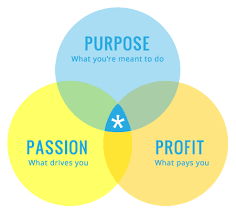
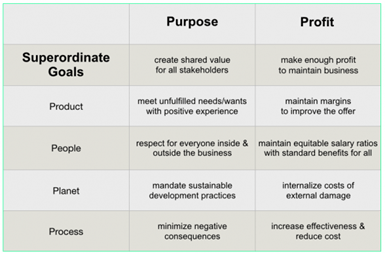
Purpose and Profit Framework Today, it is finally safe to say that collective business wisdom accords purpose and profit virtually the same weight of importance in planning and leading a sustainable new enterprise. It is particularly true for startups, but it is also progressively true for established major corporations.

Every new venture is particular to itself and there is no one size-fits-all way to define its own purpose and profit goals. Neither is there only one singular way to conduct a process to consider what they both will be.

At worst, the founder will be the sole arbiter who makes the determination. Even solopreneurs would be well advised to seek the inputs of people around him or her—people whose opinions, experience, and skills are valued.

The Purpose and Profit Framework set out below is generic, but it attempts to define a way to go about considering both the two vital subjects together.

Profit with purpose is set to become the new norm.

Up to this point, social enterprise and impact investment have been driving this concept, which has somehow remained confined to a niche. Not anymore. Now, it is all set to change: the CEOs of the future will want their companies to be recognized as forces for good.

The most successful companies do not target profit directly but are driven by purpose – the desire to serve a societal need and contribute to human betterment.

Purpose, according to Ratan Tata, the recently retired CEO of the Tata Group, is “a spiritual and moral call to action; it is what a person or company stands for.” When such a purpose exists, it provides employees with a clear sense of direction, helps them prioritize and inspires them to go the extra mile — which, the argument goes, should ultimately be good for profit. Purpose, by its nature, transcends making money:

Purpose, according to Ratan Tata, the recently retired CEO of the Tata Group, is “a spiritual and moral call to action; it is what a person or company stands for.”1 When such a purpose exists, it provides employees with a clear sense of direction, helps them prioritize and inspires them to go the extra mile — which, the argument goes, should ultimately be good for profit. Purpose, by its nature, transcends making money:

Companies with a purpose beyond profit tend to make more money.

It is a paradox that the most profitable companies are not the most profit focused.

With your passion and purpose in alignment, you are well suited to aim within that space for a creative business project you can earn a profit on. This is business after all. Really, profit is the result of a healthy business. Profit is what funds your venture and allows you to grow further.

Is the choice between purpose and profit a false one?

Fortunately, studies indicate that the choice between purpose and profits is a false one. Joint research by Harvard Business Review Analytics and EY’s Beacon Institute shows that companies focusing on purpose to drive performance see higher profitability.

JOIN US

Join us for this training on Purpose and Profit. We will share his secrets to wealth and fulfillment for about an hour each day.  And it will not cost you a dime.

What would be the simplest thing you could do, that would bring a desired change in your life? Bob Proctor Paradigm Shift, Bob Proctor Meditation (1) Bob Proctor Paradigm Shift, Bob Proctor Meditation – YouTube

To Change or Shift your Paradigms listen to Napoleon Hill’s Audiobook Outwitting the Devil (1) Napoleon Hill’s Audiobook Outwitting the Devil – YouTube

Need Help: Contact Michael Kissinger –Phone 415-678-9965 Email: mjkkissinger@yahoo.com

MKS-14: The Business of the 21st Century 50-30-20 Rule to Financial Freedom

15 Best Finance Definition ideas | how to plan, finance, money saving tips

The 50-30-20 Rule. While we all define success differently, money is typically one of the factors in the equation.

Some people hope to become incredibly wealthy. Most want to achieve a degree of financial freedom, and the peace of mind that comes with it.

And then there is people don’t want to be rich. They want to be able to choose. The [more money you have], the more choices you have. That is the freedom of money.”

The 50/30/20 rule of thumb is a guideline for allocating your budget accordingly: 50% to “needs,” 30% to “wants,” and 20% to your financial goals. It was popularized by Elizabeth Warren and her daughter, Amelia Warren Tyagi. Your percentages may need to be adjusted based on your personal circumstances.

The 50-20-30 (or 50-30-20) budget rule is an intuitive and simple plan to help people reach their financial goals. The rule states that you should spend up to 50% of your after-tax income on needs and obligations that you must-have or must-do.

Sounds great.

But when you are barely making ends meet, achieving even a semblance of that kind of freedom also sounds impossible.

Where do you even start? A simple approach is to adopt the 50-30-20 rule of thumb for budgeting.

Let us break it down

If you implement the 50/30/20 rule properly it will help you spend less, save more, and reach your financial goals faster. Step 1: Figure out Your Take-Home Pay. The first step to using the 50/30/20 rule is to figure out your take-home pay, or after-tax income.

The 50-30-20 Rule: The Basics

Start by putting your monthly income (and spending) into three basic categories.

Needs: 50 Percent

Think of needs as relatively fixed costs. Housing. Utilities. Food. Clothing. Insurance. Debt payments (payments on things you already have, not on things you may finance in the future).

Needs are truly needs. Netflix is not a need. Starbucks is not a need. Food is a need but eating out is not a need. Current debt payments are, for now, a need since you need to make them.

Hold that thought because we will come back to it.

Wants: 30 Percent

Think of wants as desires. Entertainment. Hobbies. Vacations.

Anything you do not have to have to survive — even if some seem so important you cannot imagine doing without.

Keep in mind the easiest way to blow your budget is to mistake desires for needs. We all need to decompress, but how we decompress, and how much money we spend to relax and recharge, is a choice.

The same is true for “upgrades.” If I commute to work, I need a car. But I do not need, say, a Porsche. So, the upgrade portion of car expenses — and any other expenses — should go into the “want” category. Like eating out. We all need to eat. But we do not need to eat out; the difference in cost falls into the “want” category.

Or take fitness; I see staying fit as a need, but a $1,500 to $2,000 bike meets all my cycling fitness needs. I may want an $8,000 bike, but I do not need one. So, if I decide to buy a high-end bike, the extra $6,000 should go into the “want” category.

Granted, we all define “basic” needs differently. Plus, we all tend to ratchet up our expectations of “basic” as we earn more money. Or to think we “deserve” certain things.

But that is a slippery financial slope; if you consistently increase your spending to match your paycheck, you will never get ahead.

And find yourself wondering why.

Again: Be ruthless when you categorize “wants” and “needs.”

Financial Goals: 20 Percent

Emergency savings. Investments. Retirement funds. College funds. Paying off debt. (Not making minimum payments, but making additional principal payments, like adding an additional $50 to your credit card payment.)

If you are barely scraping by, this category probably has very few entries.

Putting the 50-30-20 Rule into Action

Once you have placed all your spending into categories, do the math: Divide the total of each category by your total monthly income.

Let us work through an example. The Census Bureau says the U.S. median income is just over $31,000. After taxes, that is a net of around $2,000 a month.

Using the 50-30-20 rule, $1,000 should go to needs, $600 to wants, and $400 to savings and paying down debt.

Granted, that is a tough ask. Taking care of housing, food, transportation, and other basic needs on $1,000 a month is daunting, if not impossible. So, your ratios may be different. Your “needs” money may take up the bulk of your income, and your savings percentage may be nonexistent.

So where should you start?

Take a hard look at your needs. Any item you can eliminate or reduce helps rebalance your ratios. Pay special attention to recurring expenses. Every year we shop for better insurance rates; every year we do a little better. (It is amazing how discounts suddenly appear when your business may be lost.)

Same is true for things like cable; call and say, “I think I need to cancel my cable subscription. It’s too expensive,” and the rep will magically find ways to cut your costs.

Take a close look at every need and see if there is a way to reduce, or work to someday eliminate, the cost.

Take a harder look at your wants. Right now, what you really need — and should really want — is to gain a sense of financial freedom. Short term, that will likely mean a little sacrifice.

But once you get through the period, barring unforeseen circumstances, you will never have to take such harsh measures again. Trust me: The tradeoff is worth it.

Be smart about savings. Financial experts love to say, “pay yourself first.” And you should. But sometimes paying yourself means paying off high-interest debt.

As Warren Buffett says, “If I owed any money at 18 percent, the first thing I’d do with any money I had would be to pay it off. It’s going to be way better than any investment idea I’ve got.”

So, if you have high-interest-rate debt, see paying it off as a form of investment — because it is. Putting an extra $100 toward a high-interest debt is like making 15 percent on that $100. And there is a bonus: Once that debt is paid off, the principal portion of the payment comes out of your “needs” category, making your ratios shift even more in your favor. 

What Is the 50/20/30 Budget Rule?

The Bottom Line

Keep in mind the 50-30-20 rule is just a guide. If your income is relatively low and you have a big family, saving 20 percent may be a struggle.

If you are doing relatively well and want to put 20 percent down on your first home, “only” saving 20 percent may mean it takes a while to get there. (The median house price in Austin, Texas, is more than $400,000, which means you will need to save $80,000 just to cover the 20 percent down payment.)

That is why the real value of the 50-30-20 rule may be that it forces you to take a close look at what you spend — and at your short- and long-term goals. 

If you can generate more income, great: The more you make, the more money available to fund each category. Still, making more money is only partly in your control. You can get a part-time job. Or start a side hustle. Or work incredibly hard to increase your business’s revenue, or your income.

But there are only so many hours in the day. And building an extremely successful business takes time.

So, for now, the only way to have more money is to spend less money. Knowing when a need is actually a want. Knowing when an upgrade is a want, and not a need. Knowing that money you spend today is money you get back — and that putting money aside now is the only way to build wealth.

Knowing where, and how, you spend money — and making smart decisions about where and how to spend it in the future.

That is the only way to achieve at least some degree of financial freedom, and to enjoy the increased number of choices that come with it.

If you are seeking proven ways to financial freedom that you can do in as little as an hour a day contact us.

Michael Kissinger

Sydney Reitenbach

Phone: 415-678-9965

Email: mjkkissinger@yahoo.com