

This is my 9th week in the Master Key Experience. We have been working on Meeting Our Future Self. We have been working on changing our present selves and installing a new “Blueprint” into our subconscious so we become better people.
In essence we have been working on creating new lives and meeting our future selves.
The Master Key Experience advises and teaches us that the way to “Meet Your Future Self” is to do certain activities on a daily basis.
This may seem to be a lot of work. The question is, “What would you do to meet “Meet Your Future Self”? What will your future self be in the next three-five or ten years? What would it be work to you, your family, your career, your business, your financial future, your health, etc. to meet your future self now?
According to Benjamin Hardy, if you look at your present and future selves as two different people, then your likelihood of making better decisions here and now will improve.
Why is this?
According to research done by Dr. Daniel Gilbert of Harvard, people are really bad at predicting who they will be in the future. The reason is simple: it’s far easier to remember the past than to imagine the future.
Because we don’t take the time to imagine the future, we assume that things will pretty much be the same in ten years as they are now. We even erroneously believe we will be the same person in ten years as we are right now.
Gilbert and others call this The End of History Illusion, and what it means is this:
- We recognize that we’ve gone through some big changes in our past
- We see our current selves as the finished and evolved version of ourselves
- We assume that in the future, we will mostly be who we are now
If you look back on who you were ten years ago, you will likely see some differences. You were probably in a different situation. You probably had different goals. You likely had different friends and hobbies. Of course, some of what you were doing is probably still the same as ten years ago.
As people get older, they tend to change less over ten year periods of time.
From age 15 to 25, you’re going to see some big change.
From 25 to 35, you’re likely to see some big changes as well.
But from 35 to 45, the rapidity of change tends to slow down for most people.
Why?
According to research on the Big 5 Factors of personality, as people age, they tend to become less and less open to new experiences. They stop seeking novelty and change. They stop imagining a bigger future. Their past becomes increasingly prevalent in predicting who they are and will be. Their life becomes increasingly routine.
Although routines are good for momentum, over time they are very bad for the brain. The brain thrives on novelty, newness, and challenge. As someone seeking rapid growth and progress in your life, you have to balance these two conflicts. You need routines to move forward, but your routines need to continually involve pushing beyond them.
According to the Master Key Experience your routine needs to be continually challenging yourself beyond what you’ve ever done before.
The only way to create confidence is by pursuing what you’ve never done before.
According to the Master Key Experience says, “Personal confidence comes from making progress toward goals that are far bigger than your present capabilities.”
So, with that backdrop, it’s time to start imagining a bigger and better future. It’s time to stop attaching yourself so much to the person you think you are. It’s time to let go of the notion that your future self is going to be the same as your present self.
It’s just not true.
Your future self will be a different person regardless of effort and intention. Change is inevitable. Growth is optional.
Albert Einstein said that “Imagination is more important than knowledge.”
How much imagination are you willing to use to meet your future self?
There are five powerful strategies for imagining and creating your desired future:
- Imagine Who You Want To Be In Three-Five-Ten Years
- Feel, Deeply, What It Would Feel Like To Truly Be That Person
- Shift As Much In Your Current Life To Reflect Your Future Self
- Expect Everything, Attach To Nothing
- Measure The Gain, Not The Gap
1. Imagine Who You Want to Be in Three-Five-Ten Years

“Your vision of where or who you want to be is the greatest asset you have. Without having a goal it’s difficult to score.” – Paul Arden
There is a growing body of research in psychology examining the difference between our current and our future selves.
What the research shows is that:
- Your current and future selves are indeed two different people
- Viewing your future self as a fundamentally different person allows you to think about what they would want
This is where vision comes in.
- What is your vision for your future?
- How detailed is your vision?
Without having a vision, you will have little meaning in your life.
According to the late psychiatrist, Gordon Livingston M.D., humans need three things to be happy:
- Something to do
- Someone to love
- Something to look forward to
If you don’t have something to look forward to, for which are you exerting conscious and daily effort to create, then you cannot have happiness. Without vision, the people perish, the Bible states.
When you create a new vision for your life, you immediately begin to see your whole life in light of that new vision. It becomes the context of your life. Changing the context changes the meaning and possibility.
So, let’s get clear on your vision.
According to the business author and expert Cameron Herold, you should have both a personal and professional Vision.
In this vivid vision, you should not focus on how you’re going to achieve the vision. You simply want to get very, very clear on what you want three to five to ten years from now.
So, pull out your calendar and put a big X three-five-ten years in the future.
- What does your life look like?
- What do you look like?
- What does your environment look like?
- Who are the main people in your life, and on your team?
- What types of clients or people are you working with?
- What is the overall experience you’re having?
- What does your typical day look like?
- How much money are you making?
- What is important to you?
- Where is your focus?
The Master Key Experience has us draft our Person Personal Needs and Definite Major Purpose when answering these questions.
Remember, your job right now is not to determine how any of this stuff is going to happen. Your first job is simply to get clear on your vision. The more clear your vision is, the more obvious and easy will be the execution.
- According to the Master Key Experience, you should ideally have a vision written down which you begin sharing with EVERYONE! That is why we drafter our Definite Major Purpose, PPNs, Press Releases and Movie Posters, etc.
Why share with everyone?
A few reasons:
- When you share it with others, they will begin holding you accountable to it
- Hearing yourself say it will cause you to believe it more . Your thoughts should become words, words should become actions, actions habits, and habits your personality and destiny. That is why there is so much writing and reading in the Master Key Experience.
There are mixed science and opinions as to sharing your goals publicly. The question is: if you’re 100% committed to your goals, then why wouldn’t you?
People talk about how publicly sharing goals decreases motivation because you feel like you’ve already achieved something by simply saying it. This argument is a strawman for one important reason: if you’re trying to figure out how motivated you are toward a goal, you probably aren’t committed to it.
Once you get committed to something:
- Then you stop worrying about what people think about you
- You begin orienting your entire life and environment to create that thing
- You stop over-attaching to failures along the way - In other words, you embrace imperfectionism.
So, create your PPNs and Definite Major Purpose.
- Where will you be in three-five-ten years from now?
Then, begin sharing it with EVERYONE. Watch what happens. You’ll begin to repel the wrong people from your life and attract the right people.
Are you really ready to do that?
If you’re committed, then the answer must be yes. If you’re not, then stop reading this article.
2. Feel, Deeply, What It Would Feel Like To Truly Be That Person
“According to research on mental rehearsal, once we immerse ourselves in that scene, changes begin to take place in our brain. Therefore, each time we do this, we’re laying down new neurological tracks (in the present moment) that literally change our brain to look like the brain of our future. In other words, the brain starts to look like the future we want to create has already happened.” – Dr. Joe Dispenza
Once you’ve committed to something, your job is to shift your brain, mindset, and identity to match that future reality.
According to the Master Key Experience you do this through
- Visualization/journaling
- Environment design, and
- Courageous action
During your morning meditation/visualization, you want to see your future goals. You want to see yourself where you ideally want to be. This is an important distinction. All goals are not really desired outcomes but desired versions of yourself.
- That’s all a goal is: a new you.
Your body is a chemical machine that becomes addicted to and accustomed to various emotional states. Your body then subconsciously acts in ways to reproduce the emotions it has become habituated to.
So, before you know it, you grab your cellphone and are back scrolling the newsfeeds. You didn’t consciously choose to do this. Your body impulsively did it because when you engage in that particular behavior, your body gets the chemicals it has become addicted to.
According to the Master Key Experience if you want a new future and new you, then you need new internally created mental chemicals.
This occurs through:
- Emotion-based visualization
- Fresh environments/experiences, and
- Bold new behaviors
Each of these produces emotions. The new emotions can reset your subconscious normal. You want and need a new normal because your sense of normal is your identity and reality.
Every day, you need to produce the desired emotions of your future self. This is what all the reading exercised and visualization is all about.
- How often do you visualize?
It turns out only 3% of Americans have written goals. Only 1% write their goals down daily. Our guess is far far less than 1% have a vivid vision which they share with everyone. Far less than 1% trigger the emotional state of their future self. Far less than 1% courageously pursue their future dreams, right here and now.
Will you?
3. Shift As Much in Your Current Life to Reflect Your Future Self

“Design crushes will power.”– Dr. Bj Fogg
According to the Master Key Experience visualization isn’t enough. You need to begin seeing evidence throughout your life that you’re serious about this. One of the most powerful ways to create evidence of your future dreams is to begin investing money in those dreams.
It’s really interesting what has happened, psychologically, to me in the past two months since I made a spontaneous investment in the MKE program.
I’ve begun seeing myself complete building my networking business much more lately. In other words, the investment triggered a great deal of imagination.
I’ve been thinking about it and visualizing myself building my networking business much more. I’ve also begun listening to MKE and Simple 6 audios about business development. I’ve been doing way more business training and changing my health and diet.
It’s totally shifted everything related to my business and fitness. The effects have also spilled over into my other goals.
My whole life is becoming more active and excited. My body is changing, as are my behaviors and routines. This is positively impacting my relationship with my business partners, associates, finances, wife, children and my work as a business owner, coach, writer and entrepreneur.
When you begin making powerful decisions in your life, you are then enabled to prioritize your life oor business. You can determine who you want in and out. You can determine what success looks like, for you. You can stop playing other people’s games and reset your brain to expect very different and unexpected results.
How much do your current life, environment, and behavior match your desired future?
4. Expect Everything, Attach to Nothing
“Expect everything and attach to nothing.”– Carrie Campbell
One of the most common platitudes is to lower your expectations so you don’t get hurt.
Why are we so afraid of getting hurt?
According to the Expectancy Theory of Motivation, your expectations play a huge role not only in your motivation but in your results in life.
According to the theory, there are three prerequisites to being motivated:
- You have to actually want the outcome in question
- You have to have some knowledge or competency as to how to get it
- You have to believe you can do whatever is involved in achieving that goal
Now, the more evolved you become, the less you are the one to do everything involved. You increase your confidence by teaming-up with other capable people. You increase confidence by making progress.
Often, people fail to make progress and instead procrastinate because they don’t know what to do. They have a goal but have little skill or knowledge. So, the goal becomes a dream unfulfilled.
When you begin taking action toward the dream, investing in that dream, and building a team around you - then you’ll start making progress. This progress will increase anticipation and expectation that you’ll succeed.
It’s your choice, really, if you succeed or fail. It’s up to you how bold and committed you will be. It’s up to you how motivated you will be.
Of course, you’re going to face painful moments. If the future you’re pursuing is boldly bigger and different from your present, then you’re going to fall flat on your face a lot.
It’s going to hurt. You should get used to that.
It’s going to be complex and confusing. You should and can get used to that. It just takes repeated exposure, increased knowledge, commitment, and support.
Lots of self-help promoters these days argue you shouldn’t have goals because they make you feel horrible. You feel bad if you fail and you’re disappointed when you succeed.
According to the Master Key Experience that is total nonsense.
Without purpose, you perish. The problem isn’t goals or expectations. The problem is an emotional attachment to the outcomes you’ll experience along the way.
Get used to pain and failure and nothing can stop you from meeting your future self except you.
5. Measure the Gain, Not the Gap

According to the Master Key Experience “The way to measure your progress is backward against where you started, not against your ideal.”
Every 30 or 90 days, answer these questions:
- What were the five biggest wins?
- What about your current situation gives you the most confidence and excitement?
- What are the five jumps or wins in the next 30 to 90 days that will create the biggest impact?
That first question may be the most important. It helps you frame your past in a positive way. It helps you selectively attend to the progress you’re making. Most people, regardless of their success, focus on the gap. They only see lack. They only see what they’re not doing well.
Of course, having high expectations can be good for performance. But a relentless insistence that nothing is good enough is also bad for joy and even confidence.
You can keep moving forward in your life while at the same time enjoying the process. In fact, research shows that happiness bolsters motivation and success.
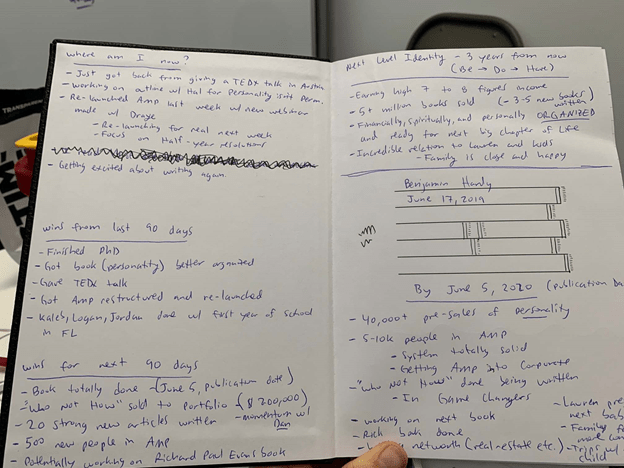
This is a picture of the inside cover of my journal.
The Master Key Experience recommends every 30 days, I complete a new journal. Every time I open my journal to write, I start by looking at this first page.
On this first page are the following questions:
- Where am I now?
- What were the wins from the past 90 days?
- What are the wins from the next 90 days I want?
- Where do I want to be in three years? (vivid vision)
- Where do I want to be in one year?
These questions trigger and frame my journal writing. They help me remember what I’m trying to accomplish in my Definite Major Purpose and PPNs. They keep me living in the gain all the time.
Life becomes a lot of fun. Success becomes much easier. You become much happier.
I ask myself:
- Are you in the gap or the gain?
- Are you emotionally attached to outcomes along the way?
- Are you incessantly negative, despite your success?
- Is happiness always somewhere in the future, and never here and now?
Conclusion

Look at the woman in this picture. Is it a picture of “An Old Woman or a Young Woman?” This is what the Master Key Experience is teaching so you understand how to meet and become “Your Future Self.”
According to the Master Key Experience success is a joyful process when you are on your journey of discovering Your Future Self.
Change is a joyful process. Without purpose, you will perish. The Master Key Experience and five steps can help you achieve your dreams and find joy along the way.

Ready to get started? Contact us now!
Michael Kissinger
Phone 415-678-9965
Email: mjkkissinger@yahoo.com










 REACH YOUR PEAK PERFORMANCE TODAY with the World's #1 Consulting Firm. The Reitenbach-Kissinger Institute and the MKS Master Key Consulting-Law-Engineering Systems. You are committed to achieving your goals. Do not compete without proven consultants. FREE 30-Minute Win the Game of Life or Business Consulting Session Call: 650-515-7545