
Transformational, Strategic, Empowering

How To Set (And Hit) Your Million-Dollar Revenue and Profit Goals
Reaching $1 million in annual revenue and profit within 3–5 years is achievable for most business models when you follow proven strategies: identify a problem people already pay to solve, build a scalable offer, and execute with consistency over speed as you grow.
A significant number of construction companies struggle to reach $1 million in revenue within their first few years.
- Revenue Milestone: Approximately 10% of male-owned firms and about 5.5% of female-owned firms achieve $1 million in revenue. This indicates that a large majority do not reach this milestone.
- Business Longevity: Many small businesses, including construction firms, face high failure rates, with a majority likely to fail within the first three years. Those that survive past this point may still struggle to achieve profitability.
- Industry Trends: The construction industry has shown growth, but many companies still operate below the $1 million revenue mark, particularly in challenging economic conditions
JPMorgan Chase Institute research confirms that reaching $1 million is a real and repeatable milestone, with a notable portion of small businesses hitting it within their first five years.
The path differs depending on your business model—service businesses might need fewer high-value clients, while product businesses require volume—but the foundation remains the same.
Success Factors
Proven business ideas help you reach $1+ million by paying attention to where demand is coming from and by making practical choices about tools and systems. The successful contractors who succeed follow these principles. They:
- Problem-solving focus — Find a problem people are already paying to solve; execution matters more than genius insight
- Build systematically — Most businesses reaching $1 million have a product or service people want, a way to sell it, and a system that gets more efficient over time
- Stamina over speed — Turning a good idea into a million-dollar business requires the stamina to persist, not just a brilliant concept
Revenue Models
Different business types reach $1 million through distinct paths depending on your model
Breaking down $1 million: roughly $83,333 per month, $19,231 per week, or $2,740 per day—but remember revenue is not profit
- Service-based — Fewer high-ticket clients: 10 clients at $100K each or law firms generating 42 cases per month at $10K per case
- Product-based — Thousands of lower-ticket sales through e-commerce, digital products, or physical goods; 46% of established merchants began as side projects that grew over time
Three Action Steps to Hit Your Target
Build a strategic revenue and profit plan grounded in real numbers, not estimates. Start with your baseline from the last 12 months, calculate the gap to $1 million, then break it into achievable steps.
- Audit your offers — High-value offers that solve meaningful problems command profitable pricing and allow you to serve more clients without proportional cost increases
- Track milestones — Aim for $100K, then $250K, then $500K to focus, keep momentum, and adjust strategy as you scale
- Invest in systems — As revenue increases, consistency starts to matter more; decisions around pricing, fulfillment, customer experience, and technology have bigger impact
The Business Revenue and Profit Challenge
Breaking down $1 million: roughly $83,333 per month, $19,231 per week, or $2,740 per day—but remember revenue is not profit. In construction would require fewer high-ticket clients: 10 clients at $100K each.
Approximately 63% of construction companies with employees generate less than one million dollars in annual revenue. WHY?
Among firms with paid employees, three out of four remodeling establishments, nearly two-thirds of land developers, and 59% of specialty trade subcontractors fall far below the million-dollar threshold, while about 45% of home builders report annual sales under one million
While these are challenging times, they are also times of opportunity. In fact, the best companies have always excelled in the most difficult eras.
More than half of the Fortune 500 were birthed in an “economic winter”—a recession or a depression. Companies like Disney, Apple, Exxon, Microsoft and FedEx were launched when the rest of the business world was licking its wounds.
If you can learn, as they did, not only to become more efficient, but to also optimize your construction business in this environment, you’ll be able to dominate in any economy.
Whether you’re an army of one or a billion dollar corporation, there are principles and strategies that you must understand and master to take your construction business to the next level.
Construction Business Mastery is about creating systems that improves your business by empowering you with the skills, strategies and tactics you need to gain an invincible advantage—in any environment and become a million dollar plus construction business.
Ways to Grow and Thrive in Any Economy
- An Effective Business Map: The only true competitive advantage in today’s changing market is not just having a business plan, but also a business map that can take you from where you are to where you want to be in the shortest amount of time.
- Constant & Strategic Innovation: As a leader in your industry, you have to strategically innovate. You must be constantly looking for ways to create something more, new or better than what currently exists. Consumers are no longer impressed with any one new feature or service for very long—they expect a constant evolution of improvement or they will go elsewhere.
- World-Class Marketing: Have you ever seen a business that has inferior quality products or services, and yet they dominated the market? It’s because the business knows who its customers are, what they want and need, and how to tell the business story in a way that compels prospective customers to buy.
- Sales Mastery Systems: Marketing makes people want to do business with you, but sales is what you get paid for. You must create multiple channels to capture, convert and close sales.
- Financial & Legal Analysis: Do you know where your company is spending its money? It’s easy to lose sight of the key measurements that can predict your progress or demise. Being able to measure where your business is, where it’s going, and being able to see the blind spots that could get you into trouble are factors that are paramount for any business.
- Optimization: Sometimes, the biggest growth opportunities don’t come from new initiatives, but rather from taking the core processes the business is already doing and executing them more effectively. A small incremental improvement made in a few key areas can result in geometric growth to the business as a whole.
- Raving Fan Customers: You must understand, anticipate and consistently fulfill the deepest needs of your clients. The more value you are able to add to your customer, the more you’ll dominate the marketplace.

Take Action with These Simple Steps
Let’s make this practical and powerful—here’s how you can start applying Construction Business Mastery right now, no matter where you are in your business journey.
1. Create Your Business Map: Don’t just write a business plan and file it away. Take 10 minutes today to map out where you are, where you want to go, and the biggest obstacles in your way. Get clear on your destination and the milestones along the path.
2. Commit to Constant & Strategic Innovation: Ask yourself: What’s one thing I can improve, add, or do differently for my customers this month? Set aside time each week to brainstorm new ideas, and encourage your team to do the same.
3. Upgrade Your Marketing: Identify your ideal customer and review your current marketing message. Does it speak directly to their needs and desires? If not, rewrite it. Test a new marketing channel or campaign this week—progress comes from action.
4. Build Sales Mastery Systems: Look at your sales process. Where are leads falling through the cracks? Create a simple follow-up system—whether it’s a calendar reminder, an email sequence, or a phone call schedule—to make sure every opportunity is maximized.
5. Strengthen Financial & Legal Analysis: Set aside time to review your numbers. What are your biggest expenses? Where is your profit coming from? If you don’t already, start tracking your cash flow weekly and consult a professional to check for legal blind spots.
6. Optimize What’s Already Working: Pick one core process in your business—like onboarding clients or delivering your product—and ask, “How can I make this 2% better?” Small tweaks, repeated over time, create massive results.
7. Create Raving Fan Customers: Reach out to your top customers and ask for honest feedback. What do they love? What could be better? Use their insights to deliver more value and turn satisfied clients into passionate advocates.
Remember, you don’t have to do it all at once. Start with one idea, take action, and build momentum. Progress is power—so choose your first step and move forward today.
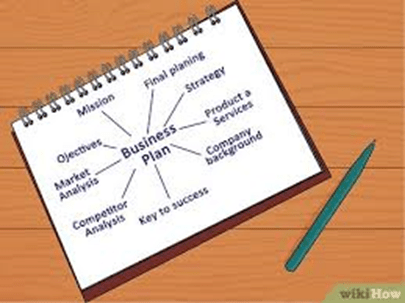
Construction Industry Revenue and Profit Models
HOW DO YOU STACK UP AS A MILLION DOLLAR COMPANY?
Construction Companies Under $1M Companies Over $1M
1. Remodelers 75% 25%
2. Land Subdivision 63% 37%
3. Specialty Subcontractors 59% 41%
4. For-Sale Builders 55% 45%
Construction Firms by Revenue and Profit Size
Remodelers — Three out of four firms (75%) generate under $1 million annually, making this sector the smallest by revenue
Land Developers — 63% of land subdivision companies operate below the $1 million threshold
Specialty Contractors — 59% of specialty trade subcontractors report annual receipts under $1 million
Home Builders — About 45% of for-sale builders stay below $1 million, the highest revenue threshold among these categories
Self-Employed vs. Employer Firms
Self-employed independent contractors dominate the construction industry Mostly Home Builders.
Nonemployer firms — Over 813,000 self-employed residential builders exist, with average annual receipts under $103,000; over 1.9 million specialty trade independent contractors average under $70,000 annually
Industry composition — Nearly 80% of home builders and specialty trade contractor firms are self-employed independent contractors, far exceeding firms with paid employees
Revenue contribution — Despite their numbers, these nonemployer firms account for only 12% of all sales in residential construction and just 9% of specialty trade revenue

Million Dollar+ Revenue and Profit Solution
Consider this Solution to Your Challenges, Make a Decision and Take Action:
QUESTION:
Would a consultant-coach-mentor with 40 years construction experience coaching, 17 years teaching of construction Law and Professional Liability of Architects and Engineers at San Francisco State University and Golden Gate University and 10 years hands on construction experience working through Union Local #22 from apprentice to foreman, assistant superintendent in commercial and residential be valuable to you?
ANSWER:
Michael Kissinger has substantial value across multiple construction industry dimensions that align closely with your demand.
With 40 years of construction coaching experience, 17 years of academic teaching of construction law and professional liability, litigated over $100,000,000 of construction claims and 10 years of hands-on Local #22 union work progressing from apprentice to foreman, brings you deep technical expertise combined with rare pedagogical and legal credentials that few consultants possess.
| Michael Kissinger’ Qualification Category | His Background | Industry Standard | Alignment: Exceeds most other Coaches |
|---|
Why Past Clients Valued Him
Construction firms face mounting professional liability exposures as project delivery models shift from traditional construction to design-build and construction management.
His background demonstrates hands-on construction, mastery of business and construction, law, and dispute resolution principles that contractors need today.
| Value Proposition | Why It Matters | Industry Demand |
|---|---|---|
| 40 years coaching expertise | Transforms operational processes and business development | Coaching services focus on leadership development, succession planning, and performance improvement across the trades |
| 17 years academic + legal credentials | Rare pedagogical authority; differentiates you from field-only consultants | Construction expert with advanced credentials and specialization command premium positioning; few combine teaching with litigation experience |
| $100M+ litigation background | Demonstrates capacity to analyze high-stakes disputes; proven track record | Construction dispute resolution expertise is in rising demand due to supply chain disruption, labor challenges, and cost overruns |
- Design liability guidance — With design-build models becoming standard, contractors need advisors who understand both the practical realities of execution and the legal obligations of design responsibility
- Insurance optimization — His professional liability expertise helps contractors understand when CPL coverage is needed and how to structure contracts to manage vicarious liability for subcontractors
- Training and compliance — 17 years teaching at two accredited universities positions him to develop internal training programs, ensuring teams understand construction errors and omissions.
His Market Recognition & Credentials
His formal credentials strengthen his market positioning in a field where qualifications and accreditation matter significantly to clients and insurers.
- University teaching appointment — Two universities (San Francisco State, Golden Gate) confer academic credibility that independent consultants must otherwise earn through certifications or published work
- Specialized subject matter — Construction law and professional liability are high-value specializations in a field where claims and disputes professionals command premium rates
- Union apprenticeship pathway — San Francisco Local #22 experience demonstrates mastery of field realities; progression to foreman and assistant superintendent shows you’ve managed the execution side of the liability triangle
His Positioning in Market
His value is strongest when positioned as a risk advisor and educator for mid-to-large contractors, design-build firms, and construction management companies.
- Target clients — Firms expanding into design-build or construction management roles who need internal expertise to manage professional liability before it becomes a claims issue
- Service model — Expert consulting on contract language, liability allocation, insurance structuring, and staff training rather than claims defense (which requires legal licensing)
- Differentiation — 40 years of coaching experience is rare; most construction consultants come from either pure field backgrounds or pure legal backgrounds, not both with teaching credentials
He is highly valuable—particularly in 2026, when design-build continues to disrupt traditional contractor roles and professional liability coverage is no longer optional for firms taking on advisory or design responsibilities.
Why Him
His experience directly addresses key construction businesses and contractors needs in the industry.
He has guided clients through project planning, risk identification, and regulatory compliance and other areas where his combined background excels.
- Legal & Liability Expertise — 17 years teaching construction law and professional liability at San Francisco State and Golden Gate University gives him specialized knowledge construction consultants must have regarding compliance, contracts, and regulatory frameworks
- Union Operations Knowledge — 10 years progressing from apprentice to assistant superintendent in San Francisco Union Local #22 provides hands-on understanding of labor, scheduling, and site management that classroom training cannot replicate
- Coaching & Teaching Track Record — 40 years of business and construction coaching and two decades of university instruction demonstrate ability to communicate complex technical information clearly to diverse audiences — a core consultant-coaching requirement
His Market Demand In the Industry
The field values his multifaceted expertise.
Construction consultants-coaches typically earn $75–$200/hour or 3–7% of total construction costs, and hiring criteria emphasize 10+ years of industry experience plus specialized knowledge. His profile exceeds this threshold significantly.
- Rare Combination — Most consultants specialize in either field operations OR legal/contract work; his integrated background spanning both is uncommon and highly marketable
- Growing Demand — Construction consulting-coaching is in demand due to project complexity; expertise in risk management and legal liability — his specialties — directly reduces client exposure
- Educational Credibility — University teaching positions strengthen his standing with institutional clients (universities, government agencies, large developers) seeking expert advisors with proven communication and credentialing
His profile is valuable precisely because it is multidisciplinary — merging field mastery, academic rigor, and legal/professional liability expertise in a market that increasingly needs consultants-coaches with his specialized knowledge
Recommended Payment Range
Construction businesses actively seek experts with this combination of credentials. The profile you describe—40 years of coaching, 17 years of academic construction law teaching, $100M+ in litigated claims, and 10 years of union hands-on experience—represents a rare blend of pedagogical and legal credentials that aligns directly with how construction firms address their most complex challenges.
| Expertise Area | Market Demand | Why Construction Firms Value It |
|---|---|---|
| Construction Claims & Disputes | High | Construction disputes rising due to supply chain, labor, COVID impacts; requires deep litigation experience |
| Legal & Professional Liability | High | Academic credentials + litigation track record establish credibility in high-stakes claims resolution |
| Union Labor Relations | Medium-High | 10 years progressing from apprentice to foreman demonstrates credibility with workforce; rare among consultants |
| Coaching & Leadership | High | Construction professionals need personalized guidance for decision-making, communication, and leadership development |
| Technical Construction Knowledge | High | 40 years ensures current knowledge of processes, materials, codes, and industry changes |
Value Propositions
Construction expert witnesses with deep industry credentials command premium rates because their credibility drives case outcomes.
- Claims & Litigation Support
- His $100M+ litigation portfolio directly matches dispute resolution support needs; construction firms face rising complexity in cost overruns, schedule delays, and contract disputes
- Expert Witness Credibility
- Extensive industry knowledge combined with academic credentials (17 years teaching) positions you as a defensible expert; courts and juries weight pedagogical authority heavily
- Union Expertise
- Rare among consultants; hands-on construction experience from apprentice to foreman gives you credibility with union labor that pure academics and attorneys lack
Market Segments Actively Hiring Him
His construction consulting capabilities span project oversight, dispute resolution, and risk management—all areas where your profile commands value.
- General Contractors & Owners — Seek advisors for project management, scheduling, cost analysis and claims prevention; his legal background differentiates him from “operations-only consultants”
- Construction Coaching & Leadership — Individual coaching services for construction leaders focus on decision-making and communication; his 40-year industry tenure + pedagogical training positions him uniquely
Competitive Positioning
Construction experts typically emphasize either technical depth (engineering/trades) or business coaching—rarely does an expert have both with legal credentials.
- Differentiation — Most construction consultants bring project controls or scheduling expertise; few combine coaching, law, litigation, and union credibility in one profile
- Pricing Power — Experts with 40+ years who leverage deep industry experience command premium rates; his academic credentials justify higher expert fees
- Demand Drivers — Rising dispute frequency and labor retention challenges mean construction firms actively budget for specialized advisory services
Given San Francisco’s cost of living being 64% higher than the national average and his specialized credentials, a realistic salary band would be:
- Conservative floor — $240,000–$355,000: aligns with his Senior Consultant baseline and reflects your advanced expertise
- Market-competitive mid-point — $260,000–$375,000: matches general consultant rates plus the 15–20% uplift for his teaching credentials and union background
- Premium tier — $375,000–$485,000+: is justified for his advising on risk management, liability mitigation, or training delivery for your business
His combination of theoretical mastery (law, professional liability) and practical union experience is rare and defensible at the higher end of the payment range.
Payment Recommendations
For a full-time salaried position, target $350,000–$500,000 base, with potential for performance bonuses and professional development allowances (your credentials justify advanced insurance/risk certifications).
For independent consulting or project-based coaching, $400–$600/hour reflects your law teaching background, hands-on union experience, and specialized professional liability expertise — rates competitive with construction management consultants and risk engineers in the Bay Area.
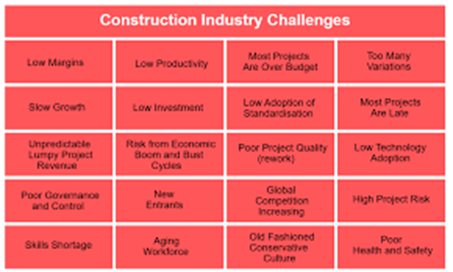
Construction Challenges He Solves That Prevent You From Being a Million Dollar+ Business
.
In 2026, a million-dollar construction company faces a precarious landscape where thin margins, labor scarcity, and rapid technological shifts leave little room for error. While revenue may look strong, operational “leaks” and failure to adapt to new regulatory or economic realities can quickly lead to insolvency because of:
Solving Operational & Financial Risks
Inaccurate Job Costing:
Failing to account for real-time inflation in metals (copper, aluminum) and labor can turn a profitable bid into a massive loss before breaking ground.
Fixating on Revenue Over Cash Flow:
Growth without disciplined cash flow management—especially regarding retainage and billing cycles—can leave a firm “profitable” on paper but unable to meet payroll.
Ignoring Scope Creep:
Working on unbilled changes without signed change orders remains a primary reason $1M+ firms lose up to 10% of their annual revenue.
Lack of Back-Office Infrastructure:
Neglecting administrative oversight leads to rework from mismanaged documents and schedule overruns that nobody catches in time.
Underinsurance from Valuation Gaps:
Rising material costs can make existing builder’s risk and property policies inadequate, leaving firms with high out-of-pocket costs after a claim.
Weak Subcontractor Negotiation:
Failing to properly transfer risk or negotiate firm terms with subs leads to “margin leaks” that compound over multiple projects.
Solving Workforce-Regulatory Challenges
Aging Workforce Retirement:
With 41% of construction workers expected to retire by 2031, failing to have a succession or recruitment plan for younger talent is a long-term death sentence.
Neglecting Safety Training:
Onboarding new, less experienced workers without adequate safety programs leads to higher injury rates and skyrocketing workers’ compensation claims.
Immigration Enforcement Impact:
Firms that rely on a workforce affected by stricter immigration policies face sudden work stoppages and acute labor shortages.
Failure to Use Apprenticeship Programs:
In certain states, failing to meet mandatory apprenticeship utilization requirements can disqualify firms from lucrative public works projects.
Solving Strategic & Missteps
Resistance to Digital Transformation:
Relying on paper timesheets and manual processes in 2026 makes a firm significantly less productive than competitors using integrated ERP systems.
Ignoring the Data Center Boom:
Firms that fail to pivot or adapt their skill sets toward high-demand sectors like data centers and energy infrastructure may find themselves in shrinking traditional commercial markets.
Fragmented Tech Stacks:
Using disconnected software for accounting, field ops, and payroll creates data silos and “blind spots” that prevent informed decision-making.
Slow Estimation Processes:
Competitors using AI-driven tools can bid faster and more accurately; firms using “handshake deals” and slow manual estimates will lose the best jobs.
Failure to Diversify Portfolios:
Concentrating solely on residential or private office sectors—which are seeing softening demand—increases the risk of a total work drought.
Overextension through Rapid Growth:
Adding volume without scalable systems strains existing teams and often results in a catastrophic drop in project quality and safety.
Ignoring Sustainability Standards:
As green building practices and climate-related disclosures (like those becoming mandatory in mid-2026) move from “nice-to-have” to “requirement,” firms that don’t adapt will be excluded from major contracts.

Solving Underperformance Challenges
- 72% of firms say projects have taken longer than anticipated. Construction profit growth is expected to cool down from 14.2% in FY23 to 4.4% on average over the next five years.
- Over 50% of engineering and construction professionals report one or more underperforming projects in the previous year.
- 69% of owners say poor contractor performance is the single biggest reason for project underperformance.
- Only half of owners say that their projects are completed on time.
- 87% of owners report that their projects are coming under greater scrutiny.
- Large projects typically take 20% longer to finish than scheduled and are up to 80% over budget.
- 98% of megaprojects become delayed or over budget.
- 77% of megaprojects around the globe are 40% or more behind schedule.

Solving Risk Which Remains a Major Concern
- 53% of contractors in the U.S. feel that time constraints/ urgency of decisions presented the greatest risk to decision making.
- 30.3% spike in overall construction project abandonments was reported in May 2025.
- 83% of construction firms report their biggest priority to address market volatility and poor performance is to improve estimating accuracy of materials and equipment.
- Average of 35% of all construction projects will have a major change.
- Up to 30% of initial data created during design and construction phases is lost by construction project closeout.
- 82% of owners feel they need more collaboration with their contractors.
- 78% of engineering and construction companies believe that project risks are increasing.
- 43% of construction firms prioritize immediate financial goals over organizational resilience.
- 14.4 months is what the global average of construction dispute length in 2024, 6% increase over previous year.
- U.S. $43 million was the global average of construction disputes in 2025.
- 41% of construction firms long lead times for electrical equipment such as transformers and switchgear as a source of project delays.
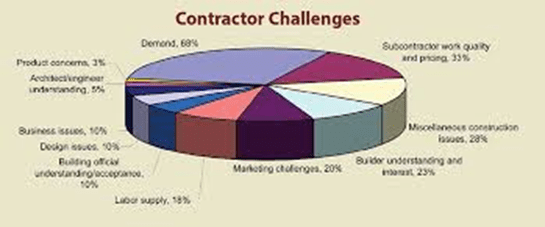
Solving Productivity Challenges
- 45% of construction professionals report spending more time than expected on non-optimal activities.
- Construction professionals spend an average of 13 hours per week looking for data.
- 65% of firms report projects they work on have been delayed because of supply chain challenges.
- 35% of construction professionals’ time is spent (over 14 hours per week) on non-productive activities including looking for project information, conflict resolution and dealing with mistakes and rework.
- 60% of general contractors see problems with coordination and communication between project team members and issues with the quality of contract documents as the key contributors to decreased labor productivity.
- 68% of trades point to poor schedule management as the key contributors to decreased labor productivity.
- 50% variation in productivity of two groups of workers doing identical jobs on the same site and at the same time. This gap in productivity was found to vary by 500% at different sites.
- 30.9% of construction industry professionals say that the top reason for miscommunication is unresponsiveness to questions/requests.
- 35% of construction firms report delays due to government such as lack of approvals or inspectors. 31% report delays due to an owner’s directive to halt or redesign a project.
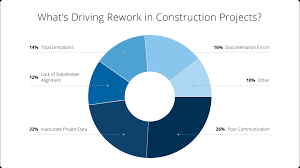
Solving Rework Challenges
- 14% of all rework in construction globally is caused by bad data.
- Up to 70% of total rework experienced in construction and engineering products are a result of design-induced rework.
- 52% of rework is caused by poor project data and miscommunication.
- Meaning, $31.3 billion in rework was caused by poor project data and miscommunication in the U.S. alone in 2018.
- Roughly 4-6% of total project cost is the median cost of rework—but only taking into consideration direct cost or reported rework.
- 9% of total project cost is closer to the actual total cost of rework—considering both direct and indirect factors combined.
- Between 2% and 20% of total costs is the estimated amount of rework, which has a negative impact on a project schedule.
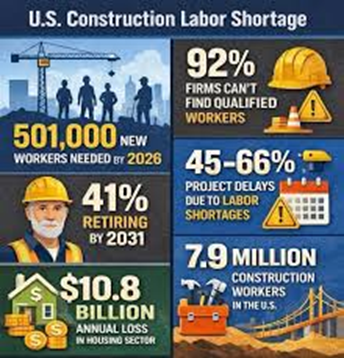
Solving Labor Shortage Challenges
- 94% percent of construction firms report having openings for craft workers.
- 85% of construction firms have openings for salaried workers.
- 94% of construction firms with craft worker openings and 92% of firms with salaried worker openings report those positions are hard to fill.
- 54% of contractors report experiencing project delays due to shortages of their own or subcontractors’ workers.
- 80% of construction firms report experiencing at least one project that has been canceled, scaled back, or postponed due to workforce shortages.
- 61% of construction firms raised base pay for hourly craft workers more than they did a year earlier.
- 62% of construction firms report that available candidates are not qualified to work in the industry for reasons such as a lack of skills.
- 74% of contractors say they are asking skilled workers to do more work.
- 60% of contractors are putting in higher bids for projects.
- 54% of firms indicated labor shortages caused them to lengthen completion time for projects already underway.
- 248,000 construction job opening.
- 21.4% industry wide turnover rate, making it one of the highest rates of all industries.
- 27% of construction firms report implementing a new learning program or technology to deliver and track training and skills development for its workforce.
- 47% of construction industry leaders say AI proficiency will be a top hiring priority in the next few years.
- 62% of US construction firms report that candidates lack the skills to qualify for a job.
How He Solved Construction Industry Challenges

Michael Kissinger Solution Details
He is a renowned peak performance consultant, coach, trainer, and mentor known for his transformative strategies. He has spent over 40 years working with top construction companies, helping them unlock their potential and achieve extraordinary results in various aspects of life and their construction business. He emphasizes the importance of mindset, emotional mastery, and key components of peak construction business performance.
He is a peak performance life and construction business strategist who offers personalized peak construction performance consulting, coaching, and mentoring designed to help clients achieve breakthroughs across finances, relationships, health, and business. With over 40 years of experience, he has worked with over five thousand small to medium construction companies and twenty thousand people across America.
His peak performance training, consulting, coaching, and mentoring combines psychological insight with strategic coaching to help clients close the gap between where they are and where they want to be.
He offers personalized construction coaching programs designed to deliver rapid, measurable results across all life areas.
Results Coaching
Break through limiting beliefs and get crystal clear on goals with accountability from trained strategists: Has a 70% increased work performance among clients.
Peak Performance Strategy Sessions
One-hour team sessions that teach the three keys for success, overcome obstacles, and master techniques to double sales without additional spending.
Personal Coaching
1-on-1 guidance helps you define your vision, set value-driven goals, and gain the outside perspective that reveals blind spots and roadblocks
Business Coaching
Over 5,000+ contractors, subcontractors, architects, and engineers have worked with him on breakthrough growth, emotional mastery, and sustaining performance under extreme pressure. His coaching methods go beyond strategies and include daily tools, immersive events, and ongoing community support for lasting change.
Results & Methodology
His Construction Coaching Success System integrates four fully interconnected components to create sustainable transformation.
It provides environment and strategies to examine beliefs, discover personal power, and shape your future. Stanford University research found a 300% increase in cognitive performance.
- Daily Tools
Multiple comprehensive programs called the Breakthrough Collection lock in change with daily practices, from Construction Money Mastery to The Business You Deserve
- Community
Thousands of construction industry businesses and owners across America and worldwide have access his tools and supportive networks; clients report 63% improved relationships and Sixty percent Increased Leadership Effectiveness
FREE 30-60 Minute Discovery-Coaching Session
Start with a 30-60 minute coaching call or Peak Performance Strategy Session at no cost to identify your biggest goals and current challenges.

Construction Industry Success Rates With His Help
| Factor | Finding | Source |
| Contractor Success Rate | Only 18% of small contractors break even after first three years | Construction millionaire potential |
| Wealth-Building Timeline | Annual net earnings of $500k–$2M can cross million-dollar threshold within 5–10 years | Five High-Profit Paths |
| Industry Size | 3.7 million total construction businesses in the U.S. (2023) | Construction businesses total |
| Construction Millionaires | Require reinvestment of at least 50% of earnings and disciplined cash flow management | Most construction millionaires |
The Primary Difference Between Million Dollar Company and a Non-Company
The primary difference between a general contractor (GC) who earns $1 million and one who goes out of business within 5 years is financial discipline and operational systems, rather than just building skills.
While 80% to 96% of construction firms fail within 10 years, those that reach the $1 million mark typically transition from being “technicians” to “business operators”.
- Financial Management vs. Cash Flow Crisis
- Successful GCs ($1M+): They master job costing—tracking every dollar spent on labor and materials per project to ensure they hit target net profit margins (typically 5–10%). They maintain 3–6 months of operating reserves to weather seasonal dips.
- Failing GCs: 67% of failures are caused by cash flow problems. They often use money from a new project’s deposit to pay for the materials of a previous, unfinished project, creating a “Ponzi-like” cycle that collapses when new leads slow down.
- Strategic Growth vs. Overextension
- Successful GCs ($1M+): They scale by systematizing their business, often focusing on high-margin niches (like custom home builds or specialized renovations) rather than bidding on everything.
- Failing GCs: Overextension is a factor in 40% of failures. Many contractors fail because they take on projects too large for their capital or try to manage too many small jobs at once, leading to mistakes, delays, and unmanageable debt.
- Pricing Accuracy vs. “Buying” Jobs
- Successful GCs ($1M+): They price projects based on a clear understanding of their overhead (insurance, rent, office staff) plus a healthy profit margin. They are willing to lose a bid if the price is too low to be profitable.
- Failing GCs: Many fail due to underpricing (31% of cases). They often “buy” work by bidding on the lowest price just to keep crews busy, not realizing that rising material costs and “job fade” (the difference between estimated and actual costs) are slowly bankrupting them.
- Operational Systems vs. Owner Dependence
- Successful GCs ($1M+): They invest in technology and software for automated invoicing, project management, and lead tracking. This allows the business to function without the owner being on-site for every hammer swing.
- Failing GCs: These owners often lack specialized business skills. They may be excellent craftsmen but fail because they lack systems for lead generation or reputation management, causing them to burn through cash once their initial word-of-mouth lead dries up.
- Risk Mitigation vs. Legal/Safety Exposure
- Successful GCs ($1M+): They act as risk managers, ensuring they have ironclad contracts, proper insurance for all subcontractors, and proactive safety protocols to avoid costly litigation or site accidents.
- Failing GCs: Rapidly hiring unskilled labor to meet demand often leads to safety issues and quality defects, which result in back-charges, legal claims, and a ruined reputation.

Pathways to Your Million Dollar+ Business
Contractors who achieve millionaire status typically follow high-profit paths, with specific success factors and capital requirements varying by business model.
- General contracting route — Requires $200k–$1M in initial capital for equipment and bonds, with scalability dependent on managing gross margins and project volume.
- Grow by leveraging online platforms and reinvesting earnings.
- Maintain Financial discipline and tight cost control in project execution to reaching wealth thresholds.
How Coaching-Consulting-Mentoring Works
Step 1: Personalized Call
In this 30-60-minute session, we will start to deep dive with you on what your biggest construction business goals are and current challenges you are having with achieving them.
Step 2: Match You
We’ll match you with a coaching strategist to help you uncover the root cause to what’s truly stopping you from getting what you want.
Step 3: Results Coaching
You’ll get started with our Results Coaching team and close the gap to where you want to be quickly and efficiently.

Results that Exceed Expectations
Informed by 40 years of extraordinary results, Reitenbach Kissinger Institute Results Coaching Programs are built to help you discover your personal power. By breaking down your limiting beliefs and pushing you forward on your personal and business goals. Our Results coaches provide the tools for you to create massive, lasting change in your life and construction business.
Construction companies report an average ROI of nearly six times their investment when using executive coaching, with coaches delivering measurable improvements in leadership effectiveness, operational decisions, and organizational engagement
Beyond coaching, we help firms streamline processes, optimize resources, and achieve higher efficiency through strategic guidance on technology adoption, contract management, and workforce training—all directly tied to improved profit margins and project outcomes
We can significantly enhance the performance of your construction company by providig tailored strategies that lead to measurable improvements in various aspects of your business.
Executive Coaching ROI & Impact
Our Executive Coaching delivers results at individual and organizational levels in engineering, architectural and construction firms.
- 6:1 return ratio — company executives reported an average ROI of nearly six times what they invested in the coaching process
- Leadership blind spots — Our coaching uncovers weaknesses and improves skills, enabling executives to achieve real business results
- Sounding board function — Our coaching provide a platform for effective leader transitions, critical during periods of growth or organizational change
- VUCA readiness — Our coaching prepares leaders to handle volatility, uncertainty, complexity, and ambiguity—endemic challenges in construction
Consultant-Coach-Led Improvements in Operations & Profitability
We’ll help you streamline processes, optimize resources, and save costs while maximizing ROI.
- Contract efficiency — Our Streamline Contract Processes using bid management software to reduce delays and disputes; simplified documentation improves stakeholder understanding
- Technology integration — Our Building Information Modeling (BIM), drones, and virtual reality boost your productivity and accuracy across project teams
- Workforce optimization — Our comprehensive training programs support smooth transitions to new technologies and processes, boosting overall operational efficiency
- Cost reduction — Our Digital project management tools and cloud-based platforms streamline procurement and identify competitive material and equipment deals
ROI MEASUREMENT & STRETEGIC PLANNING
Our Integrating technology for growth remains foundational to construction firms seeking competitive advantage through consultant-guided transformation.
Market analysis — We’ll help firms assess demographics, supply-demand dynamics, and government funding opportunities (e.g., IIJA infrastructure investment) to identify profitable project opportunities
Benchmark tracking — Our Integrate Competitive Benchmarking into ROI metrics to measure speed of vacancy reduction and tenant satisfaction improvements post-project
Holistic ROI definition — Our Beyond profit margins, construction firms measure uptime, safety performance, sustainability goals, and employee retention as core success metrics
Project selection criteria — Our Accurate cost estimation, site evaluation, and risk assessment—guided by experienced civil engineers and consultants—form the foundation of high-return project selection
Using establishing effective key performance indicators is central to measuring revenue improvements and operational success.
Key Benefits
- Improved Accountability: Your teams often experience enhanced accountability, leading to better project management and execution.
- Predictable Cash Flow: Our coaching can help establish more reliable financial practices, resulting in improved cash flow.
- Revenue Growth: Many companies report scaling to consistent 7-figure months after engaging with a coaches.
- Operational Efficiency: Our expert guidance helps your refine management skills and operational processes, making the business more efficient.
Strategic Planning and Technology
- Our coaches assist in leveraging technology and strategic planning, which are crucial for scaling and adapting to market changes.
- This approach not only addresses immediate challenges but also prepares your company for future growth
What clients
are saying:
Change Your Life or Business Destiny with These Confidential Testimonials …
Here are real-life confidential testimonials of successful entrepreneurs who we helped who have broken through barriers can provide inspiration and motivation. By following the results outlined in this post,
If not now, then when?
Book your complimentary strategy session!
Ready to build an extraordinary million dollar construction business?
Let us cultivate a 100% Breakthrough for you!

Reitenbach-Kissinger Institute
Sydney Reitenbach
Michael Kissinger
Text: 650-515-7545
Email: mjkkissinger@yahoo.com
LinkedIn: https://lnkd.in/gE7s99mP
See: Reaching Your Peak Performance
mksmasterkeycoaching.com
See: Improve of Your Business Results Up To 130% in 12 Months
mksmasterkeycoaching.com https://mksmasterkeycoaching.com › michael-kissinger


