MKS: The Real Secret to Freedom

The Real Secret is an attempt to convey the most important knowledge available to mankind in a way that the average person can understand.

For most people it is new, dramatic and almost unbelievable. We ask you to suspend judgement because everything you think and believe to be true has been fed to you since childhood by forces that do not want you to wake up to true freedom and personal power.

Many books have been written about the keys to success. There are many seminars that teach these same principles. So why do people still not find the success they desire? Could it be there are other forces at work that prevent you from finding the success you so richly deserve?

Do you want to outwit the devil in your life?

  1. What is your definition of success?
  2. Has there been a time in your life when nothing could stop you or get in your way? How did that feel? What were the circumstances surrounding that time?
  3. Has there been a time that you have been your own worst enemy? Have you gotten in your own way?
  4. Have you ever reacted to a situation and surprised yourself by your reaction (not knowing where it came from)?
  5. Have you ever talked yourself out of doing something that you knew was good for you? How did you justify it?
  6. Have you ever felt your creativity squashed or stifled? What got in your way?
  7. Do you want to conquer your obstacles and attain spiritual, physical and mental freedom?
  8. If you could identify something that prevents you from creating the success you deserve, would you deal with it and conquer it?
  9. Are you ready to release yourself from fear and uncertainty? The read on…

Drifter or Non-Drifter? Which one are you? “Wisdom comes only to non-drifters who form positive thought habits as a dominating force in their lives.”  – Napoleon Hill

Why in the world, when success is available to everyone, do so few succeed? To the vast majority of people this is one of the most perplexing questions with which they can be confronted.

Many will tell you it is a rhetorical question – there is no answer. However, that is just not so. There is an answer and we want to share it with you. Perhaps you have already heard the answer. Albert E. N. Gray delivered it in a speech years ago in Philadelphia. The speech was titled, The Common Denominator of Success.

Mr. Gray explained that success is something achieved by the minority of men and women. It is therefore unusual. Not to be achieved by following our usual likes and dislikes, nor by being guided by our natural preferences and prejudices.

In other words, success cannot be achieved by doing what comes naturally. Gray said the common denominator of success is in forming the habit of doing things that failures don’t like to do.

Let me repeat, successful people form the habit of doing things failures don’t like to do.

Mr. Gray was asked why the successful people like doing the things that make them successful. He replied that the beautiful truth is, successful people don’t like doing these things, which is precisely why they have formed the habit of doing them. A habit is something you do without any conscious thought given… you automatically do it.

Successful people are influenced by the desire for pleasing results. Failures are influenced by the desire for pleasing activities. They are inclined to be satisfied with such results as can be obtained by doing things they like to do.

Exercise: Make a list of four activities you know will give you the success you seek. Commit to do these things religiously for thirty days and they will become habitual.

Read Aloud and Do These 4 Simple Things Daily

Put Yourself In The Flow of Affluence

1. Where ever I go I bring a gift. I may bring a compliment, prayer, trinket, flower…. but I promise I will give something to every person I encounter

2. I promise to a grateful receiver of the gifts that surround me, pausing often and noticing nature, kindnesses, smiles, and compliments; to which I gladly receive with a ‘thank you’

3. I promise to give hope for joy, affluence, kindness, and love, consciously with every encounter, regardless of the brevity

4. I promise to give, without expectation of reciprocity, to the channels I enrich because I know I am in the dynamic flow of giving and receiving

Then, as William James put it, you will wake up one fine day to find you are one of the competent or great ones of your generation.

You can choose whatever you want out of life. I personally thought this was the Carnegie wealth secret for a long time, especially since Napoleon Hill focuses on this concept in his other works. For example, in Outwitting the Devil, Hill explains that most people are drifters because they never decide what they want out of life. There is no secret.

  • HE (the Devil) CLAIMS TO OWN 98% OF ALL HUMAN MINDS through Hypnotic Rhythm. It is described as a Universal phenomenon. It is a force that collectively takes the natural course of the earth, moon, stars, galaxies and various environments and automates their rhythm in relation to each other.
  • The Law of Hypnotic Rhythm says a habit becomes a habit when you engage a behavior to which you devote no conscious attention. Conventional wisdom recommends applying personal discipline to change a bad habit.
  • The Law of Hypnotic Rhythm says a habit becomes a habit when you engage a behavior to which you devote no conscious attention. Conventional wisdom recommends applying personal discipline to change a bad habit.

In Napoleon Hill’s Audiobook Outwitting the Devil: (1) Napoleon Hill’s Audiobook Outwitting the Devil – YouTube Hill describes what he calls the Hypnotic Rhythm, which is a Law of Subconscious human nature that tends to slowly solidify our habits and make them a permanent part of our lives, often without us even noticing how powerful and addictive those habits may have become.

  • Breaking and designing new habits is a result of awareness, which leads to conscious repetition, which leads to habit, which leads to Hypnotic Rhythm. The Law of Hypnotic Rhythm is when a thought or physical movement repeats itself over and over through habit to the point where it reaches permanency.
  • A habit becomes a habit when you engage a behavior to which you devote no conscious attention. Conventional wisdom recommends applying personal discipline to change a bad habit.

24 TRAITS OF A “DRIFTER” Drifter Vs Non-Drifter?

I’ve always been a big fan of Napoleon Hill. After all, Think and Grow Rich is a timeless classic that contains a lot of seeds for personal development greatness.

So naturally, I was excited to learn about Napoleon Hill book entitled Outwitting the Devil. It was actually written in 1938, a year after Think and Grow Rich was published. The story goes that his family (specifically his wife) did not want the book published due to the controversial subject matter (an interview with “the devil”). Napoleon Hill died in 1970 and his wife, Annie Lou in 1984. The manuscript was kept by the Napoleon Hill Foundation and was only released for  publication in 2011.

Napoleon Hill describes a prevalent habit among all people which brings about suffering and destruction. This habit is known as drifting. When someone drifts, the devil, so to speak, takes hold of their life.  The “devil” claims to have control of 98% of the population while only 2% of people use their minds to stay focused and positive, thereby remaining immune to the devil’s powers.

People are divided into two classes: drifters and non-drifters. The 98% are what are referred to as “drifters”. The 2% the devil cannot reach are “non-drifters”.

Most people are drifters. This doesn’t make them good or bad. They simply let other people plan their lives for them. Sometimes it works out. Sometimes it doesn’t. Even if it does ‘work out’ the results are usually underwhelming. The “non-drifters” use a secret formula I discovered in the Master Key System referenced below:

DMP + PMA + WPOA + MMA = Personal Success

This formula sets forth the secret everyone should use to be a successful “non-drifter”.

DMP = Definate Major Purpose

PMA = Positive Mental Attitude

WPOA = Written Plan of Action

MMA = Master Mind Association

Key Takeaway: Without applying this success formula, we become drifters. The biggest thing that people struggle with is drifting: Allowing yourself to be influenced by circumstances outside your own mind.

Hill says that to get what you want in life simply requires a [1]: Definite Major Purpose, and [2]: Knowledge and Application of the Natural Laws. These two things produce the results you want.

A drifter has lots of opinions but none of them are his own. The youthful mind is apt to confuse temporary success for permanent success because they do not keep the following key points in mind.

Which one are you? Doer or Drifter?

Doers have a definite major purpose; positive mental attitude. Manage circumstances and resources; examine every idea they encounter before they adopt or discard it; take risks and assume responsibility; and learn from their mistakes. 

The following is a list of character traits and habits of a typical DRIFTER according to Napoleon Hill’s Book titled: Outwitting the Devil.

1. He will be conspicuous by his lack of self-confidence.

2. He will never accomplish anything requiring thought and effort.

3. He spends all he earns and more too, if he can get credit.

4. He will be sick or ailing from some real or imaginary cause, and calling to high heaven if he suffers the least physical pain.

5. He will have little or no imagination.

6. He will lack enthusiasm and initiative to begin anything he is not forced to undertake, and he will plainly express his weakness by taking the line of least resistance whenever he can do so.

7. He will be ill-tempered and lacking in control of his emotions.

8. His personality will be without magnetism and it will not attract other people.

9. He will have opinions on everything but accurate knowledge of nothing.

10. He may be a jack of all trades but good at none.

11. He will neglect to cooperate with those around him, even those on whom he must depend for food and shelter.

12. He will make the same mistake over and over again, never profiting by failure.

13. He will be narrow-minded and intolerant on all subjects, ready to crucify those who may disagree with him.

14. He will expect everything of others but be willing to give little or nothing in return.

15. He may begin many things but he will complete nothing.

16. He will be loud in his condemnation of his government, but he will never tell you definitely how it can be improved.

17. He will never reach decisions on anything if he can avoid it, and if he is forced to decide he will reverse himself at the first opportunity.

18. He will eat too much and exercise too little.

19. He will take a drink of liquor if someone else will pay for it.

20. He will gamble if he can do it “on the cuff”.

21. He will criticize others who are succeeding in their chosen calling.

22. In brief, the drifter will work harder to get out of thinking than most others work in earning a good living.

23. He will tell a lie rather than admit his ignorance on any subject.

24. If he works for others, he will criticize them to their backs and flatter them to their faces.

Reitenbach Institute of Tae Kwon Do - Home | Facebook

Here’s the description of a “non-drifter” as described by Hill.

  1. He is always engaged in doing something definite, through some well-organized plan which is definite. He has a major goal in life to which he is always working, and many minor goals, all of which lead toward his central scheme.
  2. The tone of his voice, the quickness of his step, the sparkle in his eyes, the quickness of his decisions clearly mark him as a person who knows exactly what he wants and is determined to get it, no matter how long it may take or what price he must pay.
  3. If you ask him questions, he gives you direct answers and never falls back on evasions or resorts to subterfuge.
  4. He extends many favors to others, but accepts favors sparingly or not at all.
  5. He will be found up front whether he is playing a game, or fighting a war.
  6. If he does not know the answers he will say so frankly.
  7. He has a good memory; never offers an alibi for his shortcomings.
  8. He never blames others for his mistakes, no matter if they deserve the blame.
  9. He used to be known as a go-getter, but in modern times he is called a go-giver. You will find him running the biggest business in town, living on the best street, driving the best automobile, and making his presence felt wherever he happens to be.
  10. He is an inspiration to all who come into contact with his mind.
  11. The major distinguishing feature of the non-drifter is this: He has a mind of his own and uses it for all purposes.

There they are the traits of a non-drifter as opposed to those a drifter. Study them and make necessary changes.

Scroll 16 - Budgeting Time and Money - | Napoleon hill, Napoleon hill  quotes, Think and grow rich

The Seven Principles of Hypnotic Rhythm

Make sure you put them into action!

  1. Definiteness of Purpose (VS. Drifting)- Using Hypnotic Rhythm for your own good. Definiteness of purpose is another way of saying that you MUST have a clear vision, clear goals, clear intentions and clear plans on how to achieve them. Many people in the world today are “Drifters”.
  • Napoleon Hill describes a drifter as someone that is lazy, indifferent, allows others to think for them and procrastinates. A passive consumer rather than a proactive researcher and thinker.
  • The classic drifter becomes part of someone else’s plan rather than having his/her own plan. As you look to break into the business field, you must know that there are many Drifters applying to these careers.
  • The Drifter copies and pastes job descriptions onto their resume vs. thinking through the problems potential employers might have and write up their resume as a solution to those problems, like someone with definiteness of purpose.
  • “Faith is definiteness of purpose backed by belief in the attainment of the object of that purpose. “ “All habits, save only that of the love of definiteness of purpose, may lead to the habit of drifting. “
  • 2. Mastery over Self: “The person who is not master of himself can never be master of others. “If you practice your god given gift to think about how you will apply yourself in a way that will add massive value, you’ll break free from the me-too mindset. Mastery over self is the ability to respond to your mind, body and spirit in such a way that does not tolerate anything below your standards.
  • 3. Learning from Adversity: In order to create meaningful results in your life, you must be able to learn from adversity. For every challenge, there is a huge opportunity on the other side.
  • 4. Controlling environmental influence (associations): Are you surrounding yourself with friends that are not supportive of your goals? Perhaps they don’t take you seriously when you share your dreams or aspirations. If that is the case, you must divest yourself of them.
  • 5. Time (giving permanency to positive, rather than negative thought-habits and developing wisdom) Whatever you feel, think or do consistently, with time, it becomes engrained in your life as a habit. This is why the principle of time will make or break you. It is in your best interest to understand that time is the glue of your thoughts and actions.
  • Time eventually sets a course for you, good or bad, profitable or not, that will determine your future. The important thing to remember here is smart business people set goals, measure and accomplish them daily. By doing so, you’ll be using the principle of time to mold you right into this six-seven figure business and beyond.

6. Harmony (acting with definiteness of purpose to become the dominating influence in your own mental, spiritual, and physical environment). This can work for or against you. It is a law of nature. Remember Hill’s definition of the Master Mind: “harmonious coordination of two or more minds working to a definite end. “

7. Caution (thinking through your plans before you act): As it relates to caution… The best think you can do is think through and practice your plans before showing up to the interview. There’s nothing worse than showing up unprepared. The same is true when you get into the business. You’ll want to make sure to prepare a yearly and quarterly plan for your territory or business.

10 rules to Eliminate Drifting

Rule #1: Do your own thinking on all occasions. The fact that human beings are given complete control over nothing save the power to think their own thoughts is laden with significance.

Use the spotlight of your mind to direct your thinking. If you cannot ‘not think’ for 15 seconds you are a slave to your mind.

Do you worry? Constantly feel fear and anxiety? These are all further reasons to take back the power that you have to control your thinking.

Rule #2: Decide definitely what you want from life; then create a plan for attaining it and be willing to sacrifice everything else, if necessary, rather than accept permanent defeat.

Understand that not having a plan, is a plan by itself. Just an absolute terrible one. If you don’t have the GPS destination of where you want to go, then you will just let the wind decide instead.

In order to create what we want in our life, it requires sacrifice. The bigger the sacrifice the more commitment and drive you create for yourself.

Rule #3: Analyze temporary defeat, no matter of what nature or cause, and extract from it the seed of an equivalent advantage. 

Squeeze that orange until all the juice comes out. By dissecting past failures, you gain invaluable lessons and prevent yourself from doing the same mistake again and again. Mistakes are great, just don’t make them twice. 

Rule #4: Be willing to render useful service equivalent to the value of all material things you demand of life, and render the service first. 

If you want a billion dollars, solve a billion dollar problem. Create and give the service equivalent or more of what you desire, first. No more needs to be said. 

Rule #5: Recognize that your brain is a receiving set that can be attuned to receive communications from the universal storehouse of infinite intelligence, to help you transmute your desires into their physical equivalent. 

Have systems put in place to create empty space in your mind. The more empty space from mindfulness, walking etc, will allow the universal intelligence to come inside and provide the guidance you desire. 

Rule #6: Recognize that your greatest asset is time, the only thing except the power of thought which you own outright, and the one thing which can be shaped into whatever material things you want. Budget your time so none of it is wasted. 

If you were truly in forward motion and on your path and purpose, would you want to rest? Take breaks? No. You wouldn’t. Eliminate procrastination, defeat the Enemies that are not allowing you to utilize the gift of time. 

Rule #7: Recognize the trust that fear generally is a filler with which the Devil occupies the unused portion of your mind. It is only a state of mind which you can control by filling the space it occupies with faith in your ability to make life provide you with whatever you demand of it. 

Fear is the compass to more life. Breathe, and overcome. Notice that every time you get close to the perceived dragon, it disappears. The fear is not real. It’s only a state of mind.

Rule #8: When you pray, do not beg! Demand what you want and insist upon getting exactly that, with no substitutes. 

Please oh please God! Absolutely never again. I want. I demand. I deserve. Demand what you want and insist on getting it. Raise your standards. 

Rule #9: Recognize that life is a cruel taskmaster and that either you master it or it masters you. There is no half-way or compromising point. Never accept from life anything you do not want. If that which you do not want is temporarily forced upon you, you can refuse, in your own mind, to accept it and it will make way for the thing you do want.

There is no half way or compromising. It’s either you are in control or you are not. The power of your mind is limitless.

Rule #10: Lastly, remember that your dominating thoughts attract, through a definite law of nature, by the shortest and most convenient route, their physical counterpart. Be careful what your thoughts dwell upon. 

Are your dominating thoughts bringing you closer to what you desire or further? Think it’s time to change something?

Assessment: Question for you. Dear reader regarding Napoleon Hill defeating the Devil: If you were to rate these rules on a scale of 1-10. 1 being I’m terrible at it and 10 being I’m a master.

  • What would your combined number be?
  • Which one is your weakest link?

I look forward to hearing about it in the comments. 

HELPFUL TOOLS:

[1]: Master Key System tells us everything in this Universe, including you, boils down to energy, frequencies, and vibrations. And within this Universe, there are Seven Major Universal Laws and Seven Major of Mind or Principles that explain how energy, frequencies, and vibrations “work” to become a non-drifter and create what you want. (1) The Master Key System – [CHARLES HAANEL] – The Secret of a Success Mindset – YouTube

[2]: Napoleon Hill’s Audiobook Outwitting the Devil: (1) Napoleon Hill’s Audiobook Outwitting the Devil – YouTube

[3]: The Strangest Secret by Earl Nightingale: (4) Audiobook – The Strangest Secret by Earl Nightingale – YouTube

[4]: Success the Glenn Bland Method How to Set Goals | If You Want to Succeed Read This Book: 978-1-4143-3605-3.pdf (tyndale.com) This book is filled with many great illustrations and references to give you have a Life Plan, Goals and Plans that really work. 978-1-4143-3605-3.pdf (tyndale.com)

[5]: The Greatest Salesman in the World Scrolls 1 to 10: (1) The Greatest Salesman in the World Scrolls 1 to 10 – YouTube

We want to hear from you!

Do you feel like you do not have what you want in life?   If not, we would love to hear more from you. Where Do You See Yourself in 1-5-10 Years? If you do not know contact us.

Michael Kissinger

Phone 415-678-9965

Email: mjkkissinger@yahoo.com

MKE: Dead Men Talking

A mysterious conversation between Michael Kissinger and Charles “Freddie” Kohl the Ghost of the Kohl Mansion.

According to CBS News pollsters, nearly half of the U.S. adult population believes in ghosts. Certainly, there are many noted incidents of famous U.S. ghost sightings which include: Abraham Lincoln, John and Abigail Adams, Benjamin Franklin, Betsy Ross, Al Capone, Rudolph Valentino, and the ghosts of Gettysburg.

Every house has a story to tell.

Almost all of the good ones involve ghosts. Gothic narratives are almost inseparable from the places or dwellings it chooses to fictionalize- whether it is a crumbling manor house or a decadent mansion or an abandoned apartment building- the house is always sentient, always watching and listening to the lives of those who live and once lived in them …

Included among the San Francisco Bay Area’s most reported Phantom Zones and haunted spots are:

  • The Kohl Mansion (Burlingame),
  • The abandoned prison on Alcatraz Island,
  • Winchester Mystery House (San Jose),
  • Stow Lake (San Francisco),
  • The Rose Hill Cemetery (Antioch) and possibly
  • The 1908-built Sam Mazza Castle right in Pacifica.

The Kohl Mansion (Burlingame)

Are you asking, “Can dead talk with the living?

  • Answer: Possibly. Some people believe the dead cannot talk with the living, nor does the dead know what the living are doing (Ecclesiastes 9:5, 6). However, almost half the people on earth believe in reincarnation, a teaching that the soul never dies …

We’ll also focus on Clayton Kissinger, “Michael’s” youngest son who died on February 28, 2003 and returned to life on March 1, 2003. It took 18 years to bring him back from a Traumatic Brain Injury, stroke, coma, loss of, etc. eyesight

Why this message?

  • One of the biggest reasons is “Freddie” committed suicide.  Who else would be better to discuss death with? “Freddie” has been roaming the Kohl Mansion for over 100 years.
  • Another is suicide is the tenth leading cause of death overall in the United States. More years of life are lost to suicide than to any other single cause except heart disease and cancer [5] 44,000 Americans die by suicide each year.The Veterans Administration admitted that as many as 20 American veterans commit suicide every single day. This may help as a prevention. The rate of suicide is highest in middle-aged white men . On average, there are 132 suicides per day. Worldwide an estimated one million people per year die by suicide. [“a death every 40 seconds or about 3,000 every day”].

A GHOSTLY EXPERIENCE

“Michael” says the conversation with “Freddie” remains in his memory from years ago. At the time he was working as a night security guard at the Kohl Mansion.

Every night he would walk multiple times through the Mansion and around the grounds surrounding the Mansion.  He discovered many unusual things.   Strange noises, lights on the 4th floor in a locked room, and strange feelings as he walked in the Mansion and around the grounds.

He says it was like he was being followed all through the Mansion. He worked there for months every night until 7:00 am the next morning.

As he worked there strange feelings would occasionally come over him.  It was not something that caused him to get scarred and uncomfortable.  It was strange feelings that are hard to describe.

Months went by but every evening he felt these feelings with “Freddie“.

One evening while “Michael” was in the Grand Ball Room something came over him. It caused him to talk out loud.  This started many conversations between “Freddie” and “Michael”.

Freddie” spoke softly and told “Michael” not to worry he was “Freddie” the owner of the Mansion.

As the evenings went by “Michael” would call out for “Freddie“.  “Michael” started receiving short responses.

In “Michael” mind he thought he was talking out loud. As “Michael” thinks about it could have been a mental conversation.

More time passed.

The conversations first started the were very short.  General greetings.  Then as the evenings passed and as time went on the conversations lasted longer. Then they became longer and more serious.

“Michael” heard before starting to work in the evenings at the Mansion that it had a ghost.  He was interested in knowing more and more.  

No Benefit of Intracranial Pressure Monitoring for Pediatric Traumatic  Brain Injury - Neurology Advisor

“Freddie” said he wanted to know more about “Michael”. 

“Michael” fold him about his youngest son Clayton who had been attacked by 21 guys with baseball bats. He died that night and was brought back to life. Clayton had a traumatic brain injury, a coma, a stroke. Clayton was in a coma for a very long time.

“Michael” told “Freddie” on the night of the attack he was on the floor in the San Francisco General Hospital ICU praying that if God kept Clayton alive, he would do whatever God asked him to do. Ever since that night “Michael” has done whatever God asked him to do.

The hospital doctors told “Michael” many things that night.

The doctors told him: Traumatic brain injury (TBI), a condition to the head which disrupts normal brain function. It is a major cause of death and disability in the United States. In the U.S., every year, about 2.6 million people have some type of brain injury.

A TBI impaired concentration, limited attention span, and short-term memory. Clayton’s traumatic brain injury will cause him to experience many challenges in learning new material and completing assignments or just functioning normally in his life. God kept Clayton alive. He was in a coma.

Charles F. Haanel Quotes - StoreMyPic | Page 2

Clayton was in a coma for months. Every day “Michael” would go to the ICU hospital unit and play a subliminal program Sound Health, Sound Wealth to heal Clayton. This is a one-of-a-kind program that synthesizes ancient wisdom, post-quantum physics, vibration, color therapies, and the very latest scientific research and technology into an unprecedented new sound frequency treatment for better health.

These powerful biochemical messengers enabled Clayton to literally access his DNA codes, increasing their ability to heal him psychologically, physically, and spiritually.

Clayton was able to reap all the amazing benefits of this cutting-edge technology. It tapped into Clayton’s internal subconscious mind at the deepest core of his being!

“Michael” knew from his training that people in a coma are not brain dead or totally out of it. He knew that Clayton could hear everything in his state of unconsciousness.

Everyday Clayton was in his coma 24/7 “Michael” played the program to heal Clayton.

Clayton had been a star high school football player. He was very physical. His doctors told “Michael” Clayton may not survive from his coma or if he did wake up, he may never walk again, complete high school or ever function as a normal child or adult.

As Clayton improved, “Michael” observed Clayton had many challenges. Things like:

  • Changes in physical and mental habits
  • Change in eating habits
  • Unusual or easy irritability
  • Persistent crying and inability to be consoled
  • Change in ability to pay attention
  • Change in sleep habits
  • Seizures
  • Sad or depressed moods
  • Drowsiness
  • Loss of interest in favorite activities
  • Many more

“Michael” said to “Freddie” he worried more and more about Clayton committing suicide because the doctors told “Michael” Clayton may never recover. He was only 14 years old at the time.

Kissinger said to “Freddie” since he committed suicide, he had questions. “Michael” wanted to know all that “Freddie” knew about life and suicide.

“Freddie” agreed to tell “Michael” all that he knew.

Top 35 Charles F. Haanel Quotes | 2021 Edition | Free Images - QuoteFancy

“Michael” want to know why a man as rich as “Freddie” would take his life since he was one of the richest men in the Bay Area. “Freddie” committed suicide in 1921. He owned the Kohl Mansion and had assets in excess of $5.5 million.

  • “Freddie” wanted to know why Kissinger was in his Mansion.  “Michael” told “Freddie he was a guard walking the Mansion every evening.  “Michael” told “Freddie” his son Clayton was attacked by a gang and died but was brought back from death.  “Michael” told “Freddie” he spent years bringing Clayton back from the dead at a cost in excess of $3.5 million.  “Michael” told “Freddie” he had to give up his previous life in order to take care of Clayton.
  • “Michael said he wanted to know more about death and suicide. What it was like to die.  “Michael” told “Freddie” that Clayton told him that when you die you go to a place where there is a brilliant light.  You float in that zone until you live or die.

Over time “Freddie” talked to “Michael” on many occasions.

They had conversations about the Kohl family, its lifestyle, home, events of the time, life, and death. “Freddie” told “Michael” his father was William Kohl. That he had made his fortunes as a founding partner of the Alaska Commercial Company. 

Freddie” told “Michael” he grew up accustomed to an opulent and fashionable lifestyle and that he married Mary Elizabeth Godey (Bessie) in 1904. “Freddie” told “Michael” that:

  • Bessie and “Freddie” had traveled to extensively throughout Europe
  • They built the Kohl Mansion between 1912 and 1914.

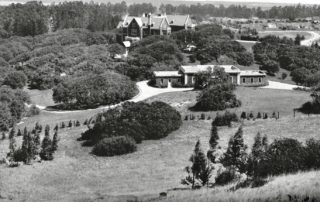
The Kohl Mansion was originally known as “The Oaks.” It was red-brick, 63-room Tudor mansion that still stands on forty acres along Adeline Drive in north Burlingame.

Freddie” told “Michael” the estate included beautiful, rolling landscapes, a sunken English rose garden, tennis courts, green houses, large carriage house, and a 150,000-gallon reservoir. That its value stood at $525,000 in those early days.

Freddie” said the Mansion was nothing short of magical. There were sprawling lawns, an incredible rose garden, and a wonderful terrace.  There was the distinctive wood-paneled Great Hall and the grand staircase.  There were lavish parties he gave for the “smart set.”

“Frederick” said he and Bessie were central members of the “Smart Set” in San Francisco during the first years of the century. They entertained at the Mansion and also at their summer home they had purchased from the Crockers. It is now called Idlewild and on their yacht there.

“Freddie” said had the Mansion designed by local architects Howard and White to resemble Somerset House, seat of the Duke of Surrey in England.

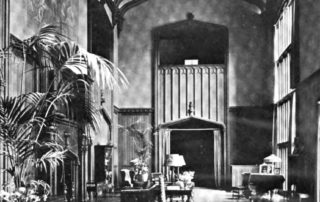
The first floor was made for entertaining in its light filled dining room and in the Great Hall patterned after Arlington Hall in Essex, England– a perfect setting for Bessie’s singing.

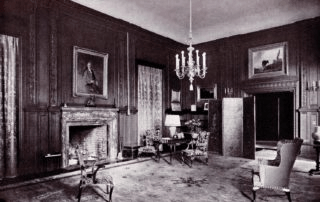
“Freddie” said the mansion’s 63 rooms included, beside the public rooms and the bedrooms, a billiard room, organ, and echo organ rooms; a china room, a scullery; cold room and storeroom; two steel-lined fireproof vaults; sewing, linen, cedar and brushing rooms; a wine cellar; a trunk room and a laundry. A chapel was built off the master bedroom on the second floor for Bessie, who was a Catholic.

The impressive Great Hall (27’x60’x40’H) took the visitor’s breath away with the height of its ceiling and the elegance of its dark oak walls. Sunlight poured in through the wall of mullioned windows.

The Hall housed both an Aeolian organ and a small echo organ installed hidden behind the oak walls. The mantle of its imposing Belgian marble fireplace large enough to stand in is decorated with choir boys holding music sheets.

The large painting of a knight on horseback above the fireplace was by artist Emile Mazy. Kohl included a portrait of his daughter Lucia.

In the main stairwell of the mansion hung a charming oil painting of Freddie at about the age of three (app. 1866). His face and his haircut are all boy, however his off the shoulder gown, usual for a fashionable young child at that time, surprises our modern eyes.

The house had many careful architectural details. The ancient oak trees surrounding the house were reflected in the oak leaves and acorns carved into the wood, especially in the entry and the library.

“Freddie” said he brought artisans from Europe to do plaster detailing. They created Pompeiian “grotesque” panels in the Library, Robert Adam-style relief work in the dining room, and also ram’s heads in the corners of the billiard room ceiling.

The Sad Tale of “Freddie” Continues

Freddie” said his ghostly tale involving a fatal attraction with his mother’s maid, Adele. It had gone too far. “Freddie” said problems developed when Adele argued with a chauffeur, slapped him, and spat in his face.

Freddie” said he thought she belonged in an asylum and called the police. The court disagreed. Adele was a bit on the temperamental side, but surely not deranged. She went free.

Freddie” said he discharged Adele, offering to pay her way to France. She refused, followed his family home, and filed suit against him.

A well-publicized trial took place in 1911, at the Grant Building at 7th and Market in San Francisco. The court dismissed the charges in his favor. Adele rushed from the room. She was waiting near the elevator when he emerged.

The outraged Adele Verge found him outside the courthouse. Drawing a nickel-plated derringer from her handbag. She fired point blank. “Freddie” said he slumping to the floor. Adele turned and fled.

Freddie” said the bullet lodged in his chest, too close to his heart to risk surgery.

He recovered, but the wound caused him great physical and mental suffering the rest of his life. “Freddie” said refused to press charges, so no trial was held.

Adele was deported to France and confined to an asylum. She vowed vengeance upon him.

“Freddie” said he put his troubles behind him and began work on an elaborate Tudor style Kohl Mansion.

Freddie” said on Christmas 1914, he opened the mansion, entertaining lavishly for two years. The rose brick mansion towered over his 40-acre estate. It included a tennis court, greenhouses, rose gardens and a carriage house.

It was not enough to dispel memories of Adele.

Freddie” said he and Bessie separated. Bessie was a talented singer. Bessie went to Europe to entertain the troops. “Freddie” said he consoled himself with socialite Marion Lord, but their happiness was short-lived.

The bullet in his chest was a constant source of pain, added to this growing anxiety.  

Adele was released from the asylum and threatened to finish the job of killing him.

In 1920, Adele wrote first from Quebec, then British Columbia. She was coming closer and closer. He said he was certain Adele was on her way to kill him.

By 1921, “Freddie” said his mental instability reached a deadly peak. He feared her revenge. It terrified him.

On the morning of November 23, 1921, at the Del Montel Lodge near Pebble Beach, California “Freddie” breakfasted alone in his suite. At 10 a.m. a single shot was heard. Freddie” was found, still seated at the table, with a .38 caliber revolver clutched in his hand. The bullet had passed through his skull, lodging in the wall.

LIFE AND DEATH CONVERSATIONS

5 Heart Attack Survivors Tell Their Stories

“Michael” asked Freddie” why he chose to die? Why die when you had a huge estate of $5.5 million in assets including the Mansion and the love of his life. What was it like to die? Should anyone commit suicide? Was worth it to die? What being dead like?

Freddie” said the moment he fired the gun he knew he made a mistake but there was no way to change it. “Freddie” said even with all the pain he was suffering at the time it was not worth giving up his life. It was not worth it to give up the love of his life, to give up $5.5 million in assets and his beautiful Mansion and the love for life.

Freddie” said his estate went to Marion Lord his mistress Marion Lord.  That she received the bulk of his estate and sold his house in 1924 to the Sisters of Mercy for $230,000. He said his ex-wife Bessie received only $250,000 from his estate. What a sad state of affairs.

  • What is it like to die?

Freddie” said was it is pretty scary. He said death is a peaceful journey down a dark tunnel towards a light. He said death includes experiences of fear, and memories which seem to correspond to real events. Your life passes before your eyes. Consciousness does not appear to stop for 20 to 30 seconds after death.

He said his experience in relation to death was like hallucinations or illusions. He said, the brain ceases functioning within 20-30 seconds of death.  

  • Kissinger’s asked “Freddie” should anyone commit suicide?
Charles F. Haanel Quotes - StoreMyPic | Page 2

Freddie” said absolutely not. Suicide often involves severe emotional or physical pain that a person finds unbearable.

This was what was he was feeling when he committed suicide. He said there are many reasons a person considers suicide. Often, it is the result of long-term difficulties with thoughts, feelings, or experiences that the individual feels that they cannot bear any longer.  This is what he was feeling when he committed suicide. He said, among other things, he was feeling:

  • sadness or grief
  • shame
  • worthlessness
  • intense guilt
  • rage, or a desire to seek revenge
  • a burden to others
  • had no worth or value
  • life was not worth living
  • trapped, either physically or emotionally
  • things would never get better
  • intense physical or emotional pain

Freddie” said this was how he felt at the time of his suicide.

Summary
40+ Charles Haanel ideas | master key, charles, law of attraction

Freddie” told Kissinger in his case he suffered many of the challenges of life and that was why he committed suicide. His wife left him and the couple separated.

  • The bullet in his chest was a constant source of pain, added to this growing anxiety.  Adele, the woman who shot him was released from the asylum, now threatened to finish the job. By 1921, his mental instability reached a deadly peak. On the morning of November 23, 1921, “Freddie” could not take any more.
  • “Michael” asked Freddy if it was worth it to commit suicide.

Freddie” said the Roman Catholic Church has long argued that one’s life is the property of God, and thus that to commit suicide is to deride God’s prerogatives. The reality is that suicide is seldom the product of cool-headed deliberation. He said, killing himself was not worth it in light of all the medical improvements available to him had he not committed suicide.

  • “Michael” asked “Freddy” how it feels to be dead

“Freddie” said whatever you imagine your final living seconds. You are an impartial observer. Death is like the darkest dark and silent silence. There is always a white noise. You are a spectator. you have reached the end.

Something in me snapped, and I remembered I had a life, and people I left behind. And my first thought when I pulled the trigger was, I can’t leave my life. Then I decided to leave my body. Once I decided I could leave, it was my physical end.

  • “Michael” asked “Freddy” what it felt like to die.
Create From Inside Out...1 - bmindful forum

Freddie” said even though death is a universal experience, death feels like many things. Death is like the darkest dark and silent silence. You Lose Your Senses. You Feel Like You’re Dreaming. You See Life Flash Before Your Eyes. Your Still Be Aware of What’s Going on Around You for A Time. It is Painful. You Get Dizzy. Then You Feel Nothing at All.

  • “Michael” asked “Freddy” How he felt to Die?

Freddie” told Kissinger it was the worst mistake of his life.

May be an image of Clayton Kissinger

“Michael” asked “Freddie” if he had ever considered Prevention.

“Michael” said he used books like the Master Key System to help Clayton and himself as a way to eliminate feelings of depression, life isn’t worth living, soon I won’t be a burden anymore, I’d be better off dead, there is no way out, or the world would be better off without me.

“Freddie” said he had thought about it but at that time in his life there was not a lot of suicide or depression prevention help available.

A Way of Prevention

Freddie” said the number one reason for his suicide was untreated his health, depression, and etc.

“Michael” said in order to not have “Freddie’s” death not a total loss, that he would write “Dead Men Talking“ the “Freddie” Kohl story and offer the Master Key System as a possible solution to people considering hurting themselves or committing suicide. Solutions are not simple or linear, but the Master Key System can help.

“Freddie” said he understands why suicide was not the best solution for him.  He said how sorry he was he committed suicide.  That the very minute he pulled the trigger he knew he made a mistake.

“Michael” told “Freddie” about Charles F. Haanel wrote the Master Key System.

40+ Charles Haanel ideas | master key, charles, law of attraction

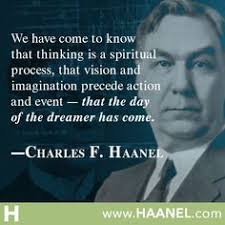
Charles F. Haanel was a noted American author and businessman who belonged to the American Scientific League, The Author’s League of America, The American Society of Psychical Research, the St. Louis Humane Society, and the St. Louis Chamber of Commerce.


Born in Ann Arbor, Michigan, Charles F. Haanel began his business career in St. Louis. He resigned his position in order to start his own company and eventually founded one of the largest conglomerates of his time. He wrote several books which were published in St. Louis by Psychology Publishing and by his Master Key Institute in New York. Mr. Haanel put into books the ideas and methods he used to gain his success.

Besides the “Master Key System,” which he wrote in 1912, he also wrote “Mental Chemistry” and “The New Psychology”

By 1933 The Master Key System had sold over 200,000 copies and then seemingly disappeared. The Master Key System is one of the finest studies in self-improvement and higher consciousness ever written. Covering everything from how to get wealthy to how to get healthy, Mr. Haanel leaves no stone unturned. With precision, he elucidates on each topic with logic and rigor that not only leaves you feeling good, but also thinking good. The book was banned by the Church in 1933 and has been hidden away for seventy years.

The Master Key System - Review, Results and Final Summary - Completed  Thoughts

Rumor has it that while he was attending Harvard University, Bill Gates discovered and read The Master Key System by Charles F. Haanel. It was this book that inspired Bill Gates to drop out of the University and pursue his dream of “a computer on every desktop.” You probably know the results. . .

It is Silicon Valley’s secret that almost every entrepreneur who made a fortune in
recent years did so by studying the words Mr. Haanel penned over eighty years ago! Almost every millionaire and billionaire in the Valley read The Master Key System by Charles F. Haanel. Since this book was no longer in print until recently, copies of The Master Key System became a hot commodity in the Valley.


The Master Key System is a system that teaches the ultimate principles, causes,
effects, and laws that underlie all attainment and success. When you want to attain
something, The Master Key System will show you how to get it. The results you will
attain from using this system are so startling as to appear incredible. For this reason, more and more people are becoming students of The Master Key System than ever before.


In 24 parts, The Master Key sets out the fundamental principles of life and creative
living, as Haanel came to understand and apply them. Basic to his teaching is the correct development and use of mental power — the key to truly creative power and action, harmony and health, love and happiness, and abundant possibilities. Each part is meant to be studied like a correspondence course lesson, but this is also a book that can be opened at random for whatever gem of advice your eyes happen to fall upon.

60+ Charles F Haanel ideas | charles, inspirational quotes, words

This age-old wisdom was written by someone who could perceive and tap into
Universal Mind but who seems to have no particular allegiance to any specific system of knowledge. Haanel’s numbered common-sense messages still have a freshness 89 years after they were first assembled.


Mr. Haanel died in 1949 and is buried in Bellefontaine Cemetery, St. Louis. Walter
B. Stevens described Mr. Haanel as “a man of mature judgement, capable of taking a calm survey of life and correctly valuing its opportunities, its possibilities, its demands and obligation.

Conclusion

Freddie” told Kissinger over the years the nuns reported unexplainable occurrences including visions, eerie sounds, and an empty elevator going up and down and the sound of a limping figure in his locked billiard room.  That was him walking through his Mansion.

The Priests were summoned to exorcise his ghost. They were unsuccessful. He still haunts his Mansion to this day. People continue to report seeing “Freddie” in the parlor as well as on the stairs. “Freddie” has become like the friendly “Ghost of the Kohl Mansion.”

Let us talk….

Do you feel like you are having challenges in your life that may led to suicide or that you do not have the life what?   We would love to hear from you. Where Do You See Yourself in 1-5-10 Years? If you do not know contact us.

Suggested Listening: Outwitting the Devil is a work of fiction that was written in 1938 by Napoleon Hill, which was considered too controversial to be published in its era. The book is written as an interview between Hill (Mr. Earthbound) and the devil (our inner dark self), wherein Hill attempts to uncover the secrets to freedom and success by evaluating the greatest obstacles that humans face in order to attain whatever they want. (1) Napoleon Hill’s Audiobook Outwitting the Devil – YouTube

Michael Kissinger

Phone 415-678-9965

Email: mjkkissinger@yahoo.com

References

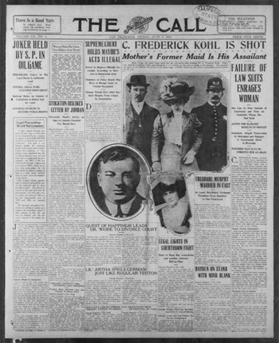
C. Frederick Kohl is Shot. (1911, June 9). The San Francisco Call. Retrieved from
http://chroniclingamerica.loc.gov/lccn/sn85066387/1911-06-09/ed-1/seq-1.pdf

Charles F. Kohl Weds Miss Godey. (1903, October 8). The San Francisco Call. Retrieved from http://cdnc.ucr.edu/cgi-bin/cdnc?a=d&d=SFC19031008.2.24

Dossa, L., Gouailhardou, M., and Wilkinson, C. (2013). Freddie Facts. Retrieved from  http://kohlmansion.com/wordpress1/freddie-facts/

Mrs. Wm. Kohl dies in Santa Barbara. (1912, February 28). The San Francisco Call. Retrieved from http://cdnc.ucr.edu/cgi-bin/cdnc?a=d&d=SFC19120228.2.23

Richter, J. (1999, October 15). Kohl Mansion has its roots in The Oaks. San Francisco Chronicle. Retrieved from http://www.sfgate.com/bayarea/article/Kohl-Mansion-has-its-roots-in-The-Oaks-3062547.php

MKE WEEK 17-HJ: Goodbye Old Self-A Return from Death

“The only place where your dreams become the impossible are in your thinking.” – Robert Schuller

There are a lot of things I am saying goodbye to and that is my old self. This is probably the best feeling to overcome. Sometimes we all let our old selves hold us back from moving on into the future.

Whether it is from our insecurities, past mistakes, people making presumptions due to your past. Believe me, it can be haunting, but once you overcome the past, it is truly the best accomplishment ever.

I have never been as comfortable with myself, until this year because of the Hero’ Journey. I truly love my son Clayton’s recovery from an attack that occured on February 28th, 2003 in which he died and was brought back to life, my new marriage, my new experiences, teaching, business building, training and people that have come into my life. Without them, I do not think I would be the person I am today.

  • One, I started a new blog this year.  My old self would be way too concerned to share my life experiences and opinions in public.
  • Two, I have drastically changed my style since 2003.
  • Three, I am not as intimidated by the opinions of others anymore.
  • Four, I started to get out of my comfort zone by doing more things by myself with Clayton’s recovery. For instance, I started teaching Master classes again. My old self would ask myself in light of all my life changes.
  • And lastly, I love who I have become as a person in light of all the changes in my life. God, Master Key System techniques and many people helped me and Clayton get over of what others thought of us, my business and what I do.

If you are not happy with yourself, it is important to change that. Do not be afraid to grow out of your old self. Your past does not define who you are.

I did it in part with the Master Key System.  Here’s how!

Master Key System Week 17HJ provided me with a way to knowingly “Start My Hero’s Journey and Eliminate My Fears and Move Quickly Towards the Success I Deserve.”

Chances are… your fear or ignorance has long held you back from discovering your true self or achieving the things that are most important to you.

Master Key Experience Week 17HJ provided me with a way to discovering my true self, to stop self-defeating behaviors and begin self-confident ones.  Isn’t it time to see yourself as God and others see you and easily change perceptions?

Master Key Experience provided me with a new way to think and act in accordance with my self-directed thinking. Isn’t it time for dissolving your personal fears, to begin your own Hero’s Journey and to make real progress toward your real self and the life you desire?
 

What is the Hero’s Journey?

The Master Key Experience teaches us we are powerful beyond measure, but we must take our Hero’s Journey.   MKE tell us the Hero’s Journey is a common story structure shared by cultures worldwide, in which a character [you] ventures into unknown territory to retrieve something they need.

Facing conflict and adversity, the hero [you] ultimately triumphs before returning home, transformed.

The Master Key Experience has done that for me and every other person who has participated in this training.

Let me explain:

On February 28, 2003, my life was turned around.  My youngest son Clayton was attacked by 21 guys with baseball bats at the Holiday Inn in San Francisco. He died that night and was brought back to life. 

It took $3.5 million in medical expense and 18 years of my life and his to bring him back to a point in life when he was 14.  It resulted in a divorce, loss of my busines, my home, my earning power, and many other things.  It took all that I had worked for most of my life.  It caused large financial problems, mental challenges, religious challenges and physical challenges.

In late 2020 I became involved with the Master Key Experience. Through it I was able to meet my authentic self. Meeting my authentic self, meant I had to acknowledge my other self.  The MKE and many others put me on my Hero’s Journey.

In MKE Week 17, I pointed out “You are gods. You are a son of the Most High.” But you will die like mere men; you will fall like every other ruler.” This passage is saying that God has appointed men to positions of authority in which they are considered as gods among the people.

May I ask, “Do you feel or live your life as a god? As a son of the Most High?”

If not continue reading this message. Then take up your own Hero’s Journey.

There are three stages to the Hero’s Journey as coined by academic Joseph Campbell in 1949:

  • The Departure Act: The Hero leaves the Ordinary World.
  • The Initiation Act: The Hero ventures into unknown territory (the ” Special World “) and is birthed into a true champion through various trials and challenges.
  • The Return Act: The Hero returns in triumph.

The Hero’s Journey has its fingerprints in everything from The Lion King and horror novels to Star Wars and Arrival. But keep in mind that you do not necessarily need to follow it beat by beat.

You can instead think of the Hero’s Journey as a map: you can stray from the set path whenever you like. But when you are struggling to figure out what should happen next, it can act as a narrative arc guide to suggest what the next milestone should be in your life.

There 12 Steps of the Hero’s Journey

The Hero’s Journey is a model for both plot points and character development: as the Hero traverses the world, they will undergo inner and outer transformation at each stage of the journey. The 12 steps of the hero’s journey are…

1. The Ordinary World
2. The Call of Adventure
3. Refusal of the Call
4. Meeting the Mentor
5. Crossing the First Threshold
6. Tests, Allies, Enemies
7. Approach to the Inmost Cave
8. The Ordeal
9. Reward (Seizing the Sword)
10. The Road Back
11. Resurrection
12. Return with the Elixir

Believe it or not, this story structure also applies to all our lives. 


1. Ordinary World we meet our Hero.

In the Master Key System Hero’s Journey, we are the Hero. The journey has yet to start. Before our Hero discovers a strange new world, we must first understand our status quo: our ordinary, mundane reality.

It is up to this opening leg to set the stage, introducing you the Hero to your true self.  Importantly, it lets you identify with the Hero [your high self-] as a “normal” person in a “normal” setting before the journey begins.

Example of the Ordinary World:


In the opening you are introduced as a mediocre person — just doing your best to live day-to-day in your present environment.

2. Call to AdventureIn which an adventure starts.

The call to adventure is all about booting you the Hero out of your comfort zone. In this stage, you are generally confronted with a problem or challenge you cannot ignore. This catalyst can take many forms, as Campbell points out in Hero with a Thousand Faces. The Hero can, for instance:

  • Decide to go forth of you own volition, i.e., Theseus upon arriving in Athens,
  • Be sent abroad by a benign or malignant agent, i.e., Odysseus setting off on his ship in The Odyssey,
  • Stumble upon the adventure as a result of a mere blunder, i.e., Dorothy when she is swept up in a tornado in The Wizard of Oz,
  • Be casually strolling when some passing phenomenon catches the wandering eye and lures one away from the frequented paths of man, i.e., Elliot in E.T. upon discovering a lost alien in the tool shed.

The stakes of the adventure and your Hero’s goals become clear. The only question: will you rise to the challenge?

Example of the Call to Adventure in found in Rocky or in my life in 2003:


Apollo Creed, the undisputed World Heavyweight Champion, decides to make a big fight interesting by giving a no-name a chance to challenge him. Intrigued by the nickname, “The Italian Stallion,” he rings Rocky up.

3. Refusal of the Call In which the Hero digs in their feet.

Great, so you, the Hero’s received your summons. Now you are all set to be whisked off to defeat, right?

Not so fast. You, the Hero, might first refuse the call to action. It is risky and there are perils — like spiders, trolls, or perhaps a creepy uncle waiting back at Pride Rock. It is enough to give anyone pause.

In Star Wars, for instance, Luke Skywalker initially refuses to join Obi-Wan on his mission to rescue the princess. It is only when he discovers that his aunt and uncle have been killed by stormtroopers that he changes his mind.

Example of the Refusal of the Call:


Rocky says, “Thanks, but no thanks,” to Creed’s invitation. He is reluctant, given that he has no trainer and is incredibly out of shape.

In my life I had no other choice but to take care of my son, Clayton

4. Meeting the Mentor in which the Hero acquires a personal trainer.

You, the Hero’s decided to go on the adventure — but you are not ready to spread your wings yet. You are much too inexperienced at this point and we do not want to do a fabulous bellyflop off the cliff.

Enter the mentor: someone who helps you, the Hero, so that you do not make a total fool of yourself (or get yourself killed). The mentor provides practical training, profound wisdom, a kick up the posterior, or something abstract like grit and self-confidence.

Wise old wizards seem to like being mentors. But mentors take many forms, from witches to hermits and suburban Taekwondo instructors. They might literally give weapons to prepare for the trials ahead, like Q in the James Bond series. Or perhaps the mentor is an object, such as a map. In all cases, they prepare you, the Hero for the next step.

Example of Meeting the Mentor:


In this step former boxer Mickey “Mighty Mick” Goldmill, who sees potential in Rocky, starts training him physically and mentally for the fight.

In my case with Clayton, I had the 5 Curuches that directed and guided me.

5. Crossing the First Threshold in which you the Hero enters your other world in earnest.

Now you, the Hero is ready — and committed — to the journey. This marks the end of the Departure stage and is when the adventure really kicks into the next gear.

As Vogler writes: “This is the moment that the balloon goes up, the ship sails, the romance begins, the wagon gets rolling.”

From this point on, there is no turning back.

Like our Hero, you should think of this stage as a checkpoint for your story. Pause and re-assess your bearings before you continue into unfamiliar territory. Have you:

  • Launched the central conflict? 
  • Established the theme of your book
  • Made headway into your character development? 

Example of Crossing the First Threshold:


Rocky fully accepts the gauntlet to square up when he crosses the threshold into his love interest Adrian’s house and asks her out on a date.

In my case with Clayton I had to accept the challenge of his Tramatic Brain injury, stroke, coma and my love for my son.

6. Tests, Allies, Enemies In which you the Hero faces new challenges and gets a squad.

When we step into the Special World, we notice a definite shift. You the Hero might be discombobulated by this unfamiliar reality and its new rules. This is generally one of the longest stages in your story, as our protagonist gets to grips with this new world.

This makes a prime hunting ground for the series of tests to pass! Luckily, there are many ways for you the Hero to get into trouble:

  • In Jumanji: Welcome to the Jungle, Spencer, Bethany, “Fridge,” and Martha get off to a bad start when they bump into a herd of bloodthirsty hippos.
  • In his first few months at Hogwarts, Harry Potter manages to fight a troll, almost fall from a broomstick, and die, and get horribly lost in the Forbidden Forest.
  • Marlin and Dory encounter three “reformed” sharks get shocked by jellyfish and are swallowed by a blue whale en route to finding Nemo.

This stage often expands the cast of characters. Once you are in the Special World, you will meet allies and enemies — or foes that turn out to be friends, and vice versa. You will learn a new set of rules from them. Saloons and seedy bars are popular places for these transactions, as Vogler points out (so long as you the Hero survives them).

Example of Tests, Allies, Enemies:


Rocky continues to try and win over Adrian while making a dubious friend in Paulie.

In my case with Clayton I had to disregard all the doctors who said he would never recover and train him myself.

7. Approach to the Inmost Cave In which you the Hero gets closer to your goal.

This is not a physical cave. Instead, the “inmost cave” refers to the most dangerous spot in the other realm — whether that’s the villain’s chambers, the lair of the fearsome dragon, or the Death Star. Almost always, it is where the ultimate goal of the quest is located.

Note that you the protagonist has not entered your Inmost Cave just yet. This stage is all about the approach to it. It covers all the prep work that is needed in order to defeat the villain in your life.

Example of the Approach to the Inmost Cave:


The Inmost Cave in Rocky is Rocky’s own mind. He fears that he will never amount to anything — something that he reveals when he butts heads with his trainer, Mickey, in his apartment.

The Inmost Care in Me is my own mind. I feared I would never be able to get over all the losses because of Clayton’s attack.

8. Ordeal In which the Hero faces his biggest test of all thus far.

Of all the tests the Hero has faced, none have made them hit rock bottom — until now. Vogler describes this phase as a “black moment.” Campbell refers to it as the “belly of the whale.” Both indicate some grim news for the Hero.

You the protagonist must now confront their greatest fear. If you survive it, you will emerge transformed. This is a critical moment in the story, as Vogler explains that it will “inform every decision that the Hero makes from this point forward.”

The Ordeal is sometimes not the climax of your story. There is more to come. But you can think of it as the main event of the second act — the one in which the Hero actually earns you the title of “Hero.”

Example of the Ordeal:


The start of the training montage marks the beginning of Rocky’s Ordeal. He pushes through it until he glimpses hope ahead while running up the museum steps.

The start of this step in my life marked the eginning of my ordeal. I had to ush through all the days in the hospital with Clayton, the financial lossses, and etc.

9. Reward (Seizing the Sword) In which the Hero sees light at the end of the tunnel.

You our Hero been through a lot. However, the fruits of your labor are now at hand — if you can just reach out and grab them! The “reward” is the object or knowledge you the Hero has fought throughout the entire journey to hold.

Once you the protagonist has it in your possession, it generally has greater ramifications for your story. Vogler offers a few examples of it in action:

  • Luke rescues Princess Leia and captures the plans of the Death Star — keys to defeating Darth Vader.
  • Dorothy escapes from the Wicked Witch’s castle with the broomstick and the ruby slippers — keys to getting back home.

Example of the Reward (Seizing the Sword):


Rocky’s reward is the return of his faith in himself. He regains the self-esteem to realize that he has the stuff to take on Apollo Creed — win or lose.

In my son Clayton’s case my reward was the return of my faith in myself and my abilities. I had been a practicing lawyer for over 25 years, highly respected among other things. As Clayton’s life improved I regained my self-esteem and the powers I had to continue the journey.

10. The Road Back in which the light at the end of the tunnel might be a little further than the Hero thought.

The story’s not over just yet, as this phase marks the beginning of Act Three.

Now that you have seized the reward, you the Hero tries to return to the Ordinary World, but more dangers (inconveniently) arise on the road back from the Inmost Cave.

More precisely, you the Hero must deal with the consequences and aftermath of the previous act: the dragon, enraged by you the Hero who is just stolen a treasure from under his nose, starts the hunt. Or perhaps the opposing army gathers to pursue you the Hero across a crowded battlefield. All further obstacles for you the Hero, who must face them down before you can return home.

Example of the Road Back:


On New Year’s Day, the fight between Rocky and Creed is held. Rocky realizes the challenge that lies before him in the first few rounds, in which both men are more or less equally matched.

In my son Clayton’s case the long journey of Clayton’s recovery was taking place. I realized the challenge that was before me. It was years of tring to bring Clayton back. Before the attack on him he was a start football player. After the attack he was a total invalid with a Tramatic Brain Injury, loss of eyesight, strokes, lack of education and many other things.

I realized I would never get back my home, wife, income, or business.

11. Resurrection In which the last test is met.

Here is the true climax of your story. Everything that happened prior to this stage culminates in a crowning test for you the Hero, as the Dark Side gets one last chance to triumph over you the Hero.

Vogler refers to this as a “final exam” for you the Hero — you must be “tested once more to see if you have really learned the lessons of the Ordeal.” It is in this Final Battle that you the protagonist goes through one more “resurrection.” As a result, this is where you will get most of your miraculous near-death escapes, à la James Bond’s dashing deliverances. If you the Hero survives, you can start looking forward to a sweet ending.

Example of the Resurrection:


Rocky’s knocked down more than a few times as the fight continues. The entire fight winds up lasting 15 rounds and takes both men to the brink of exhaustion.

In my son’s Clayton’s case I was challenged many times as our lives continued. It has been 18 years and the struggle continues.

12. Return with the Elixir In which you our Hero has a triumphant homecoming.

Finally, you the Hero gets to return home. However, you go back a different person than when you started out: you have grown and matured as a result of the journey you have taken.

But you have got to see you bring home the bacon, right?

That is why you the protagonist must return with the “Elixir,” or the prize won during your journey, whether that is an object or knowledge and insight gained.

Of course, it is possible for your story to end on an Elixir-less note — but then you the Hero would be doomed to repeat the entire adventure.

Example of the Return with the Elixir:


Rocky does not win the fight — but he does not care. He is won back his confidence and beaten his mental demons. And he has got Adrian, who tells him that she loves him.

CONCLUSION

Now by taking your Hero’s Journey you have to Access the Power that Lies Within You and to Think for Yourself… to leverage the incredible power of mind so you can develop a plan of action and act with people who offer encouragement and care about your success. 

The secret ingredient on your Hero’s Journey is you!

With the Hero’s Journey you will uncover what you truly want in to experience in your life. 

Embark on your own Hero’s Journey and learn how to create a new blueprint so you empower yourself to achieve your goals and dreams with the least effort.

With the Hero’s Journey you will learn the skills you need to unlock the hidden power within you. You will enjoy more happiness, more harmony and feel more fulfilled in all aspects of your life… the life you were always meant to live… the one that is waiting for you.

In Part 17 of the Master Key System it states, “The kind of Deity which a man, consciously or unconsciously, worships, indicates the intellectual status of the worshipper.

  • Psalm 82:6 I have said, ‘You are gods; you are all sons of … “I said, `You are gods; you are all sons of the Most High.’ But you will die like mere men; you will fall like every other ruler.” This passage is saying that God has appointed men to positions of authority in which they are considered as gods among the people.
  • In John 10:34-35, Jesus quoted an Old Testament passage which said, “…You are gods. And all of you are sons of the Most High” (Psalm 82:6). So, you are no longer a slave but a son, and if you are a son, then you are also an heir through God (Galatians 4:7).

So, the question is will you realize you are a god and take your Hero’s Journey to prove it to yourself.

The truth is, the Hero’s Journey makes you the best person you can be . . . armed with a plan that lets you become your authentic self.

In the Hero’s Journey paradigm-shifting training, you will discover how to:

● Overcome your fear and discomfort in most areas of your life
● Leverage your innate introverted strengths
● Target and connect with top experiences of life
● Leverage the power of Universal and Personal Mind

Whether you are a career professional or small business owner struggling to make a living or a professional who is hit a career plateau, the Hero’s Journey is your path to success, prosperity, abundance or a higher income and a rolodex of powerful experiences.

HELPFUL TOOLS:

Napoleon Hill’s Audiobook Outwitting the Devil (1) Napoleon Hill’s Audiobook Outwitting the Devil – YouTube

Contact us if you need a Life Plan Results or certain individual goals to result in 2021 and beyond.

Michael Kissinger

Phone 415-678-9965

Email: mjkkissinger@yahoo.com
What People Are Saying:

PS. “The Master Key System Hero’s Journey Blueprint that will change your life – a proven approach written by people who have actually done it. If you are looking for an actionable guide to genuine and effective solutions, this is it.”

I am so grateful for all the work MKE put into designing this system and program, the encouragement, acceptance, and honesty. This makes a huge difference in my life, the lives of my children, and of my clients. I am really excited about the future and feel a shift happening inside me that is very moving and exhilarating. Thank you!

 The MKE is for everyone – young and old. Our youth are our future!

Getting the Master Key System into the hands of our youth will make their future brighter because they will be living their dream. They become self-directed thinkers – not tied down by all the ideas society tells them to do.  Nothing is stopping them.  Nothing fills a parent’s heart with more joy than to see their children flourish and live their dreams because they are self-directed thinkers. Thanks to the Master Key Experience, Clayton is living his own Hero’s Journey.