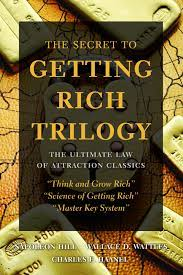
- Do you know that there is one thing top leaders and business tycoons like James Allen, Charles Haanel, Wallace D. Wattles and Napoleon Hill have in common?
“Thoughts held in mind produce after their kind.”
They believed and taught that whatever thoughts we hold in our minds, with feeling, will eventually “out picture” into the manifest realm.
Each of them adopts the “Law of Mind in Action”, i.e., they set aside their lives to discover, learn and apply this law. They did just 3 things: read, reflect, experiment to discover and apply the “Law of Mind in Action.”
The bottom line for us as individuals is that the law of mind action (thoughts held in mind produce after their kind) certainly operates 100 percent of the time at the level of the mind. Whatever we think about with emotion will affect our mental state … If we think sad thoughts, we experience sadness.
One of the great mental laws is the Law of Substitution. This means that the only way to get rid of a certain thought is to substitute another one for it. You cannot dismiss a thought directly. You can do so only by substituting another one for it.
The Law of Subconscious Activity As soon as the subconscious mind accepts any idea, it immediately begins trying to put it into effect. It uses all its resources (and these are far greater than is commonly supposed) to that end.
How do our thoughts shape our experiences?
There is a wonderful story that I wish I could give credit to from whomever I heard it.
A minister is preaching about the Law of Mind Action. With great passion, he preached that the very thoughts we hold in our minds become our reality. All during the sermon the pastor could not help but notice that a teenage boy was squirming in his seat while he preached. And the more the minister preached the more upset the young man became.
The minister could not wait to get the chance to talk to this young man and ask him what was up. When he did, the young, teenage boy said sheepishly, “Pastor, all I think about is girls these days. I don’t want to be a girl!”
Perhaps you have heard the old cliché that whatever you can dream about you can become. I do not believe this either.
Creating our own Experience
There is a wonderful female singer at the church I attend. Now, I can dream and hold the thought with emotion that I am a beautiful, black woman singing as beautifully as this woman and it will never happen in the manifest realm. It will and does happen on the screen of my mind, but no matter how hard, how often, or how emotion filled I hold that thought, I would never be a beautiful, black, female singer.
This key idea—that human beings create their experience by the activity of their thinking—is sometimes known as the Law of Mind Action.
It is usually stated: “Thoughts held in mind produce after their kind.” In some metaphysical circles it is believed and taught that whatever thoughts we hold in our minds, with feeling, will eventually “out picture” into the manifest realm.
The bottom line for us as individuals is that the law of mind action (thoughts held in mind produce after their kind) certainly operates 100 percent of the time at the level of the mind. Whatever we think about with emotion will affect our mental state …
If we think sad thoughts, we experience sadness. If we think happy thoughts, we experience happiness. It is as simple as that! There is now proof that our minds are hardwired to our bodies; our thoughts produce chemicals in our body as a result of those thoughts.
Positive thoughts give rise to health supporting chemicals, while negative thoughts give rise to “harmful” chemicals. Our thoughts can depress our immune system. So, it is important to watch the thoughts we hold in our minds and change them when they do not reflect what we want to experience.
I have heard some say that once one achieves or fully realizes his or her consciousness then the outer events and experiences of life will all be good, that life will be easy and wonderful. This stems from the misunderstanding of the Law of Mind Action.
Truthfully, I cannot say with 100 percent certainty that we do not in some way contribute to or cause all the events that happen in our lives. What I do know is that events happen.
Some of them I obviously cause; others, it appears, I had nothing to do with. I also know while I may not have control over all the events of my life, I certainly do have control over my experience of those events.
My experience of an event has to do with the ideas, thoughts, beliefs, and attitudes I hold about the event rather than the event itself.
Events do not directly cause my inner experience. This is really good news!
On any given day, you can hear more than one person say something like, “xyz caused me to feel abc.”
Nothing could be further from the truth. Events do not cause feelings. It is how we perceive, view, and think about events or comments that give rise to feelings. Think about it.
If events actually caused feelings, then the same event would cause the same feeling in every person that experienced the event. We know that not to be true.
It is probably safe to say every person involved in an event had a distinct experience of the event depending on the thoughts, ideas, beliefs, and attitudes the person brought to the event …
Isn’t it great to know that our inner experiences of outer events do not choose us but that we choose them?
Knowing this means we can always assume the point of Power and control over our lives that we have always had: the point of Power God is creating us to be.
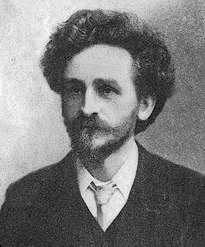
James Allen (28 November 1864 – 24 January 1912) was a British philosophical writer known for his inspirational books and poetry and as a pioneer of the self-help movement. His best-known work, As a Man Thinketh, has been mass-produced since its publication in 1903. It has been a source of inspiration to motivational and self-help authors.
Born in Leicester, England, into a working-class family, Allen was the elder of two brothers. His mother could neither read nor write. His father, William, was a factory knitter.
In 1879, following a downturn in the textile trade of central England, Allen’s father travelled alone to America to find work and establish a new home for the family. Within two days of arriving his father was pronounced dead at New York City Hospital, believed to be a case of robbery and murder. At age fifteen, with the family now facing economic disaster, Allen was forced to leave school and find work.
For much of the 1890s, Allen worked as a private secretary and stationer in several British manufacturing firms. In 1893 Allen moved to London and later to South Wales, earning his living by journalism and reporting.
In South Wales he met Lily Louisa Oram (Lily L. Allen) whom he then wed in 1895. In 1898 Allen found an occupation in which he could showcase his spiritual and social interests as a writer for the magazine ,The Herald of the Golden Age.
At this time, Allen entered a creative period where he then published his first of many books, From Poverty to Power (1901). In 1902 Allen began to publish his own spiritual magazine, The Light of Reason, later retitled The Epoch.
In 1903, Allen published his third and most famous book As a Man Thinketh. Loosely based on the biblical passage of Proverbs 23:7, “As a man thinketh in his heart, so is he,” the small work eventually became read around the world and brought Allen posthumous fame as one of the pioneering figures of modern inspirational thought.
The book’s minor audience allowed Allen to quit his secretarial work and pursue his writing and editing career. In 1903, the Allen family retired to the town of Ilfracombe where Allen would spend the rest of his life. Continuing to publish the Epoch, Allen produced more than one book per year until his death in 1912. There he wrote for nine years, producing 19 works.
Following his death in 1912, his wife continued publishing the magazine under the name The Epoch. Lily Allen summarized her husband’s literary mission in the preface to one of his posthumously published manuscripts, Foundation Stones to Happiness and Success saying:
“He never wrote theories, or for the sake of writing; but he wrote when he had a message, and it became a message only when he had lived it out in his own life and knew that it was good. Thus, he wrote facts, which he had proven by practice.”
James Allen is still relevant today. His book “As a Man Thinketh” was converted into an audiobook entitled “As A Woman Thinketh” in 2015.
(3) As A Man Thinketh | James Allen | Full Audiobook – YouTube
James Allen’s classic As A Man Thinketh. The bestselling classic that inspired “The Secret”. As a Man Thinketh, Allen’s most famous book, today is considered a classic self-help book. Its underlying premise is that noble thoughts make a noble person, while lowly thoughts make a miserable person.
In “As a Man Thinketh,” James Allen reveals how our thoughts determine reality. Whether or not we are conscious of it, our underlying beliefs shape our character, our health and appearance, our circumstances, and our destinies.
Allen shows how we can master our thoughts to create the life we want, lest we drift through life unconscious of the inner forces that keep us mired in failure and frustration. “The Vision that you glorify in your mind, the Ideal that you enthrone in your heart-this you will build your life by, this you will become.”
This principle, which others have called The Secret or the Law of Attraction, was clearly and convincingly stated for the first time in “As a Man Thinketh.” As a being of Power, Intelligence, and Love, and the lord of his own thoughts, man holds the key to every situation, and contains within himself that transforming and regenerative agency by which he may make himself what he wills.
Wallace Delois Wattles (1860–1911) was an American New Thought writer. He remains personally somewhat obscure, but his writing has been widely quoted and remains in print in the New Thought and self-help movements.
Wattles’ best known work is a 1910 book called The Science of Getting Rich in which he explains how to become wealthy
Life and career: Wattles’ daughter, Florence A. Wattles, described her father’s life in a “Letter” that was published shortly after his death in the New Thought magazine Nautilus, edited by Elizabeth Towne. The Nautilus had previously carried articles by Wattles in almost every issue, and Towne was also his book publisher. Florence Wattles wrote that her father was born in the U.S. in 1860, received little formal education, and found himself excluded from the world of commerce and wealth.
According to the 1880 US Federal Census, Wallace lived with his parents on a farm in Nunda Township, McHenry County, Illinois, and worked as a farm laborer. His father is listed as a gardener and his mother as “keeping house”.
Wallace is listed as being born in Illinois while his parents are listed as born in New York. No other siblings are recorded as living with the family. According to the 1910 census, Wattles was married to Abbie Wattles (nee Bryant), 47. They had three children: Florence Wattles, 22, Russell H. Wattles, 27, and Agnes Wattles, 16. It also shows that at the time Wallace’s mother Mary A. Wattles was living with the family at the age of 79.
Florence wrote that “he made lots of money, and had good health, except for his extreme frailty” in the last three years before his death. Wattles died on February 7, 1911 in Ruskin, Tennessee, and his body was transported home for burial to Elwood, Indiana. As a sign of respect businesses closed throughout the town for two hours on the afternoon of his funeral.
His death at age 51 was regarded as “untimely” by his daughter; in the previous year he had not only published two books (The Science of Being Well and The Science of Getting Rich), but he had also run for public office.
Christian Socialism
In 1896 in Chicago, Illinois, Wattles attended “a convention of reformers” and met George Davis Herron, a Congregational Church minister and professor of Applied Christianity at Grinnell College who was then attracting nationwide attention by preaching a form of Christian Socialism.
After meeting Herron, Wattles became a social visionary and began to expound upon what Florence called “the wonderful, social message of Jesus.” According to Florence, he at one time had held a position in the Methodist Church, but was ejected for his “heresy”.
Two of his books (A New Christ and Jesus: The Man and His Work) dealt with Christianity from a Socialist perspective.
In the 1908 election, he ran as a Socialist Party of America candidate in the Eighth Congressional District; in 1910 he again ran as a Socialist candidate, for the office of Prosecuting Attorney for the Madison County, Indiana 50th court district. He did not win either election. Florence Wattles remained a Socialist after his death and was a delegate to the Socialist Party National Committee in 1912 and 1915.
New Thought: As a Midwesterner, Wattles traveled to Chicago, where several leading New Thought leaders were located, among them Emma Curtis Hopkins and William Walker Atkinson, and he gave “Sunday night lectures” in Indiana; however, his primary publisher was Massachusetts-based Elizabeth Towne.
He studied the writings of Georg Wilhelm Friedrich Hegel and Ralph Waldo Emerson, and recommended the study of their books to his readers who wished to understand what he characterized as “the monistic theory of the cosmos.”
Through his personal study and experimentation Wattles claimed to have discovered the truth of New Thought principles and put them into practice in his own life. He also advocated the then-popular health theories of “The Great Masticator” Horace Fletcher as well as the “No-Breakfast Plan” of Edward Hooker Dewey, which he claimed to have applied to his own life.
He wrote books outlining these principles and practices, giving them titles that described their content, such as Health Through New Thought and Fasting and The Science of Being Great.
Science of Getting Rich 90-Day Challenge with Mary Morrissey
The Science of Getting Rich, Wallace D Wattles
The Science of Being Great by Wallace D. Wattles A SUMMARY OF THE SCIENCE OF BEING GREAT
📖 THE SCIENCE OF BEING WELL by Wallace D. Wattles
His daughter Florence recalled that “he lived every page” of his books.
A practical author, Wattles encouraged his readers to test his theories on themselves rather than take his word as an authority, and he claimed to have tested his methods on himself and others before publishing them.
Wattles practiced the technique of creative visualization. In his daughter Florence’s words, he “formed a mental picture” or visual image, and then “worked toward the realization of this vision”:
He wrote almost constantly. It was then that he formed his mental picture. He saw himself as a successful writer, a personality of power, an advancing man, and he began to work toward the realization of this vision. He lived every page… His life was truly the powerful life.
Influence: Rhonda Byrne told a Newsweek interviewer that her inspiration for creating the 2006 hit film The Secret, and the subsequent book by the same name, was her exposure to Wattles’ The Science of Getting Rich.
Byrne’s daughter, Hayley, had given her mother a copy of the Wattles book to help her recover from her breakdown. The film itself also references, by re-popularizing the term The Law of Attraction, a 1908 book by another New Thought author, William Walker Atkinson, titled Thought Vibration or the Law of Attraction in the Thought World.
Charles Francis Haanel (May 22, 1866 – November 27, 1949) was an American author, philosopher and a businessman. He is best known for his contributions to the New Thought movement through his book The Master Key System.
Personal life and business career: The Haanel family was of Swedish extraction, but had lived in Silesia, Prussia, before emigrating to Canada and thence to the United States.
In St. Louis: History of the Fourth City, the author Walter B. Stevens wrote that “Charles F. Haanel was born in Ann Arbor, Michigan, the son of Hugo and Emeline (Fox) Haanel.” He was the fourth of six children.
According to Stevens, “The family moved to St. Louis, Missouri when Charles was a child. His first job was as an office boy for the National Enameling & Stamping Company in St. Louis, and he worked for this firm in varying capacities for fifteen years before striking out on his own as a writer and businessman.”
In 1885 he married Esther M. Smith. They had one son and two daughters. In 1891 his wife died. In 1908 he married for the second time, to Margaret Nicholson of St. Louis, whose father was W. A. Nicholson.
He was a member of the Republican Party, a Freemason and Shriner affiliated with St. Louis Keystone Lodge No.243, (A.F. & A.M.) and a supporter of the Missouri Athletic Club.
He was a member of Pi Gamma Mu fraternity, a Fellow of the London College of Psychotherapy, a member of the Authors League of America; a member of the American Society of Psychical Research; a member of the Society of Rosicrucian’s; a member of the American Suggestive Therapeutical Association; and a member of the Science League of America. During his life, Haanel earned and received several honorary academic degrees, including hon. Ph.D., College National Electronic Institute; Metaphysics, Psy. D., College of Divine Metaphysics; and M.D., Universal College of Dupleix, India.
When Haanel died on November 27, 1949; he was 83 years old. His ashes were buried in Bellefontaine Cemetery, St. Louis.
Career as financial success writer
Haanel’s book The Master Key System was published in 1912, when he was 46 years old. It is written in the form of a course in New Thought, mental development, financial success, and personal health. The book was heavily promoted in the pages of Elizabeth Towne‘s New Thought magazine The Nautilus. By 1933 it had allegedly sold over 200,000 copies worldwide.
Haanel practiced the financial principles he preached and was a self-made success who owned several major companies. According to Stevens, writing in 1909, “He was president of the Continental Commercial Company, president of the Sacramento Valley Improvement Company, and president of the Mexico Gold & Silver Mining Company.”
The original Master Key System contained 24 parts or modules of study. The allegedly “lost” chapters of the Master Key System, chapters 25-28, which are found in some editions, are not original, but have been copied from the chapters 11-14 of A book about You.
Among the key points of Haanel’s system are what he refers to as the laws of concentration, attraction, and harmonious thinking and action.
Unique to the Master Key System is a set of exercises that accompany each chapter, and which are systematically building upon each other — they are what makes the Master Key System a system.
Another important aspect of the Master Key System is the element of “Truth”. The understanding of “Truth” is derived from the understanding that Spirit is all there is, and that it cannot be other than perfect. Truth provides readers/students with certainty, courage, and determination to change their life for the better.
In addition to the The Master Key System (1916) by Charles F. Haanel
Haanel wrote several other books including Mental Chemistry, Charles F Haanel published in 1922, The New Psychology, published in 1924, A Book about You, published in 1927, and The Amazing Secrets of the Yogi, co-authored with Victor Simon Perera and published in 1937.
Additionally, The Master Key System – [CHARLES HAANEL] – The Secret of a Success Mindset and AFFIRMATIONS from THE MASTER KEY SYSTEM | Charles F. Haanel | Law of Attraction
Influence on other writers
In 1919, Napoleon Hill wrote Haanel a letter thanking him for The Master Key System. In the letter Hill stated, “My present success and the success which has followed my work as President of the Napoleon Hill Institute is due largely to the principles laid down in The Master-Key System.”
Haanel was quoted in the best-selling self-help book The Secret by Rhonda Byrne, published in 2007.
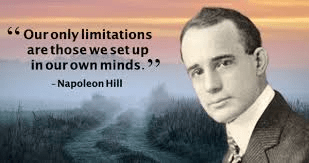
Oliver Napoleon Hill (born October 26, 1883 – November 8, 1970) was an American self-help author. He is known best for his book Think and Grow Rich (1937) which is among the 10 bestselling self-help books of all time.
Hill’s works insisted that fervid expectations are essential to improving one’s life. Most of his books were promoted as expounding principles to achieve “success”.
The Law of Success: During 1928, Hill relocated to Philadelphia and convinced a Connecticut-based publisher to publish his eight-volume work The Law of Success (1925). The book was Hill’s first major success, allowing Hill to adopt an opulent lifestyle. By 1929, he had already bought a Rolls-Royce and a 600-acre (240-hectare) property in the Catskill Mountains, with the aid of some lenders.
The beginning of the Great Depression, however, affected Hill’s finances adversely, forcing his Catskills property into foreclosure before the end of 1929.
Hill’s next published work, The Magic Ladder to Success (1930), proved to be a commercial failure. During the next few years, Hill traveled through the country, returning to his habits from the prior decade of initiating various short-lived business ventures.
During 1935, Hill’s wife Florence filed for a divorce in Florida.
During 1937, Hill published the best-selling book Think and Grow Rich, which became Hill’s best-known work. Hill’s new wife Rosa Lee Beeland contributed substantially to the authoring and editing of Think and Grow Rich. Hill’s biographers would later say this book sold 20 million copies over 50 years, although as Richard Lingeman remarks in his brief biography, “Alice Payne Hackett’s ’70 Years of Best Sellers’ suggests the amount was considerably less.”
Wealthy once more, Hill re-initiated his lavish lifestyle and purchased a new estate in Mount Dora, Florida. The couple divorced around 1940, with much of the wealth from the book going to his wife Rosa Lee Hill, leaving Napoleon Hill to start his pursuit of success once again.
Starting again: Hill met Annie Lou Norman, who was 47 years old, where he rented a room. They married in 1943 and relocated to California. Hill went on the lecture circuit once again.
Philosophy of Achievement
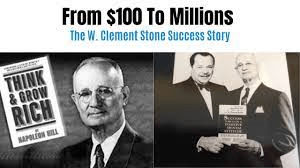
Napoleon Hill holding his book Think and Grow Rich, 1937.
Hill’s “Philosophy of Achievement,” offered as a formula for rags-to-riches success, was published initially in the 1928 multi-volume study course entitled The Law of Success, a rewrite of a 1925 manuscript.
Hill identified freedom, democracy, capitalism, and harmony as being among the foundations to his “Philosophy of Achievement”. He asserted that without these foundations, great personal achievements would not be possible.
A “secret” of achievement was discussed in Think and Grow Rich, but Hill insisted that readers would benefit most if they discovered it for themselves. Although he did not explicitly identify this secret in the book, he did offer the following:
If you truly desire money so keenly that your desire is an obsession, you will have no difficulty in convincing yourself that you will acquire it. The object is to want money, and to be so determined to have it that you convince yourself that you will have it. . .. You may as well know, right here, that you can never have riches in great quantities unless you work yourself into a white heat of desire for money, and actually believe you will possess it.
In the introduction, Hill states of the “secret” that Andrew Carnegie “carelessly tossed it into my mind” and that it inspired Manuel L. Quezon of the Philippine Islands to “gain freedom for his people.”
Although he mentions a “burning desire for money” repeatedly throughout the book, he suggests that avarice is not in fact his “secret” at all. Indeed, in The Law of Success, published nine years earlier, he identifies the secret as the Golden Rule, insisting that only by working harmoniously and cooperating with other individuals or groups of individuals and thereby creating value and benefit for them can one create sustainable achievement for oneself.
He presents the notion of a “Definite Major Purpose” as a challenge to his readers to ask themselves: “In what do I truly believe?” According to Hill, “98%” of people have few or no strong beliefs, which made their achieving success unlikely.
Hill declares that the life story of his son Blair is an inspiration to him, claiming that despite being born without ears, Blair had grown up able to hear and speak almost normally. Hill reports that his son, during his last year of college, read chapter two of the manuscript of Think And Grow Rich, discovered Hill’s secret “for himself”, and then inspired “hundreds and thousands” of people who could neither hear or speak.
From 1952 to 1962, Hill taught his Philosophy of Personal Achievement—Lectures on Science of Success in association with W. Clement Stone. During 1960, Hill and Stone co-authored the book Success Through A Positive Mental Attitude. Norman Vincent Peale is quoted saying that Hill and Stone “have the rare gift of inspiring and helping people” and that he owes “them both a personal debt of gratitude for the helpful guidance I have received from their writings.”
The book is listed in John C. Maxwell‘s A Lifetime “Must Read” Books List.
Hill claimed insight into racism, slavery, oppression, failure, revolution, war, and poverty, asserting that overcoming these difficulties using his “Philosophy of Achievement” was the responsibility of every human.
Influence of Andrew Carnegie
Later in life, Hill claimed that the turning point of his life had been a 1908 assignment to interview the industrialist and philanthropist Andrew Carnegie. At that time, Carnegie was among the most powerful men in the world. Hill wrote, after Carnegie’s death in 1918, that Carnegie had actually met with him at that time and challenged him to interview wealthy people to discover a simple formula for success, and that he had then interviewed many successful people of the time.
The acknowledgments in his 1928 multi-volume work The Law of Success, listed forty-five of those he had studied, “the majority of these men at close range, in person”, like those to whom the book set was dedicated: Andrew Carnegie, Henry Ford, and Edwin C. Barnes (an associate of Thomas Edison). Hill reported that Carnegie had given him a letter of introduction to Ford, who Hill said then introduced him to Alexander Graham Bell, Elmer R. Gates, Thomas Edison, and Luther Burbank.
According to Ralston University Press, endorsements for The Law of Success were sent in by William H. Taft, Cyrus H. K. Curtis, Thomas Edison, Luther Burbank, E.M. Statler, Edward W. Bok, and John D. Rockefeller. The list in the acknowledgments includes, among those Hill wrote that he had personally interviewed, Rufus A. Ayers, John Burroughs, Harvey Samuel Firestone, Elbert H. Gary, James J. Hill, George Safford Parker, Theodore Roosevelt, Charles M. Schwab, Frank A. Vanderlip, John Wanamaker, F. W. Woolworth, Daniel Thew Wright, and William Wrigley, Jr.
Alleged spirit visitations: Hill openly described visits from spirits in Chapter 12 of his book Grow Rich! With Peace of Mind (1967). He described them as unseen friends, unseen watchers, strange beings, and the Great School of Masters that had been guarding him, and who maintain a “school of wisdom”. Hill states that the “Master” spoke to him audibly, revealing secret knowledge. Hill further insists that the Masters “can disembody themselves and travel instantly to any place they choose in order to acquire essential knowledge, or to give knowledge directly, by voice, to anyone else.”
Grow Rich! With Peace of Mind was allegedly influenced by Hill’s spirit voices; Hill cites the “Master”, saying, “Much of what he said already has been presented to you in the chapters of this book or will follow in other chapters.”
In Chapter 14 of his book Think and Grow Rich (1937) he openly talks about his “invisible counselors” with whom he discusses various areas of his life. Hill refers to these meetings with his counselors as being real because he consistently told himself they were real, a principle he refers to as “autosuggestion”.
Hill does admit the talks were only real to him because of his imagination but professes his belief that the “dominating thoughts and desires” of one’s mind make those thoughts real.
Death: Napoleon Hill died aged 87 on November 8, 1970.
Legacy: Hill’s works were inspired by the philosophy of New Thought and the writings of Ralph Waldo Emerson, and are listed as New Thought reading. Hill has been seen as inspiring later self-help works, such as Rhonda Byrne‘s The Secret.
Works
- The Law of Success (1928)
- The Magic Ladder to Success (1930)
- Think and Grow Rich (1937)
- Outwitting the Devil (1938, published 2011)
- How to Sell Your Way Through Life (1939)
- The Master-Key to Riches (1945)
- How to Raise Your Own Salary (1953)
- Success Through a Positive Mental Attitude (with W. Clement Stone) (1959)
- Grow Rich! With Peace of Mind (1967)
- Succeed and Grow Rich Through Persuasion (1970)
- You Can Work Your Own Miracles (1971)
- Audios:
Napoleon Hill Outwitting the Devil Audiobook
Napoleon Hill’s Master Key – Complete Series (Official Video)
Napoleon Hill Your Right to Be Rich by Napoleon Hill Audiobook FULL
Napoleon Hill 17 Principles of Success {FULL AUDIOBOOK}
William Clement Stone (May 4, 1902 – September 3, 2002) was a businessman, philanthropist and New Thought self-help book author.
He was born in Chicago, Illinois on May 4, 1902.
His father died in 1905 leaving his family in debt. In 1908 he hawked newspapers on the South Side of Chicago while his mother worked as a dressmaker. By 1915 he owned his own newsstand.
In 1918 he moved to Detroit to sell casualty insurance for his mother.
Stone dropped out of high school to sell insurance full-time. He received a diploma from the YMCA Central High School in Chicago. He took courses at Detroit College of Law (now, Michigan State University College of Law) and Northwestern University.
Much of what is known about Stone comes from his autobiography The Success System That Never Fails.
In that book, he tells of his early business life, which started with selling newspapers in restaurants. At the time, this was a novel thing to do, a departure from the typical practice of boys hawking newspapers on street corners.
At first, restaurant managers of restaurants tried to discourage him, but he gradually won them over by his politeness, charm, persistence and the fact that most restaurant patrons had no objection to this new way of selling papers.
From there, he graduated to selling insurance policies in downtown business offices. His mother managed his new career.
In 1919, Stone built the Combined Insurance Company of America, which provided both accident and health insurance coverage; by 1930, he had over 1000 agents selling insurance for him across the United States.
By 1979, his insurance company exceeded $1 billion in assets. Combined later merged with the Ryan Insurance Group to form Aon Corporation in 1987.,and Combined was later spun off by Aon to ACE Limited in April 2008 for $2.56 billion.
Stone considered his success to be an example of the rags-to-riches protagonists in the Horatio Alger‘s stories he admired. He mentored Og Mandino, an alcoholic who became the publisher of Success Magazine.
In 1951, Stone founded the interfaith group “The Washington Pilgrimage”, which later became the “Religious Heritage of America“. It successfully advocated the Eisenhower administration to add the “under God” to the Pledge of Allegiance.
Stone contributed up to $10 million to President Richard Nixon‘s election campaigns in 1968 and 1972; they were cited in Congressional debates after the Watergate scandal to institute campaign spending limits.
Stone (seated at right) met with Gerald Ford in the Oval Office.
According to Tim Weiner, in One Man Against the World: The Tragedy of Richard Nixon, in 1972 President Nixon’s lawyer, Herbert Kalmbach, helped raise money for Nixon’s presidential campaign by selling ambassadorships to large donors, including “W. Clement Stone, [who] pledged $3 million.” Stone wanted to become ambassador to Great Britain, “which already was occupied by Ambassador Walter Annenberg, who gave $254,000 in order to stay on” (p. 160).
Stone associated with Napoleon Hill to teach the Philosophy of Personal Achievement “Science of Success” course. Stone wrote: “One of the most important days in my life was the day I began to read Think and Grow Rich in 1937.
Stone said that the Bible was “the world’s greatest self-help book”.
Stone died on September 3, 2002 in Evanston, Illinois.
Books: Stone emphasized using a “positive mental attitude” to succeed. Stone adopted the motto of his mentor, Napoleon Hill, “Whatever the mind can conceive and believe, the mind can achieve (with PMA).”
In 1960, Stone teamed up with Napoleon Hill to author Success Through a Positive Mental Attitude.
The book Success Through a Positive Mental Attitude includes the following testimonial from the Rev. Robert H. Schuller on the inside front cover page: “Success Through A Positive Mental Attitude is one of the ten books that has most impacted my faith and my philosophy…no person’s education is complete without the concepts articulated in it so wisely and so well.”
Norman Vincent Peale said that Stone and Hill “have the rare gift of inspiring and helping people…In fact, I owe them both a personal debt of gratitude for the helpful guidance I have received from their writings.”
Stone and Hill also founded a monthly digest magazine, entitled Success Unlimited.
In 1962, Stone wrote the Success System That Never Fails, in which he suggested how to become successful and have a healthy, productive lifestyle.
In 1964, he and Norma Lee Browning collaborated on writing The Other Side of the Mind.
He read Think and Grow Rich and now Mr. W Clement Stone is considered to be Napoleon Hill’s best student. With a small …
Think and Grow Rich Definiteness of Purpose – W Clement Stone Interview
W. Clement Stone – The Success System That Never Fails
W. Clement Stone’s 6 Magic Gateways to Success
William Clement Stone
VIEW FULL PLAYLIST
Success Through A Positive Mental Attitude – W Clement Stone, Napoleon Hill
WealthCreationLibrary
VIEW FULL PLAYLIST
Philanthropy: Stone gave over $275 million to charity including civic groups, mental health and Christian organizations.
Stone was once quoted as saying, “All I want to do is change the world”.
Among his philanthropic activities were his long-time support of the Boys Clubs of America (now Boys and Girls Clubs of America), and the National Music Camp at Interlochen, Michigan.
The Stone Student Center was dedicated on June 24, 1967 on the campus of the Interlochen Center for the Arts. Stone donated one million dollars to Rev. Dr. Robert H. Schuller to begin construction on the Crystal Cathedral.
The W. Clement and Jessie V. Stone Foundation was established by Stone and his wife to support humanitarian, mental health, religious and community causes. In 2009 the Foundation gave $3,805,625 to worthwhile causes.
The foundation also gives college scholarships; one of the beneficiaries is the demographer, pollster, and political pundit Elliott Stonecipher of Shreveport, Louisiana, who entered the “Boy of the Year” competition in the late 1960s at the national Boys Clubs competition.
Stone was a supporter of The Napoleon Hill Foundation, which he directed for forty years, and to which his estate contributes funding.
Stone celebrated his 100th birthday with a gift of $100,000 to the University of Illinois at Chicago.
Stone provided much of the initial funding for the self help organization, GROW.
Stone was inducted into the Horatio Alger Association of Distinguished Americans, and was a Freemason.
W. Clement Stone once stated, “Regardless of what you are or what you have been, you can still become what you may want to be.”
Other: In 1969 and 1970, Stone served as a Republican member of the University of Illinois Board of Trustees, having been appointed to fill the vacancy left by the death in office of Harold A. Pogue. In 1970, Stone ran unsuccessfully for reelection as a trustee. In 1973, Stone was awarded an honorary Doctor of Laws (LL.D.) degree from Whittier College.
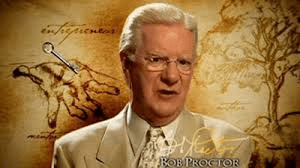
Bob Proctor (born July 5, 1934) is a Canadian self-help author, who identifies himself as a philosopher.[1] He is best known for his New York Times best-selling book You Were Born Rich (1984) and a contributor to the film The Secret (2006).
Proctor’s material has maintained the idea that a positive self-image is critical for obtaining success, frequently referencing the Law of Attraction.
This includes all the books he has authored as well as seminars he conducts, and videos shared.
Proctor, as well as the law of attraction, has been often criticized for being a threat to individuals for suggesting that simply having a sustained thought over time will materialize into reality, whether it be for riches or for health.
Furthermore, experts believe individuals may opt for positive thinking instead of physical therapies or medical intervention.
There has been no clear evidence supporting the law of attraction scientifically, and is therefore considered a pseudoscience.
Life and career: Proctor had a poor self-image and little ambition as a child, dropping out during high-school with no plans for the future. Proctor was working in a fire department in Toronto when a man Proctor met shared the book Think and Grow Rich with him at the age of 26, the first book he had ever read.
Soon afterward, his life started to change as this book shifted his focus in life. He began cleaning floors to help pay off his debt and began earning money.
Proctor went on to start a company offering cleaning services at first – a venture that he claims netted him over $100,000 in his starting year with no formal education or business experience.
Realizing the real value had come from this book, he set off to learn more about this subject.
You Were Born Rich and The Secret
Proctor joined the Nightingale-Conant Organization and worked his way up within the company, even being mentored by Earl Nightingale.
From there, he was able to master the teachings of human development and motivation.
In 1984 he published the book You Were Born Rich, which Rhonda Byrne discovered and lead her to requesting Bob to be interviewed and participate in the movie, which he was later interviewed on several news and talk show outlets, garnering widespread attention.
Bob Proctor Secret Summary
Bob Proctor Reveals ‘The Ultimate Secret’ Beyond The Law Of Attraction
Bob Proctor – Thinking Into Results
Bob Proctor – You Were Born Rich – Complete 10 Hour Seminar (Law of Attraction Secrets)
Bob Proctor, the science of getting rich seminar.
Science of Getting Rich 90-Day Challenge with Mary Morrissey
However, although there have been some reports of success using this technique, financial experts continue to express caution from not making sound investments.
Law of Attraction: Throughout his material, Bob Proctor aims to have the reader or audience tap into their inner self.
He explains that their inner-self is what is controlling all that is brought into their life – and that a bad self-image, or bad paradigm and programming, will lead to poor results even with training and proper education.
Instead of academic training, which he believe does a lot of harm, his work focuses on personal development and making people aware of the basic laws of the universe.
Proctor deducts that everything in the universe vibrates and similar vibrations attract each other.
He explains that our mind and bodies also vibrate, and since humans are capable of controlling our thoughts, and therefore our vibrations, we are capable of controlling our results. He has said there is nothing in a person’s life they cannot change through the law of attraction.
Proctor maintained the idea that even a recession was the result of excessive media negativity, attracting the recession to the economy. In a 2009 article, Wall Street Journal noted that if any followers believed they can simply choose not to participate in the recession, they were being shammed.
Ready to receive the richest prizes in all you do for the rest of your life?
Please feel free to contact us or to LIKE and SHARE this article.
As always, please let me know if I can be of service to you.
Contact us now.
Michael Kissinger
Sydney Reitenbach
Phone 415-678-9965
Email: mjkkissinger@yahoo.com
Disclaimer: Our vision is to help you bring your biggest dream into reality. As stipulated by law, we cannot and do not make any guarantees about your ability to get results or earn any money with our ideas, information, tools, or strategies. Your results are completely up to you, your level of awareness, expertise, the action you take and the service you provide to others. Any testimonials, financial numbers mentioned in emails or referenced on any of our web pages should not be considered exact, actual or as a promise of potential earnings – all numbers are illustrative only, as I am sure you understand. That being said, we believe in you and we are here to support you in making the changes you want for your life and giving you methods, strategies, and ideas that will help move you in the direction of your dream.